Brand protection · Lubricants & lube oil
How to Choose Anti-Counterfeit Labels for Engine Oil in 2026
Anti-counterfeit labels for lubricants and engine oil sit at the front line of brand protection, and counterfeiters know it. Fake lubricants do not fail loudly. They quietly erode engine warranties, distributor margin, and the brand-protection budget. The label is usually the first piece of evidence the counterfeiter has to defeat. This guide is written for procurement, packaging, and brand-protection teams who specify anti-counterfeit labels for engine oil, gear oil, hydraulic fluid, and grease, and who need a label that actually performs in the warehouses, garages, and roadside fitment shops where authentication happens.
Why anti-counterfeit labels for lubricants matter more than the bottle
Visit any high-volume lubricant aftermarket and the pattern repeats. Empty branded pails are bought in bulk from workshops, refilled with off-spec base oil, and resealed with reproduced labels and shrink sleeves. The base oil can be analyzed in a lab. The pail can be tested for re-fill marks. The label is what the workshop attendant looks at, and the label is what the counterfeiter has spent the most time matching.
Most counterfeit lubricant complaints reaching brand-protection teams trace back to three weaknesses in the label. First, an overt design that is straightforward to reproduce on commercial digital presses. Second, a tamper feature that survives steam-cleaning of empty pails. Third, a serialized code that is sequential or guessable. Closing those three gaps is what an anti-counterfeit lubricant label specification is actually for. Industry estimates from the U.S. Chamber of Commerce and UNODC have repeatedly placed counterfeit automotive products — engine oil prominent among them — in the multi-billion-dollar global trade band.
Where anti-counterfeit labels for lubricants fail in the field
Before specifying authentication features, procurement teams should map the operating environment the label is expected to survive. Lube packaging sees abuse that food, cosmetics, or pharmaceutical labels never encounter.
| Stress | What it does to a generic label | Implication for the spec |
|---|---|---|
| Hydrocarbon contact | Surface oil bleed lifts edges, smudges inkjet codes, dissolves wax-coated overprints | Adhesive and topcoat must be qualified against base oil + additives, not water |
| High-temperature storage | Drums in tropical yards reach 60–70 °C; adhesives soften, holograms delaminate | Hot-melt adhesives unsuitable; covert markers must not lose function above 80 °C |
| UV and outdoor light | Color shift, fading of warning text, masking of fluorescent security inks | Specify UV-stable substrates; pair UV-fluorescent features with non-UV covert backup |
| Mechanical handling | Forklift abrasion, stacked pails scuff label face, hologram readability degrades | Authentication should not depend solely on a single front-face holographic feature |
| Empty-pack reuse | Counterfeiters steam-clean labels intact and refill the pail under the same label | Tamper feature must irreversibly destroy on opening — sleeve cut, void cap, or destruct face |
| Aftermarket point-of-sale | Garage lighting is poor; smartphone cameras struggle on glossy black PE | QR contrast and matte topcoat matter as much as the cryptography |
A lubricant label that authenticates only on a clean desk under good lighting is not an authentication feature. It is a marketing claim.
Six decisions to settle before specifying anti-counterfeit labels for lubricants
Most procurement RFPs jump straight to “hologram + QR.” That conflates two layers of decision. The first decision is what the label has to defeat. The second is the technology that defeats it. Settle the list below in the first conversation with packaging and legal, before any supplier sample arrives.
Counterfeit threat profile
Is the dominant threat refilled originals, fully cloned packs, or distributor-level diversion? Each one calls for a different feature emphasis. Refilled originals demand destructive tamper evidence. Cloned packs demand a covert layer. Diversion demands serialized codes tied to region, batch, and shipment.
Authentication touchpoints
Who actually authenticates, and where? Distributor warehouse staff with a UV torch, mechanic at the bay with a phone, customs officer at the border, and the brand’s own field auditor will each need a different verification path. Designing for one and forgetting the others is the most common reason field inspection collapses six months in.
Survivability window
How long must the label remain authentic-looking? A 1L retail bottle has a 24-month shelf cycle. A 200L drum may sit at a mining site for 18 months in 45 °C ambient. Specify accelerated aging requirements explicitly; “weather-resistant” without numbers is unenforceable.
Verification cost per unit
An expensive forensic feature that requires a lab is fine for legal evidence but useless at the workshop counter. Pair an in-the-field feature (covert UV, lens-readable microtext, smartphone QR) with a forensic feature (taggant, encrypted dot matrix) so day-to-day checks are cheap and disputes can still be settled.
Distributor and aftermarket buy-in
Authentication only works if distributors and workshops actually use it. Build training, simple verification tools, and a reward path for genuine-product reports into the launch. The label feature is half the program; the people checking it are the other half.
Data backbone for serialization
Unique codes are only as good as the database behind them. Confirm who owns the verification platform, how scan data is shared with the brand’s anti-diversion team, and how export-market data is segregated. Many lubricant programs fail not at print but at the data tier.
A layered authentication stack for HDPE pails, drums, and 1L bottles
No single feature is sufficient for a fluid as widely counterfeited as branded engine oil. The stack below is what most credible lubricant brand-protection programs converge on, with the specifics varying by region and pack format.
Layer 1 — Overt deterrent
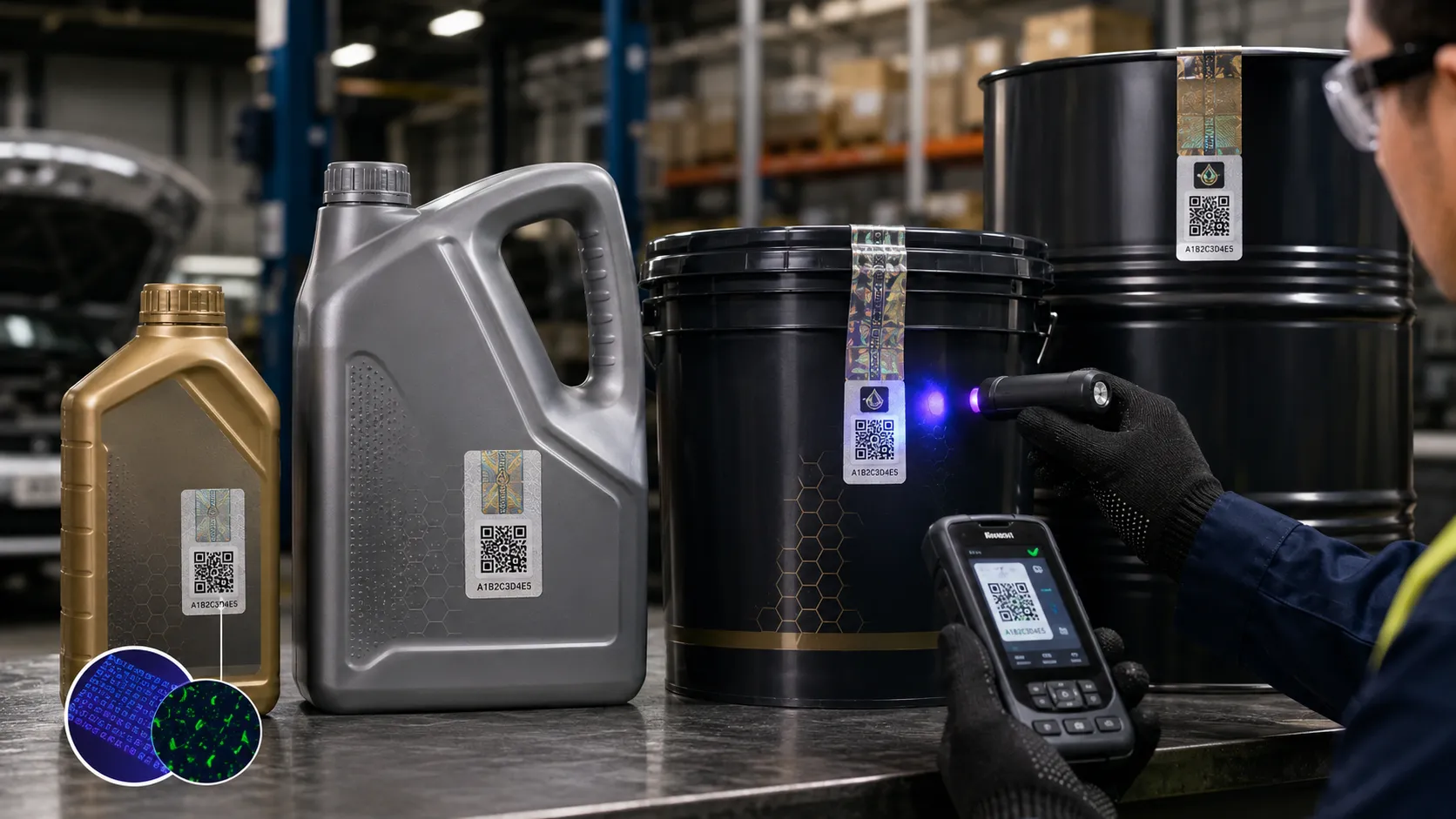
Visible features that signal to a casual buyer that the brand cares about authentication: an optically variable element, custom holographic stripe, color-shifting ink panel, or guilloche line work that does not survive flatbed scanning. The job here is psychological — to make a counterfeiter choose a different brand, not to prove authenticity on its own.
Layer 2 — Covert authentication
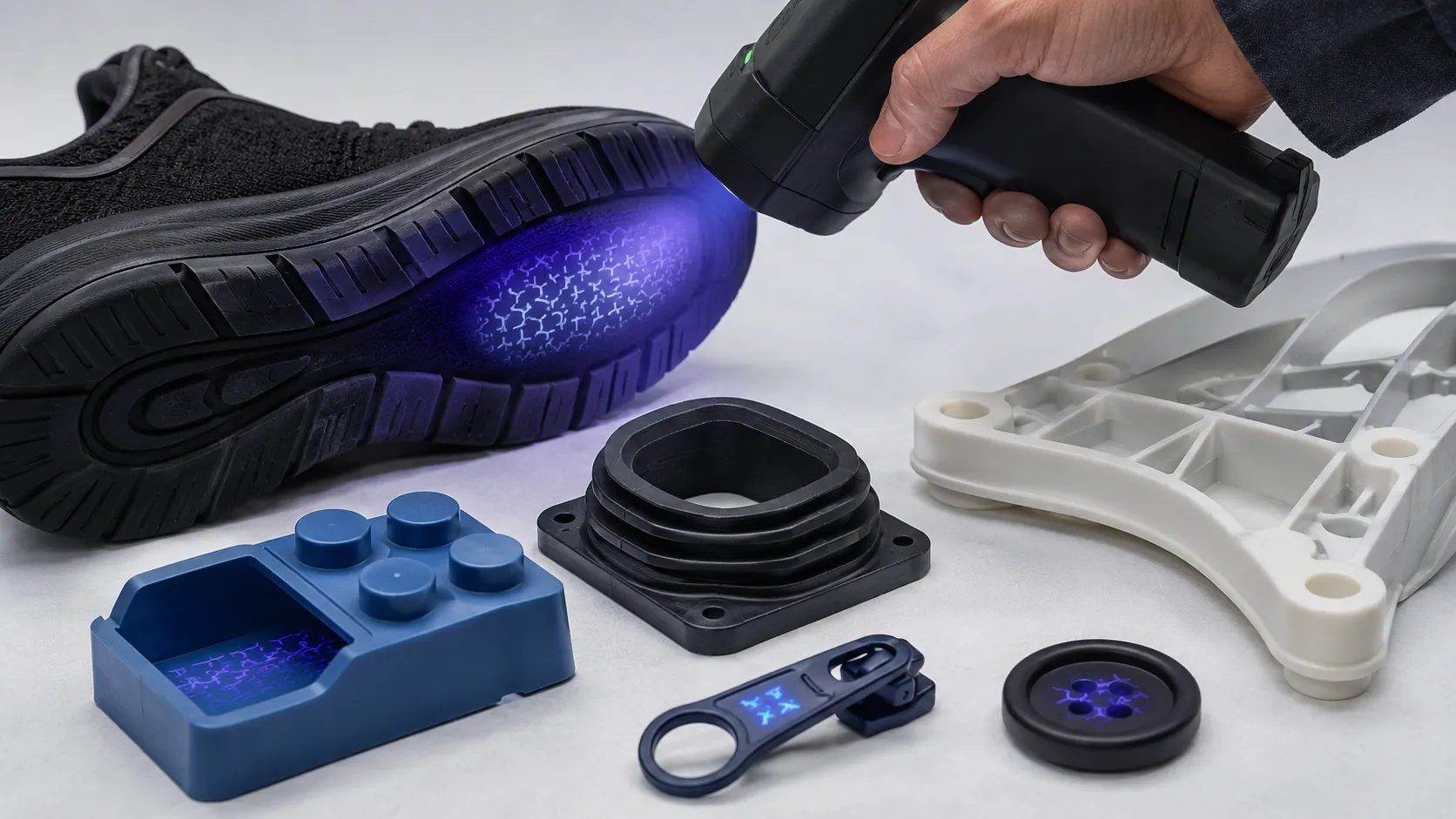
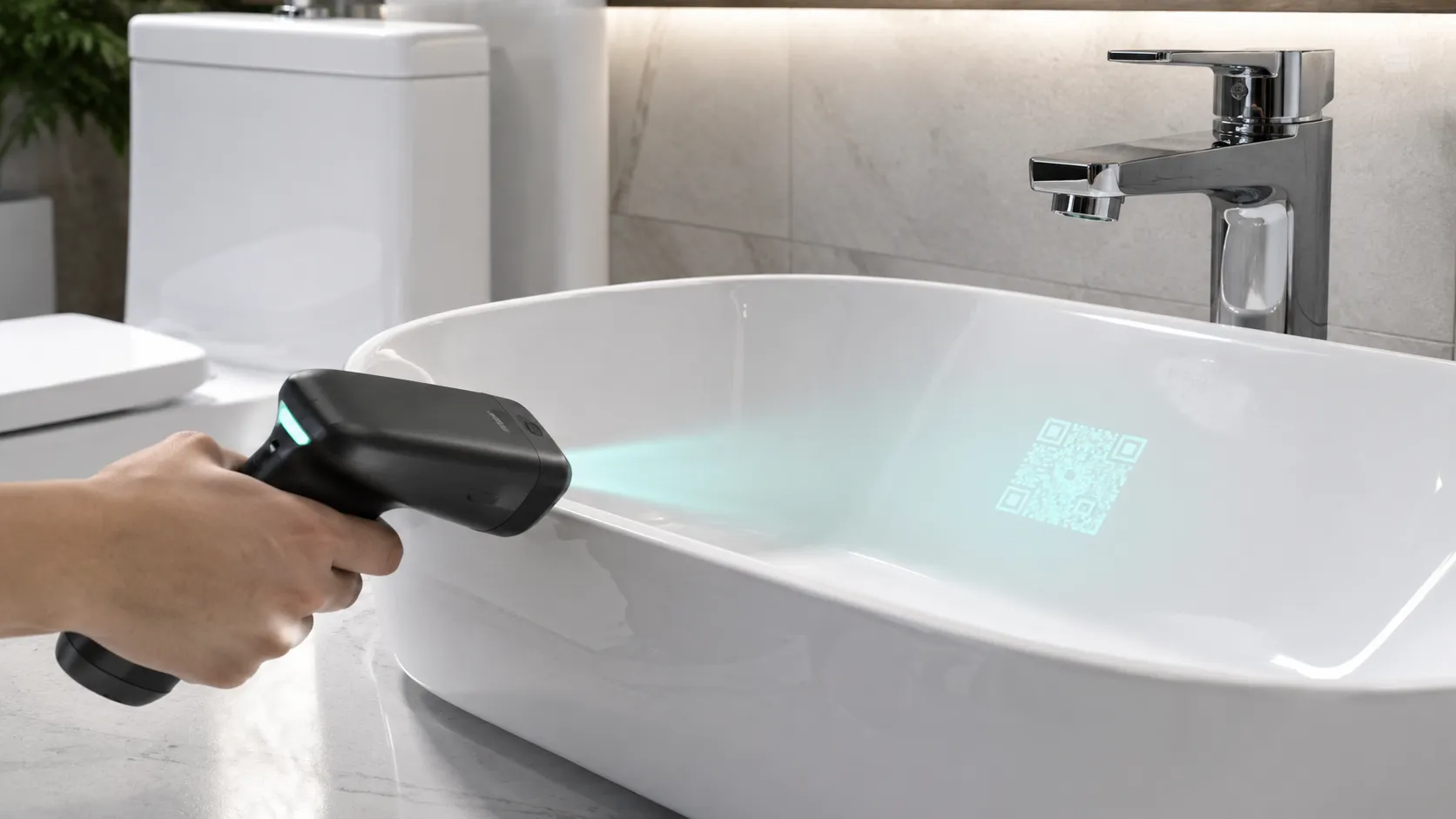
Features the buyer cannot see, but a trained inspector can verify with a basic tool. Common building blocks include UV-fluorescent ink confined to a sub-millimeter region, near-infrared markers readable with a handheld reader, and microscale inorganic tracer pigments embedded into the label varnish. Mina supplies invisible inorganic markers in this layer. They stay stable under oil contact, UV exposure, and tropical drum-yard heat. A dedicated portable reader confirms them in the field, rather than relying on appearance alone. The same approach is detailed in our overview of media-free anti-counterfeit technology for rubber and plastic, where similar harsh-environment constraints apply.
Layer 3 — Tamper evidence
The feature that defeats refill counterfeiting. Options range from destructible facestocks that fragment on removal, void-pattern adhesives, frangible cap seals, and tamper-evident shrink sleeves with perforation tear-down. For pails and drums, the tamper feature should be on both the closure and the body label — closure-only tamper is routinely defeated by careful counterfeiters.
Layer 4 — Serialized traceability
A unique code per unit, linked to batch, plant, region, and distributor. The code may be a printed QR, an encrypted dot-matrix code, or a covert serial readable only under UV. Serialization is what makes anti-diversion enforcement possible; without it, the brand cannot prove that a 4L bottle in Country A was originally shipped to Country B.
How the layers reinforce each other
Each layer protects against a different attack. A counterfeiter who clones the hologram still fails the covert UV check. One who fakes the UV mark still fails the encrypted serial scan. One who reuses a real pail still fails the destructive tamper feature. Single-layer authentication is what fails in court; layered authentication is what holds up.
An inspection workflow that survives a contaminated workshop
Most field-inspection guides assume clean conditions. Lubricant inspection happens on greasy floors with poor lighting, often under time pressure, and frequently by staff with limited training. The workflow below is built around those constraints.
Wipe and visual scan (5 seconds)
Wipe the label face with a dry cloth. Look for crisp registration on the overt feature, sharp small text, no double-printing on serial codes, and no edge lift. Most amateur counterfeits fail this step alone.
UV check (10 seconds)
Use a 365 nm UV torch on the designated covert region. The fluorescent pattern should appear in the expected color and shape. A wrong color, blurred edge, or fluorescence spreading outside the design area is a strong counterfeit indicator.
Tamper inspection (5 seconds)
Look at the cap seal and the sleeve perforation. A reused pack will show seal residue, glue marks, or a re-applied sleeve with uneven shrink. Run a fingernail across the seal seam if unsure.
Code scan (10 seconds)
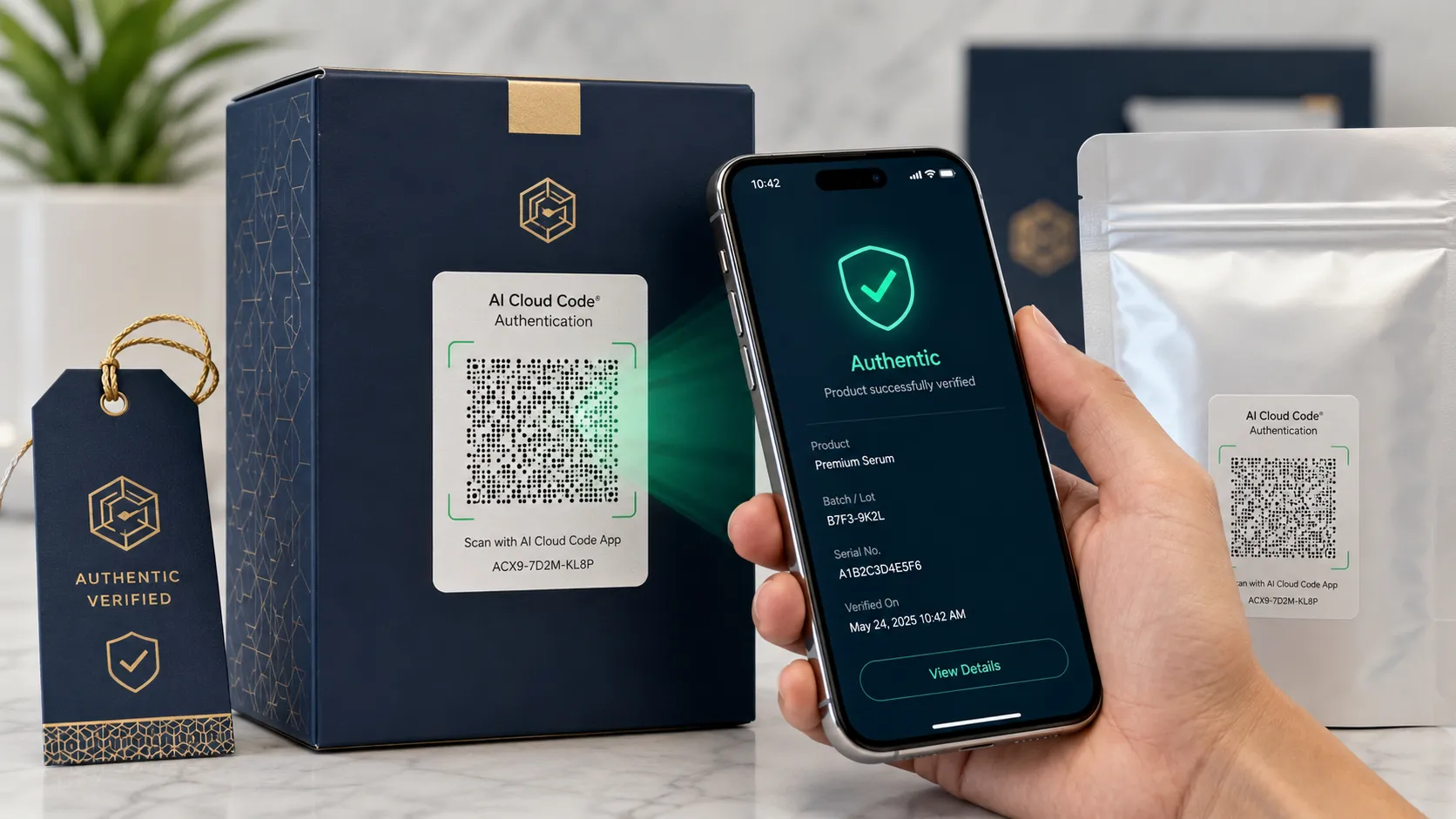
Scan the QR or dot-matrix code with the brand’s verification app. The response should include batch, region of origin, scan history, and a “first-scan / repeat-scan” indicator. A repeat scan from a region different from the labeled distribution territory is a diversion signal that should escalate, not be dismissed.
Forensic escalation (case-by-case)
If the first four steps disagree, retain the pack intact, photograph the label and code, log the GPS location, and ship to the brand’s central forensic team. Field staff should never be asked to make the final counterfeiting determination.
Where most anti-counterfeit labels for lubricants go wrong
Common mistakes
- Single hologram supplier, single feature, no covert backup
- Tamper sleeve only on the cap, body label survives steam-cleaning
- Sequential serial numbers visible on every code
- Verification app that times out or works only on premium phones
- No training for distributors — feature exists but is unused
- Same security spec for retail bottles and 200L drums
- Scan data not shared with the anti-diversion team
Stronger practice
- Two independent feature suppliers; covert and overt layers split
- Tamper evidence on both closure and body, with destructive failure mode
- Cryptographic code generation, no inferable sequence
- Lightweight verification page that loads on basic phones offline-tolerant
- Distributor incentive scheme tied to verified scans
- Pack-format-specific spec, with drum labels rated for higher temperature
- Live anti-diversion dashboard fed by every scan
Anti-diversion: how lubricant labels track grey-market flow
For most lubricant brands above a certain volume, the more painful problem is not crude counterfeit. It is cross-region diversion. Legitimate product is purchased at a discounted regional price and resold into a higher-priced market. This undercuts authorized distributors and triggers channel-conflict claims. Anti-counterfeit labels for lubricants are the mechanism that makes diversion provable.
The serialized code on each pack is locked to the destination distributor and region at the moment of issue. When the same code surfaces in a different region’s scan log, the system flags it. Over weeks, patterns emerge. A specific batch is repeatedly diverted. A specific distributor’s allocation appears far from its territory. The label does not stop the diversion by itself. It produces the evidence that contractual enforcement requires. The same logic underpins our work on transparent barcode anti-diversion for beverages and invisible cryptographic anti-diversion codes.
Two design choices make or break an anti-diversion label. First, codes must be unique per smallest sellable unit, not per case or per pallet. Diverters split shipments. Second, scan-side logging must capture geography reliably. That usually means tying scans to the verification app’s location rather than relying on consumer-side scans alone.
Supplier evaluation matrix
Use the matrix below as a starting point for vendor RFPs. Each row should be answerable with a documented reference, not a marketing claim.
| Evaluation area | What to ask for |
|---|---|
| Material qualification | Documented oil-resistance and aging test data on the proposed substrate, adhesive, and topcoat — using the brand’s own base oil where possible |
| Covert feature uniqueness | Confirmation that the covert marker is not commercially sold to other lubricant brands; chain-of-custody for the marker batch |
| Forensic depth | Independently verifiable forensic features for legal evidence; not solely visual or app-based |
| Code generation | Cryptographic, non-sequential code generation; export of generation logs to the brand’s anti-diversion platform |
| Verification path | Smartphone verification page, distributor portal, and field-reader hardware, with offline tolerance specified |
| Production scale-up | Reference customers with comparable volume and pack mix; willingness to host an audit of the security print line |
| Data ownership | Explicit contractual statement that scan data and code databases are owned by the brand, not the print supplier |
| Field detection equipment | Availability of dedicated portable readers for covert features, with maintenance and calibration commitments |
What Mina contributes to a lubricant label program
Mina’s role in lubricant programs typically sits in two places. In the covert layer, Mina supplies inorganic invisible markers and detection devices. They remain stable on HDPE pails, drums, and bottles across the temperature and chemical conditions described above. In the serialization layer, Mina supports cryptographic dot-matrix and AI cloud code formats. These integrate with brand-side anti-diversion platforms, with smallest-unit code uniqueness and region-locked issuance. Both layers coexist with whatever overt and tamper features the brand’s existing print supplier already provides. Mina is not a replacement for the print partner. Mina is the authentication and traceability layer underneath the visible label. Related background is in our writeup of AI Cloud Code and dot matrix code for packaging authentication.
Common questions from lubricant brand-protection teams
- Are holograms still worth specifying?
- Yes, as a deterrent layer, but never as the only authentication feature. Modern counterfeit holograms are close enough to the original that visual checks at the workshop are unreliable. Pair holograms with covert authentication and serialization.
- Will a covert UV feature survive 18 months on a drum in 45 °C ambient?
- Standard organic UV-fluorescent inks degrade meaningfully over that window. Inorganic covert markers — including the ones Mina supplies — are far more stable across temperature and UV exposure and are the appropriate choice for outdoor drum storage.
- Does serialization help with retail-bottle counterfeiting or only diversion?
- Both. For retail counterfeiting, the system flags repeat scans of the same code and clones with no scan history. For diversion, it correlates scan geography against issued territory.
- Should the verification app be branded for consumers or kept internal?
- Most credible programs run two channels — a public-facing verification page that any buyer can scan, and a distributor or auditor portal with deeper data. Consumer-facing scans contribute volume; auditor scans contribute decisions.
- How much of the unit cost should anti-counterfeit features represent?
- For mainstream branded lubricants, programs typically settle in the low single-digit cents per unit for retail bottles and proportionally less for drums. The number that matters is not the per-unit cost but the proportion of warranty claims, distributor rebates, and lost margin avoided — which routinely runs orders of magnitude higher.
- Can Mina supply the entire label, or only the security layer?
- Mina supplies the authentication and serialization layers. The base label, hologram, and tamper sleeve are typically produced by the brand’s existing print converter, with Mina’s covert markers and codes integrated into the converter’s process. This keeps converter relationships intact and avoids forcing a full supplier change.
Specifying anti-counterfeit labels for lubricants as a program, not a sticker
Anti-counterfeit labels for lubricants and engine oil are not a single feature on a roll. They are a stack of decisions. Decisions about the threat profile. Decisions about who authenticates and where. Decisions about how data flows from a roadside scan back into a brand-protection dashboard. Procurement teams that get this right treat the label as the front end of a system, not a sticker.
For brands evaluating that system, Mina works with packaging and brand-protection teams to scope covert authentication, serialization, and field-detection equipment. The scope covers lubricant pack formats from 1L bottles to 200L drums and IBCs. Reach out via https://minananotech.com/contact-us/ to discuss a specification review or pilot for your next batch.