Phone-readable packaging authentication
AI Cloud Code, also called Dot Matrix Code, is a visual AI authentication code that uses random point features instead of a conventional QR pattern. For packaging teams, it offers a phone-readable way to authenticate tags, labels, boxes, and bags while making copying and decoding more difficult.
Tags, labels, boxes and bags
Smartphone recognition
QR alternative for packaging
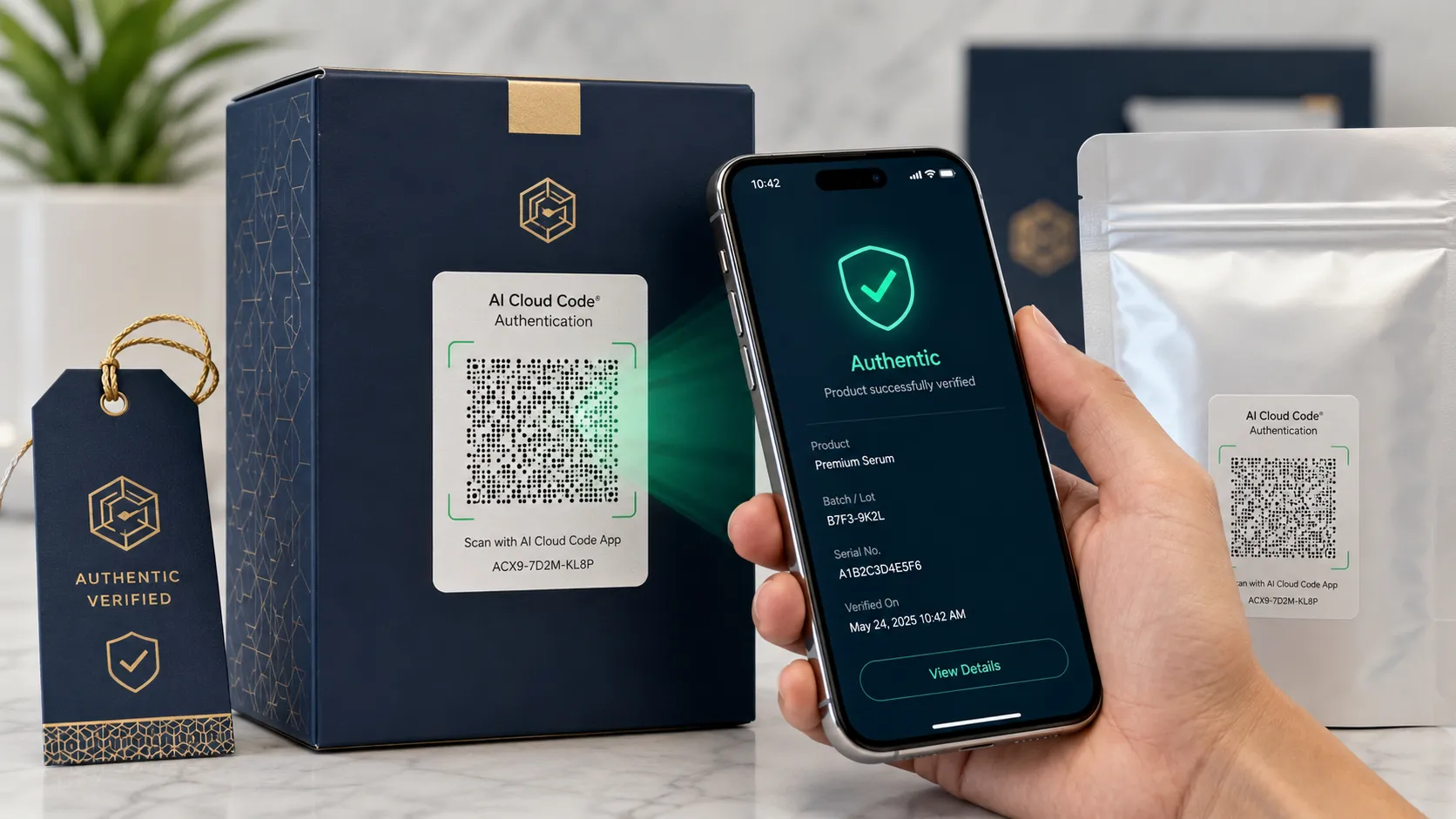
AI Cloud Code uses random point features and visual AI recognition to support phone-readable packaging authentication.
What it protects
Packaging carriers such as product tags, labels, folding cartons, outer boxes, flexible packaging bags, sleeves, and inserts.
Why it matters
Ordinary QR codes are familiar and useful, but their visible patterns can be photographed, copied, reprinted, or redirected.
How it works
Random point features are read by visual AI, allowing phone-based recognition without using a conventional QR grid.
Best use case
Brands that need a smartphone-readable packaging code with stronger copy resistance than ordinary QR patterns.
Key takeaways for procurement teams
- AI Cloud Code is a phone-readable code application for packaging, not a general label article.
- Mina’s source profile describes it as a new algorithm that replaces QR codes by using visual AI to extract features from each point.
- Each point has inherent randomness, increasing the difficulty of forgery and decoding.
- It can be customized exclusively for enterprises and applied to tags, labels, packaging boxes, and packaging bags.
- Procurement should test print quality, phone recognition, lighting, abrasion, campaign logic, and copied-code controls before launch.
What is AI Cloud Code / Dot Matrix Code?
AI Cloud Code, also called Dot Matrix Code, is a product authentication code that uses a field of random points and visual AI recognition rather than a traditional QR pattern. It is designed to be recognized by a phone without special equipment while making direct copying, decoding, and alteration more difficult.
Mina as a new algorithm that replaces QR codes. It uses visual AI to extract features from each point, and each point has inherent randomness. The same source states that the code is customized for enterprises, unique, difficult to replicate or alter, and readable by phone.
For packaging teams, the appeal is practical: a code can be applied to tags, labels, packaging boxes, and packaging bags while still supporting consumer or staff verification. The buying question is whether it solves copied QR risk without creating friction for users.
Why brands look for QR alternatives
QR codes are familiar and useful, but they are also easy to reproduce visually. A counterfeiter can photograph a genuine QR code, copy it onto fake packaging, or create a fake page that looks like a brand verification page. Server-side scan rules help, but the printed code itself remains visible and easy to duplicate.
Brands with high counterfeit risk often need a code that supports smartphone access while raising the technical barrier. Digital watermarks, secure QR, serialized codes, NFC, and AI-recognized patterns all try to solve this problem in different ways.
The business case is clear. OECD and EUIPO reported global trade in fake goods at USD 467 billion in 2021, equal to 2.3% of world imports. For packaging categories such as cosmetics, consumer goods, electronics accessories, toys, and apparel, copied codes can damage consumer trust and campaign data quality.
How Mina’s visual AI reading works
Mina’s Dot Matrix Code uses point-level visual features rather than a standard QR grid. The random characteristics of each point become part of the authentication signal. The source profile states that AI algorithms support precise and stable reading, allowing phone recognition without special inspection equipment.
This makes the code useful for consumer-facing or staff-facing workflows where special detectors would be inconvenient. A consumer product can still be verified by phone, while the underlying code pattern is harder to forge than a simple copied QR image.
Procurement teams should specify both print and data requirements. The code must be printed consistently enough for phone recognition, but unique enough to support authentication. The system should define what happens when a scan is repeated, copied, damaged, photographed, or used in the wrong market.
Best-fit applications
Cosmetics packaging
Cartons, labels, and outer boxes can use a phone-readable code that supports authenticity checks without relying on ordinary QR patterns.
Consumer goods labels
Daily chemical, food, toy, and accessory brands can connect verification, product information, and campaign pages.
Packaging bags
Flexible bags can carry a code when surface area or design requirements make ordinary labels less attractive.
Brand licensing programs
Enterprise-customized codes can help brands track authorized packaging and detect copied code behavior.
Scan rules buyers should define before printing
A packaging code is only as strong as the rules behind the scan. Before approving AI Cloud Code artwork, procurement should define what the platform will do when the same code is scanned once, scanned many times, scanned in the wrong market, scanned before launch, scanned after expiration, or scanned from a location that does not match the shipment plan. These rules turn a printed code into an operational signal.
For consumer products, the first scan usually confirms authenticity and opens product information. A repeat scan should not automatically mean counterfeit, because genuine consumers may scan more than once. A useful threshold is behavioral: repeated scans across distant locations, abnormal scan velocity, or the same code appearing across many devices can indicate copying. The article page should explain this logic in plain language so procurement, marketing, and brand protection teams agree on what the code is expected to prove.
For channel-control projects, the scan result should be connected to product assignment. A code printed for a Southeast Asia distributor should raise a different alert when it appears in Europe than when it appears in the assigned territory. This does not require the code to expose confidential distribution data to the consumer. The public result can stay simple, while the enterprise report records SKU, batch, market, scan time, and abnormal pattern.
For campaign projects, the buying team should separate engagement data from authenticity data. A campaign may reward scans, collect leads, or display product education. An authenticity workflow should preserve evidence, detect copied codes, and support investigation. Mixing the two goals without rules can create noisy data: high scan volume may look like campaign success when it actually indicates copied packaging.
The last rule is failure handling. A failed scan should not only show a dead end. It should tell the user how to retry under better light, how to contact the brand, and what information to provide if the package appears suspicious. For B2B teams, the failed-scan report should capture enough context to support action: product photo, package code image, time, country, device type, and scan outcome.
Dot Matrix Code vs QR, NFC, digital watermark, and covert code
| Option | Best use | Main weakness | Procurement guidance |
|---|---|---|---|
| Ordinary QR code | Low-cost consumer scan and product information | Visible pattern is easy to copy | Use for low-risk products or pair with stronger security |
| Secure QR | Serialized scan verification with server-side rules | Still depends on visible code and scan governance | Good when scan analytics and copy detection are strong |
| NFC | Premium tap experience and tag-based identity | Higher component cost and placement constraints | Use when tap interaction justifies unit cost |
| Digital watermark | Design-integrated machine-readable packaging | Requires careful artwork and scanner compatibility | Good for invisible or semi-hidden packaging data |
| Covert device-read code | Restricted brand-team inspection | Consumers usually cannot verify by phone | Pair with phone-readable code when consumers need access |
| Mina AI Cloud Code | Phone-readable random-point packaging authentication | Requires print validation, AI reading stability, and platform rules | Best when brands want a QR alternative with smartphone recognition |
Procurement checklist for AI Cloud Code projects
- Packaging carrier: define tag, label, box, bag, sleeve, or insert.
- Code role: choose consumer verification, staff inspection, campaign entry, or distribution check.
- Artwork location: confirm where the dot matrix will sit without hurting design.
- Print process: test offset, flexo, gravure, digital print, varnish, lamination, and substrate effects.
- Phone recognition: test iOS and Android cameras, low light, glare, curved surfaces, and damaged samples.
- Uniqueness rules: decide item-level, batch-level, SKU-level, or campaign-level coding.
- Data behavior: define first scan, repeat scan, wrong-market scan, and copied-code alerts.
- Landing page: specify authenticity result, product page, campaign page, and language requirements.
- Counterfeit controls: test photographed codes, scanned copies, reprinted packages, and altered point fields.
- Governance: control code generation, artwork files, platform access, and reporting permissions.
Recommended pilot workflow
Start with one packaging format
Select a real label, box, bag, sleeve, or tag, then define whether the code is for consumer verification, campaign entry, or staff inspection.
Create genuine and attack samples
Prepare genuine, copied, damaged, photographed, reprinted, and altered-code samples using the actual production method.
Test real phone recognition
Include glare, low light, worn packaging, curved surfaces, flexible packaging, and different iOS and Android phone models.
Validate platform response
The system should distinguish first scan, repeat scan, abnormal geography, copied-code clusters, and invalid code patterns.
Document rollout rules
Decide who generates codes, who approves artwork, who sees scan data, who responds to alerts, and how suspected copies are escalated.
Print QA acceptance criteria
Because AI Cloud Code depends on visual recognition, print quality should be specified before mass production. Procurement should define acceptable contrast, minimum code size, clear space, substrate color, varnish coverage, and distortion tolerance. If the code is printed on a curved bottle label, flexible pouch, shrink sleeve, or textured carton, the same carrier should be used during testing.
A useful acceptance test includes at least 30 genuine samples from the real press run, 10 damaged samples, 10 copied samples, and 10 low-light scan tests. The buyer should record recognition speed, failed-read rate, false acceptance rate, and user retry behavior. The goal is not only to make the code readable in a studio. It must work when a warehouse inspector, store employee, or consumer scans it under normal packaging conditions.
For international products, test multiple phone models and languages. A code that reads well on one flagship phone may perform differently on older Android devices, low-cost cameras, or phones with aggressive image processing. Good QA reduces customer-service noise after launch.
Limitations and practical risks
AI Cloud Code still needs print quality. Poor contrast, varnish glare, ink spread, compression, or damaged packaging can reduce phone recognition. Procurement should test real production samples rather than design proofs only.
The second risk is platform governance. A unique code is useful only if code issuance, scan rules, and reporting are controlled. If duplicated artwork files leak, security weakens. Procurement should specify who can generate codes, who can download artwork, who can edit landing pages, who can view scan data, and who can close a counterfeit case.
The third risk is overclaiming. A phone-readable code can help detect suspicious packaging, but high-risk products may still need hidden physical authentication, tamper evidence, or material-level proof.
FAQ: AI Cloud Code and Dot Matrix Code
What is AI Cloud Code?
AI Cloud Code is Mina’s phone-readable packaging authentication code that uses visual AI to extract features from random points instead of relying on a conventional QR pattern.
Is it the same as a QR code?
No. Mina’s source profile describes it as a new algorithm that replaces QR codes. It uses random point features that are read by visual AI.
Does it require special equipment?
Mina’s supplied profile states that a phone can recognize it without special equipment, supported by AI algorithms for precise and stable reading.
Where can it be applied?
The supplied source lists tags, labels, packaging boxes, and packaging bags as application carriers.
What should procurement test?
Test print quality, phone recognition, low light, glare, curved surfaces, damaged codes, copied codes, landing page behavior, and scan reporting.
When should brands choose it?
Choose it when ordinary QR codes are too easy to copy but consumers or staff still need phone-based verification.
Sources and evidence used
Company-specific product facts come from Mina’s technology. Public sources below were used for market context and benchmarking.
Next step for packaging code projects
If your brand needs a phone-readable alternative to ordinary QR codes, prepare a brief with packaging carrier, print process, code role, scan workflow, market rules, and pilot volume. Mina can then evaluate an AI Cloud Code pilot using your real packaging artwork and production conditions.
For the experience after a phone-based check, review Mina’s Security Marketing System and define the customer information, result messages and support route your project needs.