Counterfeit PPE Detection: 5 Proven Wins for Safety Equipment Procurement
A fake bearing costs downtime. A fake respirator costs a life. Personal protective equipment is the only product category where counterfeiting directly endangers the person wearing it — yet most PPE procurement programs have zero authentication layer beyond visual inspection of packaging and certification labels. This guide maps the specific counterfeit PPE detection gaps that existing methods miss and introduces material-level authentication as the layer that closes them.
Where Counterfeit PPE Enters the Supply Chain — and Why It Gets Through
Counterfeit personal protective equipment is not a theoretical risk. The OECD estimates that global trade in counterfeit goods exceeds $500 billion annually, and safety products are a growing share. During the COVID-19 pandemic alone, U.S. Customs and Border Protection seized millions of counterfeit N95 respirators and surgical masks — many bearing forged NIOSH approval numbers.
The problem is structural: PPE supply chains rely on certification marks, lot numbers, and packaging appearance to confirm authenticity. All three are trivially reproducible. A counterfeiter who can mold a hard hat shell can just as easily print a CE or ANSI marking on it.
Respirators and Masks
Counterfeit N95 and FFP2 respirators may pass visual inspection but fail filtration efficiency tests. Workers inhale hazardous particles despite believing they are protected.
Fall Protection Harnesses
Substandard webbing and stitching in counterfeit harnesses can fail under load. A fall arrest system that snaps at 4 kN instead of the rated 6 kN is a fatality waiting to happen.
Hard Hats and Helmets
Fake hard hats often use recycled or off-spec ABS and HDPE. They may crack on impact instead of distributing force, or degrade within months of UV exposure.
Chemical-Resistant Gloves
Counterfeit nitrile and neoprene gloves may have inconsistent wall thickness or wrong polymer blends, allowing breakthrough of solvents and corrosives within minutes.
Each of these categories shares the same vulnerability: the safety performance is invisible. A genuine and counterfeit hard hat can look identical on a shelf. The difference shows only under stress — by which point someone may already be hurt.
Five Inspection Methods That Counterfeit PPE Defeats
| Method | What It Checks | Catches Relabeled Counterfeits? | Catches Cloned Packaging? | Survives Field Conditions? |
|---|---|---|---|---|
| Visual inspection of markings | CE / ANSI / NIOSH stamps, lot codes | No | No | Yes |
| QR code scan | Links to manufacturer database | No — code is reproduced | No | Damaged in field use |
| Certificate / DoC review | Declaration of Conformity document | No — PDFs are forged | No | Yes |
| Packaging holograms | Security feature on outer packaging | No — replicated or transferred | Partially | Discarded at issue |
| Destructive lab testing | Impact, filtration, tensile performance | Yes | Yes | Yes |
Destructive testing is the only reliable method in this table — but it consumes the product. You cannot impact-test every hard hat. You cannot tear-test every harness. The gap between receiving inspection and lab testing is where counterfeit PPE detection fails, and where material-level authentication fills the void.
How Counterfeit PPE Reaches Procurement Teams
Unauthorized distributors and grey-market resale
PPE purchased through non-authorized channels — especially during supply shortages — bypasses the manufacturer’s controlled distribution. Counterfeiters exploit urgency, offering “equivalent” products at competitive prices with convincing documentation.
Relabeling and grade substitution
Lower-grade or non-certified products receive counterfeit labels. An industrial glove rated for light duty gets a chemical-resistance label. A basic safety glass gets an ANSI Z87.1+ impact rating sticker. The product is real — the rating is fake.
Contract manufacturer overproduction
OEMs that outsource PPE production face overproduction risk: the contract factory runs additional units on the same tooling, selling the extras through side channels. These copies may match the original in appearance but skip final QC steps, undermining brand licensing controls.
E-commerce marketplace infiltration
Online platforms aggregate sellers from multiple sources. Commingled inventory means a legitimate seller’s stock can be mixed with counterfeit units from other merchants, making source tracing nearly impossible for the buyer.
Expired or recalled PPE re-entering circulation
PPE with expired shelf life — particularly respirator filters and chemical-resistant materials — gets repackaged with new date stamps. UV-degraded hard hats are cleaned and relabeled. Without a marker tied to the product itself, the deception is undetectable at receiving.
Material-Level Counterfeit PPE Detection: Authentication That Cannot Be Replicated
The core limitation of every method in the table above is that it relies on something attached to the product — a label, a code, a sticker. Material-level authentication works differently: the security marker is inside the product, integrated during manufacturing. It cannot be seen, copied, or transferred.
Polymer-Embedded Invisible Markers (Masterbatch Integration)
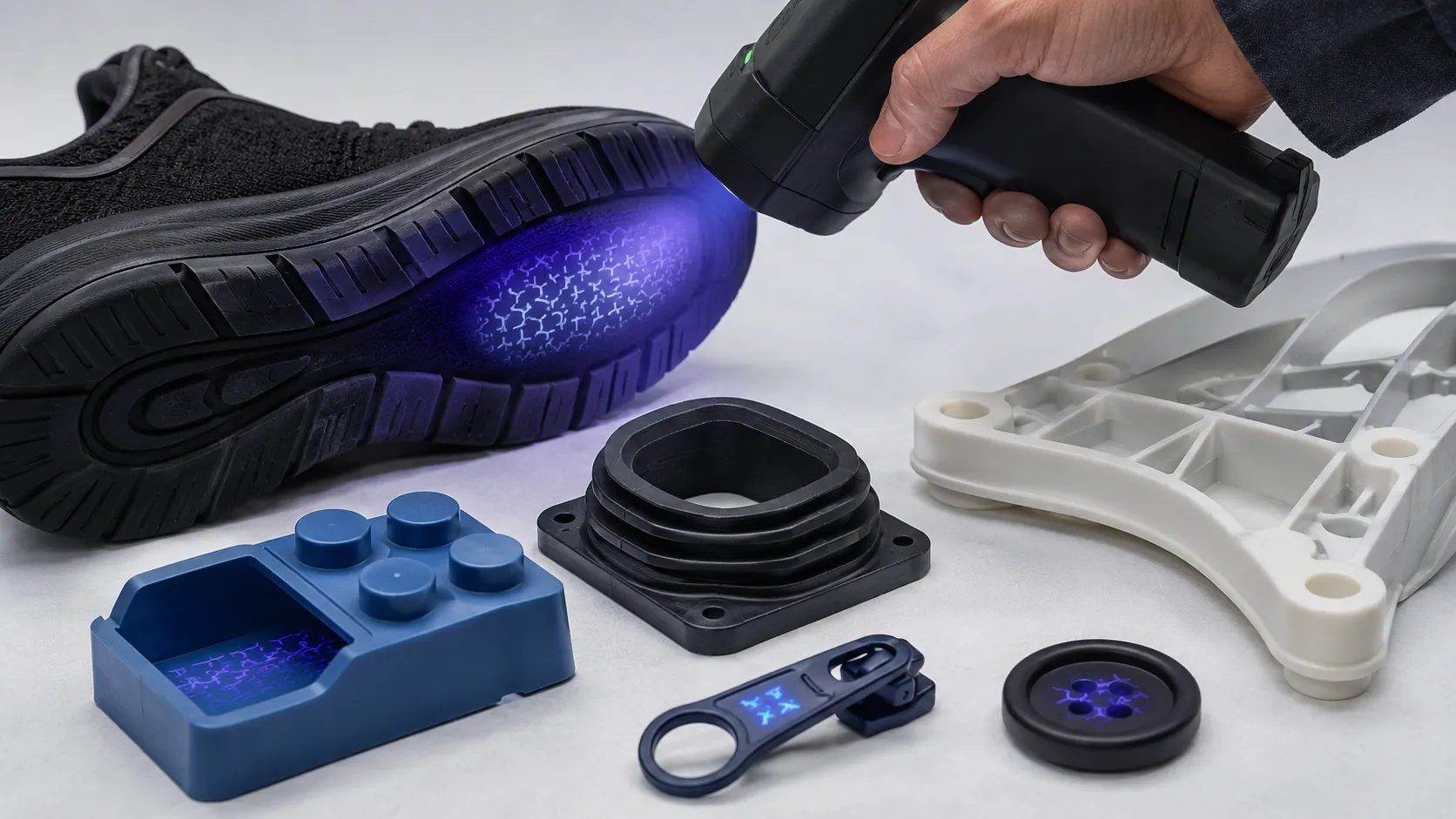
For hard hats, face shields, safety goggles, and molded respirator components made from ABS, HDPE, polycarbonate, or nylon: Mina’s anti-counterfeiting masterbatch is compounded directly into the polymer pellets before injection molding or extrusion. The marker distributes uniformly through the material. Any fragment of the product — even a chip from a damaged hard hat — can be verified with a handheld reader. The marker is invisible to the naked eye, UV lamps, and infrared scanners. It responds only to Mina’s proprietary detection device, which confirms authenticity with an audio or visual readout in seconds. This approach is particularly effective for plastic product authentication because the marker cannot be separated from the material itself.
Textile-Embedded Markers for Webbing and Fabrics
For fall harnesses, safety vests, straps, and protective clothing: Mina’s nano-quantum material can be incorporated into yarns and fibers during spinning, or applied as an invisible coating on woven webbing. The marker survives abrasion, washing, UV exposure, and the flexing that webbing undergoes during daily use. A field inspector can verify a harness at the point of use — on a construction site, at a wellhead, during a tower climb — without removing or damaging it. This brings invisible textile authentication from apparel into industrial safety.
Covert Ink for Rubber and Silicone Components
For respirator facepieces, gaskets, boot soles, and chemical-resistant gloves: Mina’s invisible security ink formulation is compatible with vulcanized rubber, silicone, and nitrile compounds. Applied during the molding or dip-coating process, the marker survives the chemical environments that the PPE itself is designed to resist. If the glove survives the solvent, so does the marker.
Micro-Chain Code on Metal and Composite Components
For carabiners, buckles, D-rings, helmet brackets, and other hardware: Mina’s micro-chain code is printed as an invisible graphic code on the component surface. Detection requires Mina’s handheld device, which delivers an audio confirmation. Combined with serialization, this enables per-unit traceability from factory to field — supporting both anti-counterfeiting and anti-diversion tracking across distribution channels.
Building a Counterfeit PPE Detection Program: Procurement Evaluation Criteria
Material Survivability
Does the marker survive the same conditions the PPE is rated for? UV, impact, chemicals, temperature, abrasion, washing.
Detection Speed
Can a receiving inspector verify a shipment in real time? Seconds-per-unit with a handheld device, not days-per-batch in a lab.
Covert vs. Overt
Can a counterfeiter see, measure, or reverse-engineer the marker? If the marker is visible, it is a matter of time before it is copied.
Field Verifiability
Can an EHS officer authenticate PPE at the point of use — on a job site, during an audit, after an incident — without sending it to a lab?
Serialization & Traceability
Can each unit be linked to its manufacturing lot, production date, and distribution path? Essential for recall management and incident investigation.
Mina’s approach covers all five criteria. The nano-quantum markers are invisible and device-exclusive (Criterion 3), survive every condition the PPE is rated for (Criterion 1), deliver results in seconds via handheld reader (Criteria 2 and 4), and support per-unit serialization through AI Cloud Code and dot matrix code systems (Criterion 5). For a broader perspective on how these anti-counterfeiting technologies compare, procurement teams should evaluate against their specific PPE categories.
Which PPE Categories Benefit Most from Covert Authentication?
Not every piece of PPE carries the same risk. Prioritize authentication investment where the consequences of counterfeiting are highest and the probability of substitution is greatest.
| PPE Category | Consequence of Failure | Counterfeiting Probability | Recommended Authentication Method |
|---|---|---|---|
| Respirators (N95, FFP2, SCBA) | Lung disease, chemical exposure, death | Very high — pandemic demand created permanent grey market | Polymer masterbatch (facepiece) + ink (filter media) |
| Fall arrest harnesses | Fatal fall | High — visual differentiation is minimal | Yarn-level marker (webbing) + micro-chain code (hardware) |
| Hard hats / safety helmets | Skull fracture, traumatic brain injury | High — simple geometry, easy to mold | Polymer masterbatch (shell) |
| Chemical-resistant gloves | Chemical burns, dermatitis, systemic poisoning | Moderate — bulk commodity with many generic suppliers | Invisible ink (nitrile/neoprene compound) |
| Arc flash and FR clothing | Severe burns, electrocution | Moderate — FR treatment quality is invisible | Textile marker (fabric) + invisible label ink |
| Safety footwear | Crush injury, puncture, electrical shock | Moderate — steel/composite toe substitution | Masterbatch (sole) + micro-chain code (toe cap) |
Implementation Pathway: From Pilot to Full Deployment
Rolling out material-level counterfeit PPE detection does not require a complete supply chain overhaul. Mina works directly with PPE manufacturers to integrate markers during existing production processes — no new tooling, no production line redesign.
- Risk assessment (2–4 weeks): Identify the highest-risk PPE categories in your inventory based on supply chain complexity, historical incidents, and regulatory exposure. Prioritize one or two product lines for the pilot.
- Marker integration (4–8 weeks): Mina’s technical team works with your PPE supplier to incorporate the appropriate marker — masterbatch for plastics, yarn additive for textiles, ink formulation for rubber. Production samples are tested against all relevant certification requirements (ANSI, EN, ISO) to confirm the marker does not alter safety performance.
- Detection protocol setup (1–2 weeks): Receiving inspectors and EHS teams are trained on handheld device operation. Verification takes 2–3 seconds per unit. Results are logged for audit trails.
- Field validation (4–8 weeks): Authenticated PPE is deployed alongside standard inventory. Verification rates, detection accuracy, and workflow integration are evaluated against agreed KPIs.
- Scale and standardize: Extend marker integration to additional PPE categories. Integrate packaging-level authentication codes to cover both the product and its packaging, creating a multi-layer verification system.
Procurement FAQ: Counterfeit PPE Detection
Does the embedded marker affect PPE certification?
No. Mina’s nano-quantum markers are inert, non-toxic, and present in trace concentrations. PPE manufacturers retain all existing certifications (NIOSH, ANSI, EN, ISO) after marker integration. Mina provides material safety data and can support third-party testing by ISO-accredited labs.
Can counterfeiters access Mina’s detection devices?
The detection devices are proprietary and supplied exclusively to authorized clients. They are not sold on the open market. Without the correct reader, the marker is invisible and unmeasurable — unlike UV or fluorescent features, which can be detected with commercially available equipment.
What if our PPE supplier resists adding a third-party marker?
Resistance usually stems from concern about production disruption. Mina’s masterbatch is a drop-in additive — it is pre-compounded and metered into the existing pellet hopper. No process parameter changes, no retooling, no additional drying steps. Mina’s engineers can be on-site for initial batches to validate integration.
How does this differ from RFID or NFC tags embedded in PPE?
RFID and NFC tags are added as discrete components — a chip bonded to the product. They can be removed, transferred, or cloned. They also fail in high-temperature environments and cannot survive the mechanical stress that PPE undergoes. Material-level markers are part of the material itself: they cannot be extracted, and they survive every condition the product is designed for.
Is counterfeit PPE detection possible for PPE we already own?
Material-level authentication must be integrated during manufacturing — it cannot be retroactively added to existing inventory. However, Mina’s micro-chain code can be applied to the packaging and storage containers of existing PPE to secure the supply chain from the warehouse forward, while new production incorporates embedded markers.
Protecting workers starts before they put on the equipment. If your PPE procurement program lacks a material-level authentication layer, Mina can help you close the gap — from risk assessment through full deployment.