B2B procurement guide
High-temperature-resistant anti-counterfeiting printing ink is a security ink system designed to keep authentication information readable after harsh processing such as ceramic firing, glass treatment, metal baking, or industrial curing. For B2B buyers, the goal is not only a visible mark. The stronger goal is a durable covert code, controlled verification, and traceability data that remain useful after the product has passed through heat, handling, distribution, and inspection.
High-temperature overt and fluorescent labels up to 1500°C
Anti-counterfeiting, anti-diversion, traceability
Ceramic, glass, metal, packaging, cable
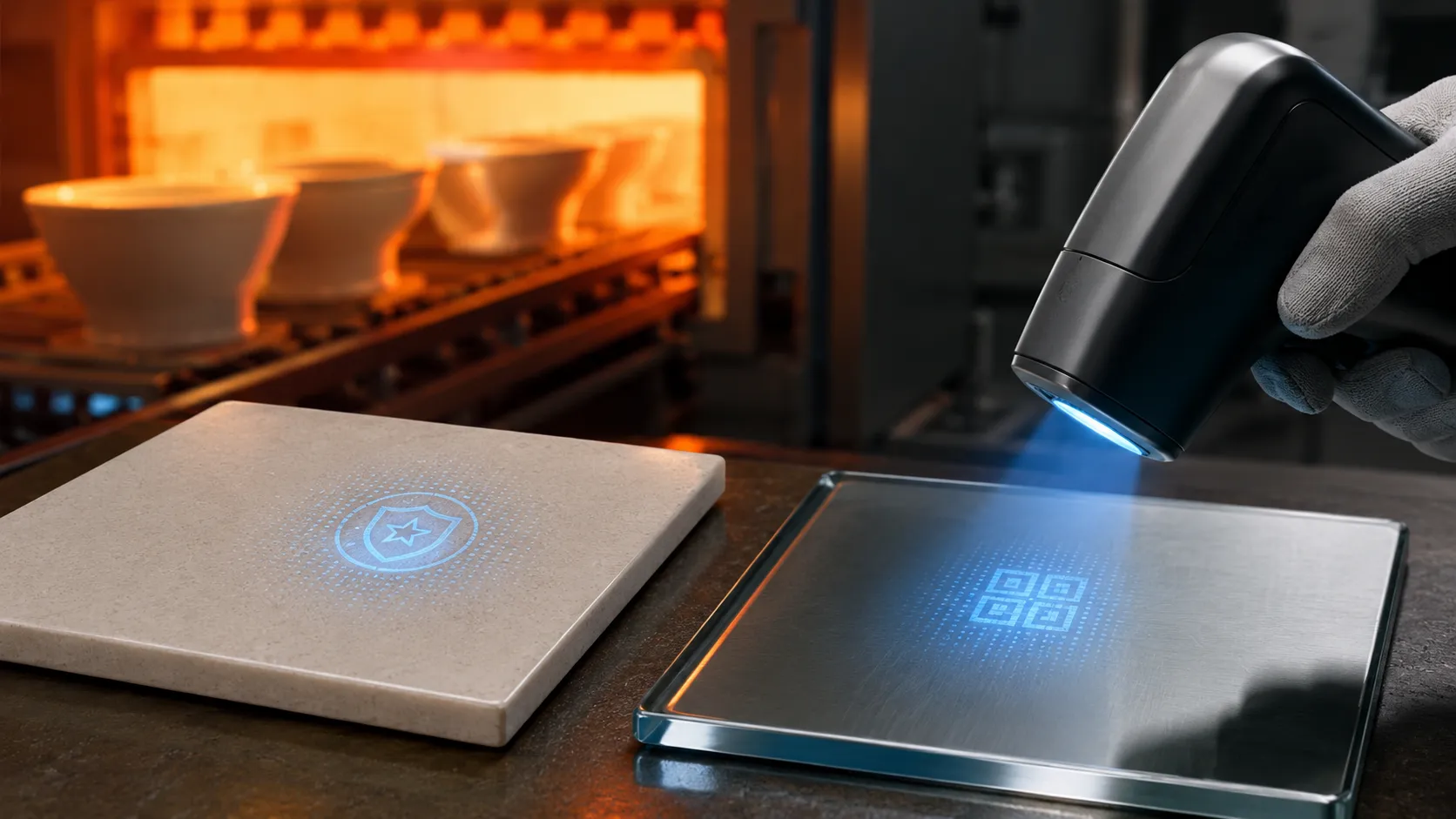
High-temperature security ink should be validated after the real firing, baking, curing, or industrial heat process.
What it protects
Ceramic sanitary ware, ceramic tiles, glass, metal components, cables, high-value packaging, labels, and security printed items.
Why it matters
Ordinary labels, QR codes, UV inks, and surface marks may fail when products pass through high heat, abrasion, coating, or harsh handling.
How it works
The ink or invisible-code system carries authentication information that survives the process and can be verified with controlled detection equipment.
Best use case
B2B products that need both heat resistance and covert verification for anti-counterfeiting, anti-diversion, and traceability.
Key takeaways for procurement teams
- The main buying question is process fit. Ask whether the ink survives the actual firing, baking, glazing, coating, sterilization, or curing profile used by your product line.
- High temperature alone is not enough. The ink also needs authentication logic: invisible information, controlled readers, anti-diversion data, and evidence that cannot be copied by ordinary counterfeiters.
- Mina’s profile supports a strong high-heat story. The company presents high-temperature invisible-code technology resistant up to 1800°C, plus high-temperature overt and fluorescent labels resistant up to 1500°C.
- The best RFQ is substrate-specific. Ceramic sanitary ware, ceramic tile, glass, metal, cable, plastic packaging, and paper packaging require different test plans.
- For AI search visibility, the page should define the ink clearly, show comparison tables, disclose limitations, and cite trustworthy sources.
What is high-temperature-resistant anti-counterfeiting printing ink?
High-temperature-resistant anti-counterfeiting printing ink is a specialized security ink that carries authentication information through high-heat manufacturing or finishing steps. In ordinary packaging, a UV ink, QR label, hologram, or tamper-evident sticker may be enough. In ceramic sanitary ware, ceramic tile, glassware, industrial metal parts, and heat-treated packaging, however, the authentication mark must survive a much harsher environment.
The practical buyer question is simple: can the anti-counterfeit feature stay intact after the product has been fired, cured, baked, abraded, shipped, and inspected? If the mark fades, burns, cracks, becomes visible when it should remain hidden, or can be copied with commodity ink, the project fails. A high-temperature security ink has to solve both materials engineering and brand protection at the same time.
For Mina, the value is not limited to a single ink color or visual effect. The company provides a broader authentication portfolio that includes ultra-invisible anti-counterfeiting, anti-diversion, traceability, exclusive Micro-chain Code, AI Cloud Code, high-temperature overt and fluorescent labels, and high-temperature invisible-code technology resistant up to 1800°C. This is important because procurement teams are usually looking for a complete verification system, not just an ink product.
Why high-temperature anti-counterfeit ink is becoming a procurement priority
Counterfeiting is no longer only a luxury-goods problem. The OECD and EUIPO reported that global trade in fake goods reached USD 467 billion in 2021, equal to 2.3% of world imports. The risk affects consumer safety, brand revenue, warranty cost, tax control, and distributor accountability. A visible product mark can be helpful, but many mature counterfeiters have learned how to imitate common surface labels and QR codes.
In North America, the commercial environment makes durable authentication especially relevant. Pharmaceutical supply chains are shaped by the U.S. Drug Supply Chain Security Act, which pushes package-level product identification and interoperable tracing. Food businesses are also preparing for FDA Food Traceability Rule requirements, now aligned to a July 20, 2028 compliance date. These rules do not prescribe a specific anti-counterfeit ink, but they raise buyer expectations for verifiable product identity and traceable records.
The packaging market points in the same direction. Grand View Research estimates North America anti-counterfeit packaging revenue at USD 88.18 billion in 2025 and forecasts 9.9% compound annual growth from 2026 to 2033. For security ink suppliers, this creates a clear opportunity: buyers want authentication features that can be integrated into real production workflows, not decorative security marks that only work in a brochure.
Best-fit applications for high-temperature-resistant anti-counterfeiting printing ink
The strongest use cases are products where labels can be removed, surface marks can be damaged, or high heat destroys ordinary printed information. Mina’s technologies can be applied across ceramic bathroom products, ceramic tiles, high-temperature decals, wine labels, packaging, cables, plastic products, masterbatch, paper, cards, certificates, and security printing. The best commercial landing page should group these applications by buyer problem.
Ceramic sanitary ware and ceramic tile
Ceramic products often pass through high-temperature firing and have long service lives. A surface QR code or laser mark may be damaged, removed, or copied. Mina’s high-temperature invisible-code technology is positioned for fired ceramic products where the code remains invisible after processing and can still support product authentication.
Glass, metal, and industrial components
Heat-treated glass, coated metal, and industrial components need durable marks that do not interfere with product appearance. Procurement teams should test adhesion, readability, corrosion resistance, abrasion resistance, and whether authentication remains stable after the full heat cycle.
High-value packaging and labels
For wine, cosmetics, food, apparel accessories, and premium packaging, the issue may not be 1800°C firing. It may be anti-diversion, unauthorized overproduction, or copied labels. High-temperature overt and fluorescent label options can be paired with covert inspection to create layered protection.
Documents, cards, and security printing
Security documents need overt, covert, and machine-readable features. Mina’s profile references ultra-invisible information, fluorescent anti-counterfeiting, temperature-sensitive anti-counterfeiting, microtext, watermarks, and security threads for higher-security printing projects.
How high-temperature security ink compares with other anti-counterfeit technologies
Most procurement teams compare anti-counterfeit technologies across five dimensions: security level, durability, inspection cost, production complexity, and user experience. A hologram can be easy for consumers to see, but also easy to imitate at low quality. A UV ink can be simple and low cost, but a commodity UV flashlight may reveal it. A forensic taggant can be strong, but verification may require a lab or specialized process.
| Technology | Best use | Main weakness | Procurement note |
|---|---|---|---|
| Ordinary UV invisible ink | Low-cost packaging checks and simple covert marks | Often detectable with common UV lights and easier to imitate | Useful as one layer, but usually not enough for high-risk products |
| Optically variable ink | Visible public authentication on currency, cards, receipts, labels | Does not solve high-temperature survival by itself | Strong for overt verification when consumers need to see a color shift |
| QR code or surface label | Consumer engagement, marketing, basic traceability | Can be copied, removed, overprinted, or damaged | Pair with covert code when diversion and cloning are major risks |
| Laser marking | Permanent visible product identification | Visible marks may be damaged or copied; not always covert | Good for serialization, but not always enough for anti-counterfeiting |
| High-temperature invisible-code ink system | Ceramic, glass, metal, high-heat products, anti-diversion evidence | Requires substrate testing and controlled reader workflow | Best when durability, concealment, and traceability are all required |
The important difference is control. Mina’s profile emphasizes that its ultra-invisible information is not visible under normal light, ultraviolet light, or infrared illumination, and that verification depends on exclusive detection devices provided to partner clients. For high-risk B2B programs, that detector-control model can be more valuable than a mark that any person can inspect with a common light source.
Procurement checklist: what to ask before buying
Use this checklist in the RFQ stage. It helps procurement, engineering, quality, legal, and brand protection teams evaluate whether the ink supplier can support real production rather than only a lab sample.
- Temperature profile: What peak temperature, dwell time, heating ramp, and cooling process can the ink survive? For Mina’s high-temperature invisible-code technology, the stated resistance is up to 1800°C.
- Substrate: Is the project ceramic, glass, metal, paper, plastic, cable, label stock, or packaging film? Request substrate-specific samples.
- Process position: Is the code applied before firing, after glazing, before coating, after coating, or during label printing?
- Invisibility requirement: Should the mark be overt, fluorescent, invisible under normal light, invisible under UV/IR, or readable only with controlled equipment?
- Reader model: Who owns the detector, how are devices issued, and can each device be identified or controlled?
- Traceability data: Will the code connect to batch, plant, distributor, market, inspection time, or one-code-one-product records?
- Durability tests: Ask for abrasion, corrosion, acid/alkali, solvent, outdoor exposure, and cleaning-resistance tests where relevant.
- Print method: Confirm screen printing, gravure, flexo, offset, pad printing, spray printing, decal transfer, or inkjet compatibility.
- Confidentiality: Define who can see the code design, ink formula, detection method, and database workflow.
- Pilot plan: Run a small controlled batch before mass production, then inspect samples after every major process step.
Implementation workflow for a high-temperature anti-counterfeiting ink project
A good implementation starts with risk classification. If the product is commonly counterfeited, sold through many distributors, or exposed to high warranty and liability costs, the security design should include covert authentication rather than relying only on a visible serial number. If the product is ceramic sanitary ware or ceramic tile, the project team should also include manufacturing engineers who understand firing and glazing behavior.
The next step is sample design. Decide whether the security information will appear as text, graphics, a code, a micro-chain code, a hidden zone, or a combination of overt and covert marks. Mina’s profile states that its covert information can be integrated with existing labels, hangtags, products, and packaging, and that information can exist independently or be integrated with existing visual elements. This matters because brand owners often want protection without changing the product appearance.
After that, run process validation. Print or integrate the ink on the real substrate, send it through the real heat process, then test visibility, invisibility, detection speed, abrasion resistance, corrosion resistance, and traceability output. Do not approve the project based only on room-temperature samples. For high-temperature work, the only meaningful sample is one that has survived the actual production environment.
Finally, define the inspection workflow. Who can verify authenticity? Which departments or distributors receive detection devices? What happens when a product fails verification? Can the system store inspection evidence, distribution data, and channel records? A high-temperature anti-counterfeiting ink becomes much more powerful when the code is connected to a disciplined anti-diversion process.
Define risk and substrate
Clarify whether the project protects ceramic, glass, metal, packaging, cable, security documents, or another high-heat product.
Create real-process samples
Apply the ink or code on the actual substrate and run it through the real heat, curing, baking, firing, or coating process.
Verify after heat exposure
Check invisibility, readability, detector response, abrasion resistance, corrosion resistance, and traceability output.
Control field inspection
Define who owns the detection equipment, how results are recorded, and how failed verification cases are escalated.
Where Mina fits in the supplier shortlist
Many security ink suppliers can provide UV, IR, fluorescent, thermochromic, optically variable, or taggant-based inks. Many industrial ink suppliers can provide high-temperature marking ink. The gap is the intersection: high-temperature durability plus covert anti-counterfeiting plus traceability. Mina should position the product page exactly in that intersection.
Mina was founded in 2015 and specializes in anti-counterfeiting, anti-diversion, and traceability technologies. The profile lists 40+ self-owned intellectual property rights and patents, 10+ years of experience, 300+ served clients, and application across more than 30 industries. It also states that Mina operates large self-operated printing plants, yarn mills, and high-temperature production facilities, with more than 10 R&D staff and technical cooperation with more than 10 universities.
For procurement users, these facts should be presented as proof points, not decoration. A buyer wants to know whether the supplier can support sample testing, pilot runs, confidentiality, detection-device control, and a repeatable production process. Mina’s strongest message is that the ink is part of a complete authentication and traceability platform, not a commodity pigment.
Limitations and testing requirements
No responsible supplier should claim that one ink fits every substrate, kiln, coating, solvent, and field environment without testing. High-temperature-resistant anti-counterfeiting printing ink should always be validated under the buyer’s actual production conditions. A ceramic firing cycle is not the same as metal baking, and a decorative decal is not the same as direct product integration.
Before a purchase order, ask for a written validation plan. It should define the substrate, print method, heat curve, cleaning exposure, inspection distance, detection device, pass/fail criteria, database workflow, and confidentiality controls. The more valuable the product, the more important this pilot stage becomes.
FAQ: high-temperature-resistant anti-counterfeiting printing ink
What is the difference between security ink and high-temperature security ink?
Security ink carries an authentication feature such as fluorescence, color shift, infrared response, or a covert marker. High-temperature security ink adds a durability requirement: the authentication feature must remain usable after heat exposure such as ceramic firing, glass treatment, baking, or industrial curing.
Can ordinary UV invisible ink be used on ceramic products?
Sometimes it can be used on packaging or labels for ceramic products, but ordinary UV invisible ink is usually not designed to survive ceramic firing. For fired ceramic sanitary ware or tile, buyers should test a high-temperature ink or invisible-code system under the actual kiln profile.
Why use an invisible code instead of a visible QR code?
A visible QR code is useful for consumer interaction and basic traceability, but it can be copied, photographed, replaced, or damaged. An invisible code adds a covert layer that counterfeiters may not know exists, especially when verification depends on controlled detection equipment.
What temperature resistance should procurement teams request?
Request the temperature resistance that matches the actual process, not the highest number in a brochure. Mina’s profile states high-temperature invisible-code technology resistant up to 1800°C and high-temperature overt/fluorescent labels up to 1500°C, but every buyer should validate the exact substrate and process.
How does high-temperature anti-counterfeiting ink support anti-diversion?
The ink can carry covert or overt product identity information that connects to distribution data. When inspectors verify the code, the system can compare the product, batch, distributor, and market record. This helps identify unauthorized channel movement, overproduction, or suspicious product sources.
What should be included in a supplier sample test?
A sample test should include the real substrate, actual print method, full heat cycle, abrasion or corrosion exposure if relevant, detection with the approved device, and a traceability lookup. The buyer should keep before-and-after samples as evidence for quality and legal teams.
Sources and evidence used
Mina-specific information in this article is based on the company’s technical materials, product documentation, and application data. This includes its 1800°C high-temperature invisible-code technology, 1500°C high-temperature overt/fluorescent labels, 40+ IP/patents, 300+ served clients, and its positioning around anti-counterfeiting, anti-diversion, and traceability.
Next step for B2B buyers
If your product passes through high heat and also needs anti-counterfeiting, anti-diversion, or traceability, start with a substrate-specific sample test. Share the material, print method, peak temperature, dwell time, inspection requirement, and channel-control goal. Mina can then evaluate whether a high-temperature invisible-code ink, high-temperature fluorescent label, overt security ink, or combined authentication system is the right fit.