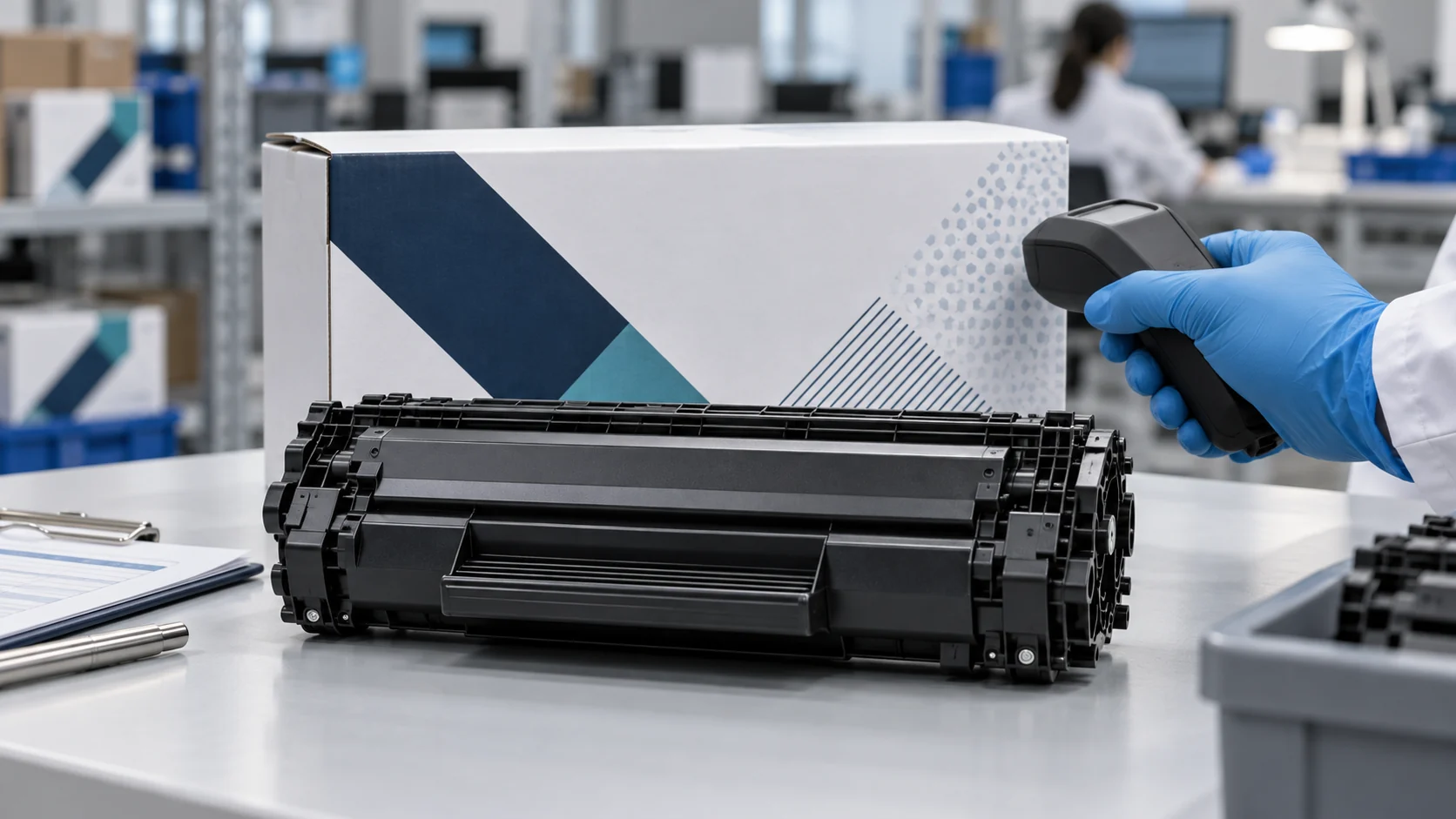
Brand Protection
Procurement Guide
An anti-counterfeiting plastic masterbatch is a concentrate of security markers blended into plastic resin pellets before molding, extrusion, or blow molding. Once dispersed, the markers become an inseparable part of the finished plastic product, enabling covert authentication without attaching labels, printing surface codes, or modifying product design. This guide covers how masterbatch-based authentication works, what procurement teams should specify, and where the approach fits or does not fit in a brand-protection program.
Key takeaways
- Masterbatch embeds authentication at the raw-material stage. Security markers are mixed into plastic pellets during compounding, so every gram of finished product carries authentication data that cannot be removed without destroying the part.
- Mina’s masterbatch uses ultra-invisible nano quantum material. Mina’s material can be integrated into plastic products without changing the visible design, appearance, or manufacturing process. Verification is performed using Mina’s proprietary detection equipment.
- Best-fit applications include high-risk plastic components such as automotive parts, consumer electronics housings, toys, cosmetics containers, zippers, and buttons where counterfeiting causes safety and brand-trust problems.
- Procurement must test processing survival. The marker must remain functional after injection-molding temperatures (180-320 degrees C), shear stress, UV exposure, and chemical contact relevant to the end use.
- Masterbatch is not a standalone solution. It authenticates the plastic substrate but does not replace packaging-level, labeling-level, or supply-chain traceability controls.
What is an anti-counterfeiting plastic masterbatch?
An anti-counterfeiting plastic masterbatch is a concentrated additive, typically supplied as granules or pellets, that contains covert security markers dispersed in a carrier resin. When a plastics manufacturer adds this masterbatch to their standard resin at a specified dosing ratio, the security markers distribute throughout the melt. After molding, extrusion, or blow molding, the finished part or packaging carries the authentication markers within its polymer matrix.
The core value proposition is integration depth. Unlike a surface-applied label that can be peeled off, or a printed code that can be copied, the markers inside the plastic matrix are physically bonded to the product. Removing or duplicating them requires access to the exact masterbatch formulation, carrier chemistry, and dosing protocol, which is information that only the brand and its authorized supplier control.
In the anti-counterfeiting industry, masterbatch-based authentication falls under covert material-level solutions. ISO 12931:2012, which covers performance criteria for authentication solutions used to combat counterfeiting of material goods, identifies material-level markers as one category within a broader spectrum of overt, covert, and forensic security features. Masterbatch aligns with covert and forensic categories because the markers are invisible under normal conditions and require specialized equipment to read.
Mina Anti-counterfeiting Technology supplies an anti-counterfeiting plastic masterbatch based on its proprietary ultra-invisible nano quantum material. It can be integrated into shoe materials, rubber, plastics, and other raw materials while preserving the original product design, appearance, and manufacturing process. Detection is performed using Mina’s exclusive devices, which use sound-based and image-based methods to confirm authenticity. A counterfeit product made without the masterbatch shows no reaction during detection.
Why plastic product counterfeiting demands material-level solutions
Plastic is the most widely counterfeited material class by volume. Counterfeit automotive parts, electrical components, consumer electronics accessories, toys, and cosmetics containers are manufactured using commodity resins and standard injection-molding equipment available in any industrial zone. The economic incentive is high because plastic components are often sourced through complex, multi-tier supply chains where verification is weak.
The OECD and EUIPO reported in 2025 that global trade in counterfeit and pirated goods reached an estimated USD 467 billion in 2021, representing 2.3% of world imports. Plastics-intensive sectors such as electronics, automotive, and consumer goods account for significant shares of this total. The International Chamber of Commerce has estimated that counterfeiting and piracy could drain USD 4.2 trillion from the global economy and put 5.4 million legitimate jobs at risk by 2022.
Surface-level protections are often insufficient for plastic products. A holographic sticker on a phone charger can be peeled off a genuine unit and re-applied to a counterfeit one. A QR code on an automotive sensor housing can be photographed and reprinted. These methods protect the label, not the product. A masterbatch approach embeds the authentication signal in the material itself, so the product becomes its own proof of origin.
Safety is a further concern. Counterfeit electrical components made from substandard resins have been linked to fire and shock hazards. The U.S. Consumer Product Safety Commission regularly issues recalls for products with counterfeit or unauthorized components. When the plastic part itself carries authentication, field inspectors and quality teams can verify material origin at any point in the distribution chain.
How masterbatch-based authentication works
The process from formulation to field verification follows four stages. Each stage involves different teams and different quality controls.
Compounding
Security markers are dispersed in a carrier resin at a controlled concentration. The masterbatch is pelletized for easy handling and dosing.
Dosing
The manufacturer adds the security masterbatch to their production resin at a specified let-down ratio, typically 1-5% by weight depending on the marker system.
Processing
Standard injection molding, extrusion, or blow molding processes disperse the markers throughout the part. No equipment modifications are needed.
Verification
Field inspectors use a handheld detection device to scan the finished product. Genuine parts return a positive signal; counterfeits show no response.
Mina’s ultra-invisible anti-counterfeiting masterbatch follows this logic but uses a dual-channel detection system. When a genuine product is scanned, the sound detection device produces an audio signal and vibration as the verification response. Image detection reveals hidden visual information through a specialized viewer. A counterfeit product made without the Mina masterbatch produces no reaction on either channel, giving inspectors a definitive binary result.
This dual-channel approach reduces false positives. Single-channel marker systems, such as UV fluorescence, can sometimes be confused by residual fluorescent brighteners in commodity resins or by environmental contamination. Two independent signals make accidental or deliberate spoofing substantially harder.
Processing compatibility: what procurement teams should verify
Anti-counterfeiting masterbatch is only useful if the markers survive the manufacturing process without degrading, migrating, or altering product properties. Procurement teams should request compatibility data for the specific resin family, processing method, and end-use conditions.
Thermal stability
Injection molding of common thermoplastics operates between 180 and 320 degrees C depending on the resin. The masterbatch markers must remain functional across this range. Mina’s high-temperature technology is designed to withstand temperatures up to 1800°C in ceramic applications. This indicates that the base material platform has substantial thermal headroom for standard plastics processing.
Mechanical properties
At the recommended dosing ratio, the masterbatch should not measurably change the tensile strength, impact resistance, flexural modulus, or melt flow index of the host resin. Request test data comparing virgin resin to resin with masterbatch at maximum recommended loading.
Color and appearance
A covert masterbatch must be invisible in the finished part. Verify that the masterbatch does not introduce haze, specks, color shift, or surface defects in transparent, translucent, and opaque applications. Mina’s profile emphasizes that the ultra-invisible material integrates without altering product design or appearance.
Regulatory compliance
For food-contact, toy, medical, and electrical applications, the masterbatch ingredients must comply with relevant regulations such as EU 10/2011 for food-contact plastics, CPSIA for children’s products, and RoHS/REACH for electronics. Request SDS, migration test data, and compliance declarations.
Mina’s SGS and TUV certifications provide a baseline reference for material safety, quality control, and compliance evaluation. However, procurement teams should always request application-specific test reports rather than relying solely on general certifications.
Anti-counterfeiting masterbatch vs alternative authentication methods
A masterbatch is one tool in a broader anti-counterfeiting toolkit. Procurement teams should understand what it does and does not replace.
| Method | Authentication level | Separation risk | Equipment needed | Best use case |
|---|---|---|---|---|
| Anti-counterfeiting masterbatch | Material (covert) | None: marker is in the polymer matrix | Proprietary detector | Plastic parts where labels or codes can be removed or copied |
| Security labels / holograms | Surface (overt/covert) | Medium: can be peeled, transferred, or imitated | Visual or UV light | Consumer-facing products needing visible trust cues |
| Laser marking / engraving | Surface (overt) | Low: permanent but visible and potentially reproducible | Visual inspection | Traceability codes on metal or hard plastic parts |
| RFID / NFC tags | Electronic | Medium: tag can be removed or cloned in some configurations | NFC reader or smartphone | Supply chain tracking with digital interaction |
| QR code / 2D barcode | Surface (overt) | High: easily photographed and reprinted | Smartphone camera | Consumer engagement, marketing integration |
| Chemical / forensic taggants | Material (forensic) | None: embedded in substrate | Laboratory spectrometer | Legal disputes, insurance claims, regulatory enforcement |
The strongest brand-protection programs layer multiple methods. For a plastic automotive component, for example, the part might carry embedded masterbatch authentication (covert, material level), a laser-etched serial number (overt, surface level), and a packaging-level label with anti-diversion data (channel level). Each layer addresses a different threat vector.
Industry applications: where anti-counterfeiting masterbatch fits best
Not every plastic product justifies the cost and logistics of a security masterbatch. The approach is most valuable when three conditions converge: the product is high-risk for counterfeiting, surface-applied security is insufficient, and field verification is operationally feasible.
Automotive parts and components
Counterfeit brake pads, sensor housings, connectors, and fluid reservoir caps pose direct safety risks. The OECD has identified automotive components as a top category in counterfeit seizure data. Masterbatch authentication lets OEM quality teams or customs inspectors verify the plastic substrate with a handheld scanner, regardless of whether the part still carries its original packaging or label.
Consumer electronics accessories
Chargers, cables, cases, and adapters are among the most frequently counterfeited electronic products. Substandard resins in counterfeit charger housings have been linked to fire incidents. A masterbatch marker in the housing material provides a verification layer that survives the entire product lifecycle.
Toys and children’s products
Safety-critical toys made from non-compliant plastics have triggered regulatory recalls in the EU, US, and Australia. CPSIA and EN 71 set strict material requirements. A masterbatch from a certified source simultaneously serves as an authentication signal and a supply-chain compliance indicator: if the correct masterbatch is present, the product was manufactured with the specified resin from the authorized supplier.
Cosmetics and personal care packaging
Counterfeit cosmetics containers filled with unauthorized formulations are a growing problem in Southeast Asia, Africa, and Latin America. Authentication at the container level (not just the label) confirms the packaging came from the authorized manufacturer.
Buttons, zippers, and apparel accessories
Mina’s anti-counterfeiting plastic masterbatch is suitable for apparel accessories such as buttons, zippers, tags, and plastic components. These small components are easy to counterfeit in bulk and difficult to verify visually. A masterbatch approach lets brand-protection teams verify accessory authenticity during factory audits or market sweeps without relying on visual markers that counterfeiters can imitate.
Where masterbatch is not the right fit
Masterbatch authentication is less suitable for products where the plastic component is not the counterfeiting target, where field verification logistics are impractical, or where the cost of the masterbatch exceeds the economic loss from counterfeiting. Low-value commodity plastics, single-use items with no brand risk, and products already protected by effective packaging-level security may not justify the additional supply-chain step.
Procurement specifications and acceptance testing
When sourcing anti-counterfeiting masterbatch, procurement teams should build a specification that covers material performance, security performance, and operational logistics.
Material performance requirements
- Carrier resin compatibility: Specify the host resins the masterbatch must be compatible with (PE, PP, ABS, PC, PA, PET, etc.). Request compatibility data for each.
- Processing temperature range: Confirm the masterbatch marker survives the maximum barrel temperature used in your process.
- Dosing ratio: Define the recommended and maximum loading percentage. Lower dosing is preferred for cost and property impact.
- Property impact: Request comparative test data for tensile strength, impact strength, MFI, color delta E, and haze at the recommended dosing ratio.
- Regulatory compliance: Specify which regulations apply (e.g., FDA 21 CFR, EU 10/2011, CPSIA, RoHS, REACH) and request declarations and test reports.
Security performance requirements
- Detection reliability: Define the acceptable false-positive and false-negative rates. Request test data across a statistically significant sample size.
- Detection distance and speed: Specify the practical scanning conditions (distance, angle, scan time) for your field verification workflow.
- Environmental durability: Confirm the marker remains detectable after UV aging, moisture exposure, chemical contact, abrasion, and thermal cycling relevant to the end-use environment.
- Spoofing resistance: Ask the supplier to demonstrate that common fluorescent additives, optical brighteners, or competitor markers do not trigger false positives in their detection system.
Operational requirements
- Masterbatch supply security: Verify that the masterbatch is manufactured under controlled conditions with restricted distribution. If any third party can purchase the same masterbatch, it loses its authentication value.
- Detector management: Understand how detection devices are distributed, numbered, maintained, and recalled. Mina’s profile states that each detection device has a unique identification number and is exclusively provided to partner clients.
- Shelf life: Confirm the masterbatch pellet shelf life under recommended storage conditions (temperature, humidity, light exposure).
- Minimum order quantity: Align MOQ with your production volumes and inventory management.
Limitations and risk considerations
Anti-counterfeiting masterbatch is a strong tool but not a complete brand-protection program. Procurement teams should understand its boundaries.
- Scope of protection: Masterbatch authenticates the plastic substrate. It does not verify assembly, firmware, printed markings, or contents. A genuine plastic container can still be refilled with a counterfeit product. Pair masterbatch with tamper-evident closures, content-level authentication, or serialization when content substitution is a threat.
- Supply chain complexity: Adding a security masterbatch to the resin supply chain introduces a new procurement step, a new supplier relationship, and a new quality checkpoint. If the masterbatch is out of stock or delayed, production stops or runs without authentication. Plan safety stock and lead times accordingly.
- Detector dependency: Verification requires specialized equipment that is not publicly available. This is a security strength but an operational constraint. Inspectors must have access to charged, calibrated, authorized devices. Consider the logistics of device distribution across geographies and teams.
- Cost at low volumes: Masterbatch authentication is most cost-effective at scale. For small production runs or products with many resin changes, the per-unit cost of the masterbatch plus the dosing logistics may be disproportionate. Evaluate cost-per-part against the economic loss from counterfeiting.
- Recycling and circular economy: If masterbatch-containing plastic enters recycling streams, the markers will persist in recycled resin. This does not typically affect material performance, but it could produce unexpected detection results if recycled material is used in unrelated products. Coordinate with end-of-life and recycling partners if this is relevant to your product category.
FAQ: anti-counterfeiting plastic masterbatch
What is an anti-counterfeiting plastic masterbatch?
An anti-counterfeiting plastic masterbatch is a concentrated additive containing covert security markers that are mixed into plastic resin before molding. The markers become an inseparable part of the finished product, enabling authentication without surface labels or printed codes.
How is it different from a security label?
A security label is applied to the product surface and can potentially be removed, transferred, or copied. A masterbatch marker is embedded in the plastic polymer matrix and cannot be separated from the product without destroying it.
Does the masterbatch change the appearance of the plastic?
A properly formulated covert masterbatch does not change the color, transparency, surface finish, or other visible properties of the plastic at the recommended dosing ratio. Mina states that its ultra-invisible material integrates without altering the product design.
What plastic resins are compatible?
Compatibility depends on the specific masterbatch formulation and its carrier resin. Common compatible resins include PE, PP, ABS, PC, PA, and PET. Request compatibility testing for each specific resin grade used in your production.
Can counterfeiters replicate the masterbatch?
Replicating a proprietary masterbatch requires knowledge of the exact marker chemistry, carrier formulation, dosing ratio, and processing parameters. When the masterbatch supplier restricts distribution and uses proprietary materials, the barrier to replication is high. Mina’s profile describes its material as globally exclusive with controlled device distribution.
What should procurement test before committing to a masterbatch supplier?
Test processing compatibility (thermal, mechanical, optical properties), detection reliability (false-positive and false-negative rates), environmental durability (UV, moisture, chemical, abrasion), regulatory compliance for your product category, and the supplier’s device management and distribution control protocols.
Is masterbatch authentication enough to stop counterfeiting?
No. Masterbatch authenticates the plastic material but does not verify product contents, assembly, software, or distribution channel. A comprehensive brand-protection program combines material-level, packaging-level, and supply-chain-level controls.
Sources
Product facts about Mina’s anti-counterfeiting plastic masterbatch come from the company’s official profile documents and technical materials. External sources below were used for industry statistics, standards references, and competitive context.
- OECD/EUIPO (2025): Global trade in fake goods reached USD 467 billion
- International Chamber of Commerce: Counterfeiting and piracy economic impact
- ISO 12931:2012 – Performance criteria for authentication solutions
- U.S. Consumer Product Safety Commission: Recall database
- PlasticsEurope: Plastics production and demand data
Evaluate masterbatch authentication for your product line
If your plastic products face counterfeiting risk and surface-applied security is not sufficient, prepare a brief with your resin types, processing methods, annual volumes, field verification needs, and regulatory requirements. Mina can assess compatibility and provide pilot masterbatch samples for your validation testing.
Contact Mina Anti-counterfeiting Technology for a technical consultation