Visible security printing for fast authentication
Optically Variable Ink for Security Printing
Optically variable ink is a visible anti-counterfeiting ink that changes color when the printed feature is viewed from different angles. For secure documents, cards, receipts, tax stamps, and high-value packaging, it gives inspectors and users a fast “tilt-and-check” feature that does not require specialized equipment.
Documents, cards and receipts
Visual tilt check
Overt anti-copy authentication
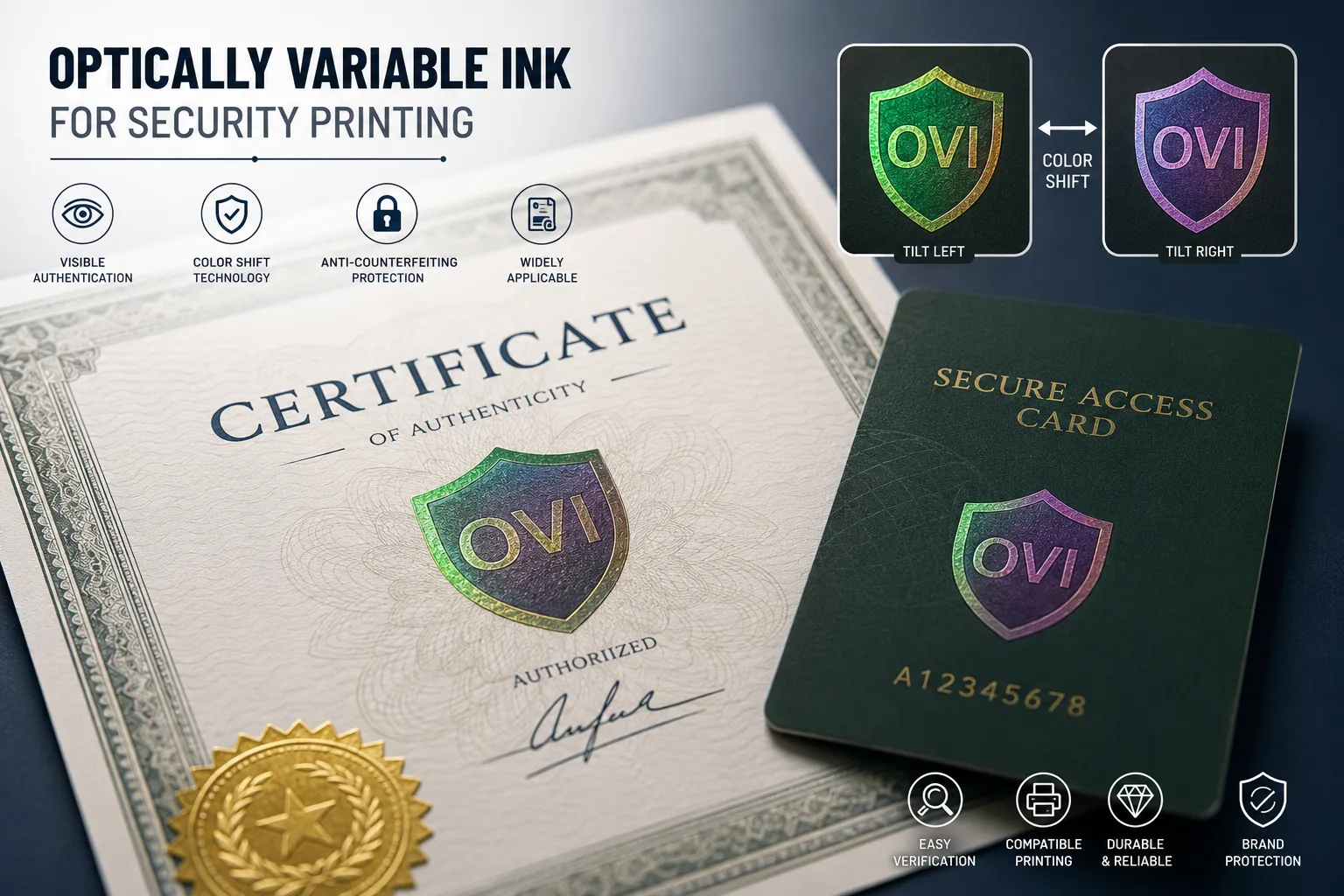
Optically variable ink creates a visible color-shift effect for quick document and packaging authentication.
What it protects
Certificates, cards, receipts, tax stamps, vouchers, tickets, currencies, official forms, and selected premium packaging.
Why it matters
OVI gives front-line users a fast visible cue that ordinary scanning, photocopying, and flat reprinting cannot reproduce well.
How it works
The printed feature displays different colors when viewed from different angles, allowing a simple tilt-and-check inspection.
Best use case
Documents or packaging that need an overt, easy-to-check security layer without requiring detectors or special equipment.
Key takeaways for procurement teams
- OVI is an overt, visual security feature. It is designed to be checked by tilting the printed item and observing a color change.
- Mina’s supplied profile states that the printed image displays two distinct colors as the viewer’s perspective changes.
- OVI does not need specialized reading equipment, making it useful for public-facing and front-line inspection.
- Best-fit applications include currencies, receipts, cards, certificates, tax stamps, secure tickets, and selected premium packaging.
- Procurement should specify color pair, viewing angle, print process, placement, wear resistance, and anti-copy acceptance tests.
What is optically variable ink?
Optically variable ink, often shortened to OVI, is a security printing ink that shows different colors when viewed from different angles. It is also called color-shifting ink. Unlike UV or infrared security inks, OVI is meant to be visible and intuitive: a user tilts the document and checks whether the printed mark changes color as expected.
As an overt security feature, optically variable ink changes between two distinct colors as the viewing angle changes. This visible color-shift effect provides a clear first-level authentication feature that users can recognize without specialized equipment.
Public security-printing references support the same search intent. The EUIPO Anti-Counterfeiting Technology Guide explains that OVI and iridescent inks use pigments that appear as two different colors from contrasting angles, and that copiers and scanners cannot replicate the color-change effect. Louisenthal describes OVI printed features as proven anti-copy security features for banknotes. VIAVI positions optically variable pigments for banknotes and high-value documents.
Why visible color-shift security still matters
Not every authentication event can use a detector, scanner, database, or laboratory. A cashier, election official, gate checker, document recipient, customs staff member, or retail employee may need a fast visual cue. OVI is useful because it supports immediate human inspection: tilt the item and compare the color shift against the known genuine feature.
Visible features also build user trust. A high-security document that contains only hidden marks can be strong for expert inspection but hard for public users to understand. OVI gives the document a visible proof point while allowing covert layers such as NIR, ultra-invisible information, microtext, or special paper to support deeper verification.
The economic reason is straightforward. OECD and EUIPO reported in 2025 that global trade in counterfeit goods reached an estimated USD 467 billion in 2021, equal to 2.3% of world imports. In secure documents, the risk is not only lost sales. It can include fake credentials, forged receipts, tax-stamp fraud, ticket reuse, card forgery, and loss of trust in issuers.
How Mina’s optically variable ink works
Mina’s OVI feature creates a printed image that displays different colors as the viewing perspective changes. The feature can be checked without special equipment, making it a first-level anti-counterfeiting layer for documents and printed products that need fast visual authentication.
The supplied profile highlights strong visual anti-counterfeiting capability, clear presentation, broad compatibility, high replication difficulty, and easy recognition. This makes OVI a practical option when the buyer needs a visible feature that is harder to reproduce with ordinary printing, scanning, or copying.
OVI should not be treated as a decorative effect. Procurement should define the exact color pair, placement, size, print process, viewing angle, light condition, and pass/fail standard. If the feature is used on a certificate, card, receipt, tax stamp, or ticket, the inspector should know what genuine color shift looks like and what common fakes look like.
Best-fit applications for OVI security printing
Certificates and official forms
OVI can give public-facing documents a visible authenticity cue that recipients can inspect without a device.
Receipts, vouchers, and tax stamps
Financial and tax-related documents can use angle-dependent ink to deter scanning, copying, and flat reprinting.
Cards and identity-related documents
Cards, permits, passes, and access documents can combine OVI with lamination, microtext, serials, and covert features.
Secure tickets and premium packaging
Event tickets, transport tickets, limited editions, and high-value packaging can use a visible color-shift feature for quick checks.
OVI vs hologram, UV, NIR, serial number, QR, and thermochromic ink
| Feature | Best use | Main weakness | Procurement guidance |
|---|---|---|---|
| Optically variable ink | Visible color-shift authentication without equipment | Feature is public, so counterfeiters know where to imitate | Use as a strong overt layer and pair with covert checks for high-risk documents |
| Hologram or OVD | Visible optical effect and premium document appearance | Can require controlled foil supply and may be imitated at lower quality | Good companion to OVI when visual complexity is important |
| UV fluorescent ink | Quick detector-assisted check with UV lamp | UV inspection tools are common and feature may be easier to search for | Useful second-level feature, but not a replacement for visible tilt checks |
| NIR security ink | Covert machine-assisted verification | Requires infrared equipment and operator control | Pair with OVI when both public and restricted inspection are needed |
| Serial number or QR code | Traceability, lookup, and issuance control | Visible data can be copied if platform rules are weak | Use with physical security so copied numbers are not enough |
| Thermochromic ink | Temperature-triggered visible change | Requires contact or heat/cold trigger, not always convenient | Useful as a secondary public demonstration feature |
Procurement checklist for OVI projects
- Document or product type: define certificate, receipt, card, tax stamp, ticket, voucher, currency, or packaging carrier.
- Inspection audience: decide whether the feature is for consumers, front-line staff, government officials, auditors, or brand-protection teams.
- Color pair: specify expected colors at defined viewing angles and acceptable color tolerance.
- Placement: choose a visible area that is easy to tilt and inspect but hard to remove or replace.
- Print process: validate screen, intaglio, offset, gravure, or hybrid production depending on the substrate and ink system.
- Substrate compatibility: test paper, security paper, plastic card, coated paper, laminated card, label stock, or packaging board.
- Layer interaction: test OVI against varnish, foil, lamination, embossing, UV ink, microtext, serials, and background graphics.
- Copy resistance: compare genuine samples against scans, photocopies, digital reprints, and low-quality imitations.
- Wear resistance: test abrasion, folding, handling, moisture, cleaning, and storage conditions.
- Training: prepare a simple reference guide showing genuine angle A, genuine angle B, and common fake responses.
Acceptance testing before mass production
Test the visible effect
Use real production stock, real ink, real finishing, and the lighting conditions expected in field use.
Compare against copy samples
Include genuine samples, blank controls, scanned reprints, color-copied samples, altered samples, and worn genuine samples.
Confirm angle-based color shift
A genuine OVI feature should show a strong and specific color transition, while a copy usually appears flat, weak, or inconsistent.
Validate human usability
Ask the actual inspection audience to identify genuine and fake examples after short training.
How OVI fits into a layered document program
OVI is a first-level visual feature. That means it is excellent for public or front-line checks, but it should not be the only evidence layer for high-risk documents. A strong architecture pairs OVI with a second layer such as UV fluorescence, microtext, watermark, serial number, QR lookup, NIR security ink, or Mina ultra-invisible information.
Layering also helps different audiences. A recipient can tilt the document and see the color change. A cashier or gate checker can compare the OVI mark to a reference. A document examiner can use magnification, UV, NIR, or covert reading equipment. A compliance team can check serial issuance and custody records. Each layer answers a different question.
For procurement, the key is not to buy every feature. The key is to match features to the threat model. If counterfeiters are scanning and reprinting certificates, OVI and microtext are helpful. If genuine blank stock is leaking, serial control and custody procedures matter. If public imitation is common, OVI creates a visible barrier while covert features support deeper investigation.
Design and training decisions buyers often miss
OVI performance depends on design discipline. The feature should be large enough to show a clear color shift, but not so large that cost becomes unnecessary. It should sit away from busy background graphics, heavy varnish glare, folds, perforations, or areas that users naturally cover with a finger. If the document is laminated, the lamination must be tested because surface reflection can make the color shift harder to see.
Training should be visual and specific. A short reference card can show “angle A,” “angle B,” and “fake copy” examples. For public-facing documents, the instruction can be simple: tilt the mark and look for the named color change. For official inspection, training should also show weak imitations, worn genuine marks, damaged marks, and common photocopy responses. This small training asset often determines whether a strong OVI feature is actually used in the field.
Limitations and practical risks
OVI can be more expensive than ordinary ink and is often used in controlled areas rather than across a full document. Procurement should therefore choose a placement that gives maximum authentication value without wasting coverage on low-risk areas.
The second risk is weak training. A color-shift feature only works when users know what to look for. A vague instruction such as “check the color” is not enough. Training should show the expected color pair, angle, lighting, and common fake responses.
The third risk is treating OVI as secret. OVI is overt by design. Counterfeiters can see where it is, but they should not be able to reproduce the effect well. For high-value documents, pair it with hidden features that are not publicly visible.
FAQ: optically variable ink for security printing
What is optically variable ink?
Optically variable ink is a security ink that changes color when viewed from different angles. It is a visible anti-counterfeiting feature used on documents, cards, receipts, tax stamps, currencies, and high-value printed items.
Does OVI require special equipment?
No. OVI is usually checked visually by tilting the document. Mina’s supplied profile states that the feature can be identified without specialized equipment.
Why is OVI hard to copy?
OVI depends on angle-dependent light reflection. Ordinary scanners, photocopiers, and flat digital reprints do not reproduce the same color-shift behavior.
Where should OVI be placed?
Place it in a visible area that is easy to tilt and inspect but difficult to remove or replace. The feature should not be hidden under heavy graphics, lamination glare, or poor lighting conditions.
Is OVI better than holograms?
OVI and holograms serve similar overt-authentication roles but create different optical effects. Many high-security documents use multiple visible and covert features instead of choosing only one.
What should procurement test first?
Test color pair, viewing angle, print process, substrate, finishing, copy resistance, abrasion, user training, and comparison against scanned or photocopied samples.
Sources and evidence used
- EUIPO: OVI and iridescent inks
- Louisenthal: printed security features using OVI
- VIAVI: optically variable pigments for banknotes and high-value documents
- Printcolor: security inks for secure documents
- Optaglio: security and background printing with optically variable inks
- OECD/EUIPO: global trade in fake goods reached USD 467 billion in 2021
Next step for OVI security printing projects
If your certificate, receipt, card, tax stamp, ticket, voucher, or secure package needs a visible color-shift authentication feature, prepare a brief with substrate, print process, desired color pair, inspection audience, threat model, and pilot quantity. Mina can then evaluate an optically variable ink pilot for your production conditions.