Security documents and official printing
Near infrared anti-counterfeiting ink is a covert security printing feature that stays invisible or unobtrusive in normal viewing conditions and becomes readable only under near-infrared inspection. For certificates, ballots, tax stamps, tickets, identity documents, and official forms, it gives procurement teams a hidden verification layer that is harder to discover than ordinary visible marks.
Documents, ballots and tax stamps
IR light plus camera or detector
Covert document authentication
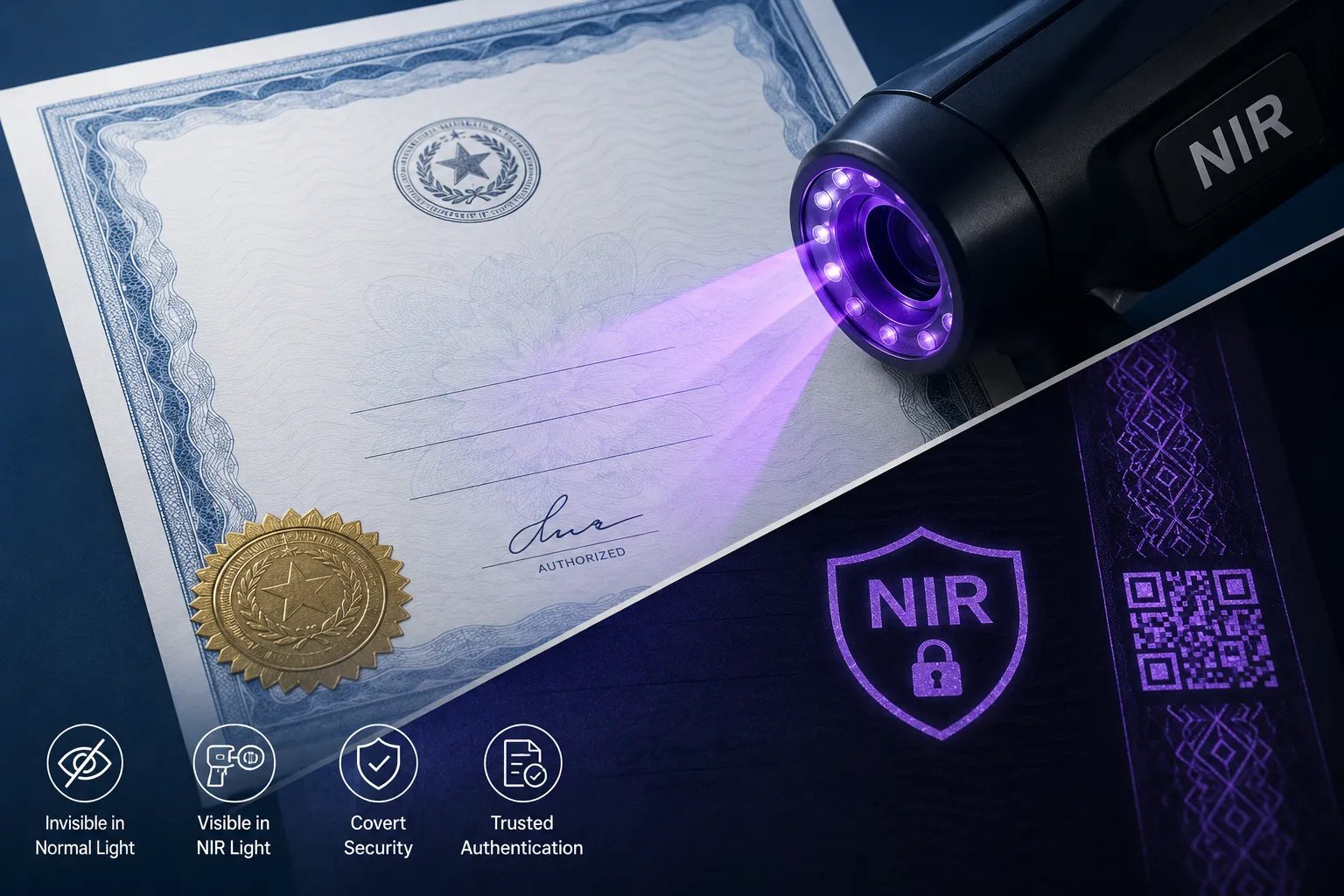
NIR anti-counterfeiting ink creates hidden infrared-readable marks for controlled document authentication.
What it protects
Certificates, ballots, tax stamps, tickets, passports, visas, identity cards, official forms, vouchers, and secure printed documents.
Why it matters
Visible features can be copied, scanned, imitated, or searched by counterfeiters. NIR marks stay hidden from ordinary inspection.
How it works
Hidden images, text, codes, or machine-readable marks become readable only under near-infrared illumination and detector inspection.
Best use case
Government, security printing, financial, and official-document programs that need restricted verification by authorized teams.
Key takeaways for procurement teams
- NIR anti-counterfeiting ink is a security document feature, not a consumer packaging code. It is best for controlled inspection by officials, printers, auditors, and enforcement teams.
- Mina’s supplied ballot proposal defines NIR as a near-infrared optical material in the 780 nm to 2500 nm range used for invisible image anti-counterfeiting printing.
- The mark is invisible to the naked eye and requires a dedicated infrared light source plus infrared camera or detector.
- Best-fit applications include ballots, certificates, tax invoices, vouchers, tickets, passports, visas, identity cards, security paper, and confidential documents.
- Procurement should test NIR readability, copy resistance, substrate compatibility, detector governance, and chain-of-custody fit before mass production.
What is near infrared anti-counterfeiting ink?
Near infrared anti-counterfeiting ink is a security ink or optical material designed to create hidden images, text, codes, or machine-readable marks that are not visible under normal light but can be detected under near-infrared illumination. It is used when a document needs a covert authentication layer that counterfeiters are unlikely to discover by casual inspection.
In Mina’s presidential ballot source file, NIR near-infrared technology is described as invisible image anti-counterfeiting printing using optical materials in the 780 nm to 2500 nm range. The same source states that the mark is invisible to the naked eye and can be read only with a dedicated infrared light source plus infrared camera or detector. That makes NIR useful for controlled official inspection rather than public visual checking.
Public security printing sources describe a similar principle. Vrijdag explains that infrared ink can be visible or invisible and requires IR-sensitive equipment. Printcolor describes infraCRYPT inks as selective in the near-infrared range and authenticated with infrared cameras. Epolin positions NIR optical dyes for secure documents, certificates, credentials, tax stamps, packaging authentication, and high-value printing.
Why security documents need a covert NIR layer
Security documents are copied because they create rights, access, payments, identity, or authority. A counterfeit certificate can support fake qualification claims. A forged tax invoice can support fraud. A copied ticket or voucher can create financial loss. A fake official form can damage public trust. A counterfeit ballot or election document can create operational and reputational risk even if it is detected later.
Visible features are useful, but visible features reveal where counterfeiters should look. A hologram can be imitated. A seal can be scanned. A serial number can be copied if numbering rules are weak. A UV feature can be tested with inexpensive lamps. A NIR layer gives the document owner a less obvious inspection point that requires the right wavelength, optics, and reference criteria.
The broader counterfeit trade provides the economic context. OECD and EUIPO reported in 2025 that counterfeit goods represented an estimated USD 467 billion in global trade in 2021, equal to 2.3% of world imports. Security documents are a narrower category, but the same counterfeiting logic applies: when the document unlocks value, counterfeiters will attack the easiest proof point.
How Mina’s NIR anti-counterfeiting layer works
Mina’s NIR layer is designed for invisible image security printing. In the supplied ballot proposal, the mark uses near-infrared optical material and is not visible under ordinary viewing. Only a dedicated infrared light source plus an infrared camera or detector can read it. This separates public document use from restricted authentication.
That separation is valuable for official documents. A voter, driver, passenger, customer, or certificate holder should not need to understand the hidden security feature. The document should work normally. An election official, document examiner, customs officer, issuer, bank, or authorized auditor can use dedicated equipment when a document is suspicious or selected for sampling.
For ballot applications, the NIR layer can work together with other Mina security printing features to create a multi-layer authentication system: ultra-invisible information, watermarks, fluorescent features, microtext, temperature-sensitive ink, security threads, unique serial numbers, anti-copy backgrounds, optically variable ink, special security paper, and holographic technology. NIR should be treated as one restricted verification layer inside a broader document-security stack.
Best-fit applications for NIR security ink
Ballots and election documents
NIR hidden images can support official authentication of ballots, ballot certificates, return envelopes, custody forms, and other election materials.
Certificates and official forms
Education certificates, professional licenses, government permits, approvals, and notarial documents can use NIR inspection to detect copied forms.
Tax stamps and financial receipts
Tax invoices, receipts, vouchers, and payment-related documents can use hidden IR-readable marks to support issuer-controlled verification.
Identity and access documents
Passports, visas, ID cards, driver licenses, access passes, and secure tickets can add NIR features as part of a layered inspection workflow.
NIR security ink vs UV, OVI, holograms, serial numbers, QR, and microtext
Procurement teams should compare security features by inspection audience. Public features help ordinary users notice authenticity cues. Restricted features help authorized teams make evidence-based decisions. NIR belongs mainly in the restricted inspection category.
| Feature | Best use | Main weakness | Procurement guidance |
|---|---|---|---|
| UV fluorescent ink | Quick low-cost inspection with UV lamps | UV lamps are common, so counterfeiters may search for and imitate the feature | Use as a secondary layer, but do not rely on UV alone for high-security documents |
| Optically variable ink | Public visual verification with color-shift effect | Visible feature reveals the inspection target | Excellent overt cue when paired with covert features |
| Hologram or foil | Visible anti-copy cue and premium document appearance | Quality varies, and low-quality imitations may still fool non-experts | Specify supplier control, design complexity, and tamper behavior |
| Serial number or QR code | Traceability, lookup, and document registration | Visible data can be copied unless query logic and issuance control are strong | Use with verification rules and physical security printing |
| Microtext | Fine-detail anti-copy inspection | Requires magnification or trained review | Good low-profile layer for printed documents |
| NIR anti-counterfeiting ink | Covert infrared-readable authentication for authorized inspectors | Requires equipment, calibration, and controlled access | Best for high-security documents that need hidden machine-assisted verification |
Procurement checklist for NIR security document projects
- Document type: define ballot, certificate, tax stamp, receipt, voucher, ticket, ID document, or security paper.
- Threat model: identify photocopying, scanning, digital reprint, unauthorized blank stock, document alteration, or issuance fraud.
- NIR function: decide whether the hidden mark is an image, text, logo, serial reference, barcode, or machine-readable control area.
- Wavelength and detector: specify the infrared light source, camera or detector, image response, and acceptable read criteria.
- Substrate compatibility: test paper, security paper, plastic card, coating, varnish, lamination, and overprint layers.
- Print process: validate offset, screen, intaglio, digital, inkjet, gravure, or hybrid printing depending on the document program.
- Layer interaction: test whether UV, OVI, thermochromic ink, microtext, watermark, or lamination interferes with the NIR feature.
- Inspection audience: define who can read the mark, who can interpret results, and who can escalate suspect documents.
- Equipment governance: control detector issuance, calibration, storage, training, device IDs, and inspection logs.
- Counterfeit controls: test copied documents, scanned reprints, altered marks, genuine blank leaks, and damaged genuine samples.
Acceptance testing before production approval
Use real production materials
Test real document stock, real inks, real print process, real finishing, and the actual detector model rather than artwork proofs only.
Prepare genuine and control samples
Include genuine samples, blank controls, photocopies, scanned reprints, overprinted samples, damaged samples, and handled documents.
Record inspection results
For each group, record detection result, read time, false rejection, false acceptance, image clarity, operator notes, and environmental conditions.
Define field decision rules
Clarify whether a failed NIR check means counterfeit, unreadable, supervisor review, or laboratory escalation.
Detector governance and evidence control
NIR security ink requires equipment governance. The buyer should decide how many infrared readers are needed, which offices receive them, how they are calibrated, how training is documented, and how results are stored. If the detector is part of an enforcement process, device custody and operator identity matter.
Access should be tiered. A front-line inspector may need a simple pass/fail response. A document examiner may need the hidden image, wavelength settings, device ID, and reference sample. A legal or compliance team may need an evidence report with photos, timestamps, chain-of-custody notes, and suspect-document handling.
Keep restricted information restricted. Public documents can say that a document includes hidden infrared authentication, but the exact location, wavelength response, reference image, and detector settings should be available only to authorized personnel. Covert security weakens when too many parties know exactly how to find and reproduce it.
Limitations and practical risks
NIR anti-counterfeiting ink is powerful, but it is not a complete security program by itself. It must be integrated with controlled document stock, secure printing, numbering, issuance control, custody records, and audit procedures. A genuine NIR mark on leaked blank stock can still create risk if blank stock is not controlled.
The second limitation is optical variability. Paper brightness, coatings, lamination, ink laydown, detector sensitivity, ambient light, and camera settings can change the read result. Procurement should require production-like testing and documented tolerances before launch.
The third limitation is inspection friction. If only one office has a reader, field teams may not use the feature. If every distributor has a reader, restricted knowledge may spread too widely. The right deployment balances security, speed, and confidentiality.
FAQ: NIR anti-counterfeiting ink for security documents
What is NIR anti-counterfeiting ink?
NIR anti-counterfeiting ink is a security printing material that creates hidden infrared-readable marks. The mark is not visible in normal viewing conditions and requires a near-infrared light source plus a camera or detector for authentication.
What wavelength range does Mina’s NIR source mention?
Mina’s supplied presidential ballot proposal describes NIR near-infrared optical material in the 780 nm to 2500 nm range for invisible image anti-counterfeiting printing.
How is NIR different from UV fluorescent ink?
UV fluorescent ink is checked with ultraviolet light, which is widely available. NIR features require infrared illumination and camera or detector equipment, making the feature less obvious to counterfeiters.
Which documents are the best fit?
Best-fit documents include ballots, certificates, tax stamps, official forms, vouchers, tickets, passports, visas, driver licenses, ID cards, security paper, and confidential documents.
Can NIR ink replace serial numbers?
No. NIR ink proves a hidden physical feature, while serial numbers support traceability and issuance control. High-security documents usually need both physical authentication and data control.
What should procurement test first?
Test document stock, print process, detector response, copy resistance, damaged samples, layer interaction, operator workflow, reader governance, and evidence reporting before approving production.
Sources and evidence used
- Epolin: optical dyes for secure printing, authentication, and brand protection
- Vrijdag: infrared security ink
- Printcolor: infraCRYPT NIR security inks
- ANY Security Printing: infra-absorbing inkjet inks for document protection
- Scientific Reports: NIR-excited nanoparticles for paper security
- EUIPO: Anti-Counterfeiting Technology Guide
- OECD/EUIPO: global trade in fake goods reached USD 467 billion in 2021
Next step for NIR security document projects
If your secure document, ballot, certificate, tax stamp, ticket, or identity document needs hidden infrared-readable authentication, prepare a brief with document type, substrate, print process, threat model, detector audience, inspection workflow, and pilot quantity. Mina can then evaluate a NIR anti-counterfeiting ink pilot for your production conditions.