Pipe and Valve Anti-Counterfeiting: 6 Essential Wins for Oil, Gas, and Industrial Procurement
A counterfeit flange in a petrochemical plant carries a different kind of risk than a fake luxury handbag. When a forged fitting fails at operating pressure, the result is not a disappointed customer — it is a catastrophic release, an unplanned shutdown costing tens of millions of dollars, and potentially, fatalities. This guide addresses a specific gap in pipe and valve anti-counterfeiting: how to authenticate the physical component itself, not just the paper trail that accompanies it.
Six Types of PVF Counterfeiting and the Failure Modes They Cause
Counterfeit pipes, valves, and fittings (PVF) are not always cheap knock-offs with obvious defects. The most dangerous counterfeits are the ones that look correct, pass visual inspection, and even carry legitimate-looking Mill Test Reports (MTRs). Understanding the specific fraud types helps procurement and quality teams target their pipe and valve anti-counterfeiting measures where they matter most.
Material grade substitution
A316L stainless steel fitting is actually made from 304 or even 201. A carbon steel pipe marked as API 5L X65 is actually X42. The component dimensions are correct, but the alloy is wrong. In sour service environments with hydrogen sulfide, wrong-grade steel leads to sulfide stress cracking — a failure mode that can rupture a pressurized line with no warning.
Fraudulent Mill Test Reports
The component may be genuinely substandard, but the MTR is fabricated or cloned from a legitimate batch. Chemical composition, mechanical test results, and heat numbers are copied from authentic documents. Without independent verification of the physical material, the paper trail creates a false sense of compliance.
Unauthorized use of certification marks
The API Monogram and ASME stamp are the primary trust signals in PVF procurement. Counterfeiters stamp these marks on products manufactured outside the licensed quality system. API reports hundreds of cases annually of unauthorized Monogram use — and those are only the ones detected.
Dimensional and wall-thickness shortfalls
Pipe that meets OD tolerance but runs at minimum or below-minimum wall thickness. The weight-per-foot looks close enough to pass a quick check, but the pressure rating is compromised. In high-pressure service, this means burst risk at or near the Maximum Allowable Working Pressure (MAWP).
Improper heat treatment
Forgings and castings that were not properly normalized, quenched, or tempered — or that received no heat treatment at all. The material may test close to specification at room temperature but becomes brittle at low temperatures or under cyclic loading. This is especially dangerous in offshore and arctic environments governed by ASTM A350 and NACE MR0175 requirements.
Reconditioned equipment sold as new
Used valves that have been cleaned, repainted, and repackaged with new nameplate data. Seat erosion, stem packing wear, and body wall thinning from corrosion are concealed. These valves may function initially but fail under the operating conditions they are nominally rated for.
Why Paper-Based Pipe and Valve Anti-Counterfeiting Fails
The standard PVF procurement verification process relies on three pillars: MTR review, visual/dimensional inspection, and Positive Material Identification (PMI) via handheld XRF. Each pillar has a specific blind spot.
| Verification Method | What It Catches | What It Misses |
|---|---|---|
| MTR review | Missing documents, obvious formatting errors | Cloned or fabricated reports — a forged MTR looks identical to a real one |
| Visual / dimensional inspection | Wrong size, obvious casting defects, missing markings | Correct-dimension counterfeits; reconditioned products with new paint; fake stamps that match genuine typography |
| PMI (XRF analysis) | Major alloy substitution (e.g., carbon steel sold as stainless) | Close-grade substitution within the same alloy family (304 vs 316L); cannot verify heat treatment, mechanical properties, or origin |
| API Monogram / ASME stamp verification | Confirms the licensee exists and holds a valid license | Cannot confirm the specific product was actually manufactured under the licensed QMS — only that the stamp text matches a real license |
The common thread: every method verifies something about the product — its chemistry, its documents, its markings — but none verify the product itself as an authentic unit from a specific authorized manufacturer. This is the gap that material-level authentication addresses.
Material-Level Pipe and Valve Anti-Counterfeiting: How It Works
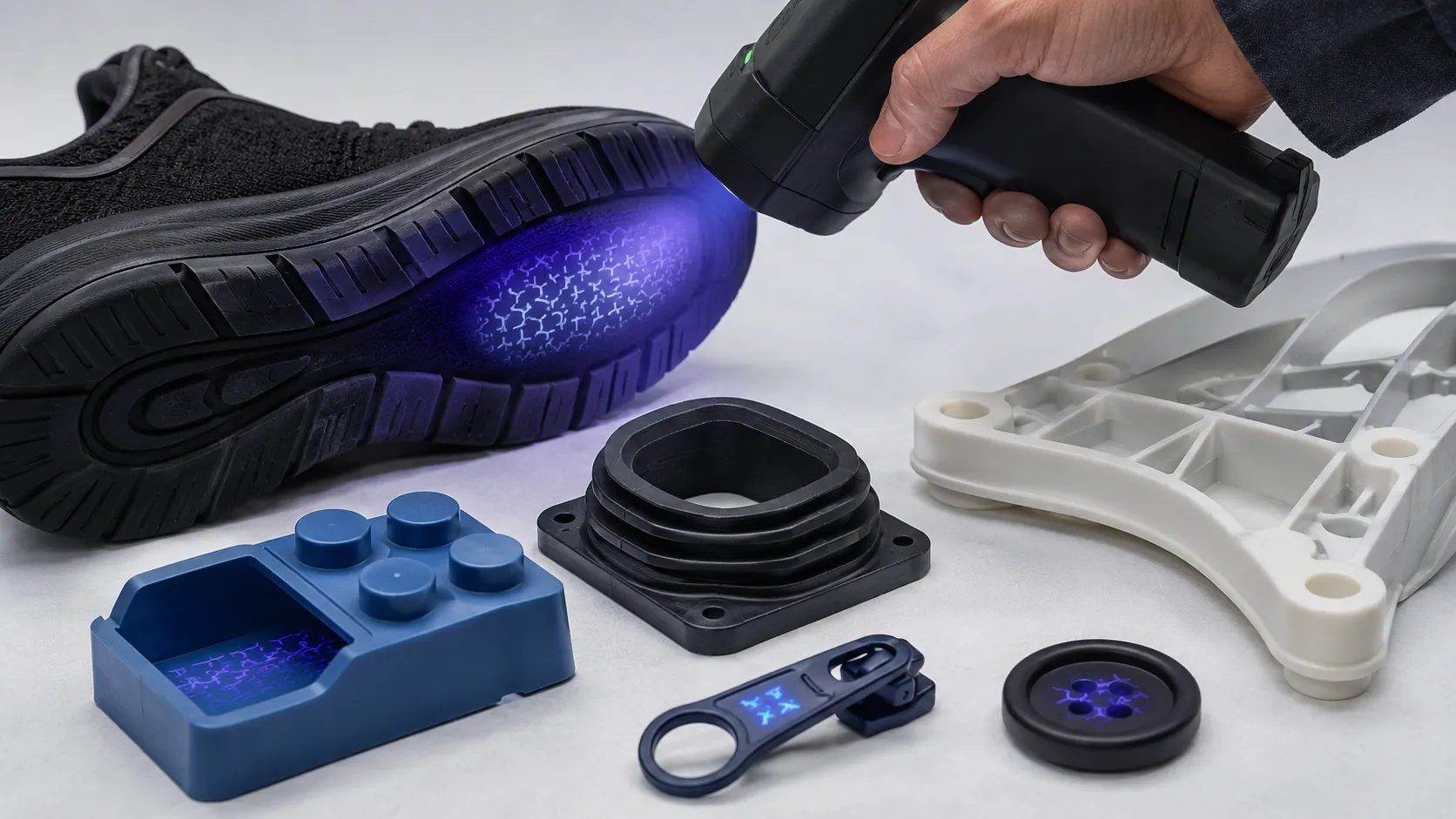
Material-level authentication embeds a covert, non-removable marker into the physical material of the pipe, valve, or fitting during manufacturing. The marker is invisible under normal inspection — including UV and IR — and can only be detected by a proprietary device. Unlike stamps, labels, or coatings, a material-level marker cannot be transferred, replicated, or removed without destroying the component.
High-Temperature Invisible Ink for Metal Surfaces
Mina’s high-temperature security ink is formulated for industrial metal applications where components undergo post-weld heat treatment (PWHT) at 600–760 °C, hot-dip galvanizing at ~450 °C, or continuous service at elevated temperatures. Mina’s ceramic-grade formulation survives up to 1 800 °C — far exceeding any thermal process in PVF manufacturing or field operation. The ink is applied to the component surface (pipe OD, flange face, valve body) during or after final manufacturing, forming an invisible code that is permanently bonded to the substrate.
Micro-Chain Code for Serialized Traceability
Each pipe joint, flange, or valve body receives a unique invisible micro-chain code — a graphic pattern readable only by Mina’s handheld device, which delivers an audio “verification successful” confirmation. This code links to a cloud database containing the component’s heat number, MTR data, production lot, and distribution chain. For the first time, a field inspector can verify not just that a flange is “stainless steel” via PMI, but that this specific flange was manufactured at a specific licensed facility on a specific date. This is the same high-temperature authentication approach that Mina applies in ceramics and glass — adapted here for industrial metals.
Anti-Counterfeiting Masterbatch for Plastic Pipe
HDPE, PVC, and PE pipes used in gas distribution, water infrastructure, and chemical conveyance face the same counterfeiting risk as metal PVF — with the additional challenge that plastic products are even easier to replicate. Mina’s anti-counterfeiting masterbatch is compounded directly into the polymer during extrusion. The marker distributes uniformly through the pipe wall. A cross-section sample from any point along the pipe — cut during installation or taken after an incident — can be verified as authentic. No label, no surface marking, no coating to wear off or be removed.
Covert Valve Authentication
Cast and forged valve bodies, bonnets, and handwheels can carry Mina’s invisible ink or spray-applied micro-chain code. For valve internals — trim, seat rings, stem packing — the marker is applied to critical surfaces before final assembly. This matters in refinery and chemical plant applications where valve internals are replaced during turnarounds: an authenticated replacement trim set confirms the parts are genuine OEM specification, not grey-market or counterfeit.
Authentication Methods Compared: Pipe and Valve Anti-Counterfeiting Technologies
| Feature | Physical Stamps / Embossing | RFID Tags | QR Code Labels | Mina Invisible Marker |
|---|---|---|---|---|
| Survives PWHT (600–760 °C) | Yes | No — tag destroyed | No — label destroyed | Yes — rated to 1 800 °C |
| Survives hot-dip galvanizing | Degraded — zinc coating obscures | No | No | Yes |
| Covert (invisible to counterfeiters) | No — visible and replicable | No — visible and transferable | No — visible and copiable | Yes — device-exclusive |
| Unique per-unit serialization | Limited — manual numbering | Yes | Yes | Yes — cloud-linked |
| Field-verifiable without lab | Yes — visual | Yes — reader | Yes — phone | Yes — handheld device |
| Resistant to copying or transfer | No — stamps are cloned | Partial — can be re-encoded | No — image reproduced | Yes — material-bonded |
| Works on metal + plastic PVF | Metal only | Surface-mounted only | Surface-mounted only | Yes — ink, spray, or masterbatch |
Where Pipe and Valve Anti-Counterfeiting Delivers the Highest ROI
Upstream oil and gas (wellhead, OCTG, and subsea)
Oil Country Tubular Goods (OCTG) specified under API 5CT are among the most counterfeited PVF products globally. A single casing failure during drilling can cost $5–15 million in rig time and environmental remediation. Covert authentication at the pipe mill, verified at the rig site before running casing, prevents counterfeit pipe from reaching the wellbore.
Midstream pipelines and transmission
API 5L line pipe in cross-country and offshore pipelines operates at pressures where wall-thickness fraud directly translates to burst risk. Authentication integrated at the mill and verified during receiving inspection at the pipe yard closes the chain-of-custody gap between manufacturer and installation contractor.
Refinery and petrochemical process piping
Process piping systems under ASME B31.3 require material traceability for every weld joint. Counterfeit fittings and flanges bearing fake ASTM A182 F316L markings are a documented problem in turnaround procurement, where schedule pressure creates openings for unauthorized suppliers. Authentication linked to the component-level verification approach used in automotive parts can be adapted for piping spool pre-fabrication shops.
Power generation (nuclear, thermal, and renewables)
Nuclear-grade piping under ASME Section III demands full material traceability with no exceptions. Fossil-fuel plants operating at high temperatures require verified material grades for creep resistance. Even wind and solar — where steel support structures and hydraulic piping are exposed to harsh environments — benefit from origin authentication as supply chains extend globally.
Water and gas distribution (plastic pipe)
HDPE pipe in gas distribution and potable water systems must meet strict material specifications (PE 4710, PE 100). Counterfeit pipe made from recycled or off-spec resin fails long-term hydrostatic testing and can develop slow crack growth under sustained pressure. Masterbatch-embedded authentication provides a permanent proof of origin that survives the 50+ year design life of buried pipe.
Incoming Inspection Checklist: Integrating Authentication into PVF Receiving
- Document pre-check: Verify MTRs match the purchase order — heat numbers, material grades, dimensions, test results. Flag any MTR that arrives as a scanned copy without a verifiable digital signature from the mill.
- Visual and dimensional inspection: Check markings, color codes, stenciling, and dimensions against the applicable standard (API, ASME, ASTM). Look for inconsistent font, misaligned stamps, or paint covering existing markings.
- PMI spot-check: XRF analysis on a statistically significant sample per ASTM E1476. Focus on alloy-critical applications (sour service, high-temperature, cryogenic).
- Covert authentication scan: Using Mina’s handheld device, scan the component surface or cross-section. The reader confirms authenticity with an audio signal and logs the serial number, linking back to the manufacturer’s production record. A failed scan triggers quarantine and investigation.
- Chain-of-custody reconciliation: Match the authenticated serial number against the cloud database record. Verify the component’s distribution path from mill to your receiving dock. Any gap — unauthorized warehousing, unexplained transfer, missing transit records — warrants further investigation.
- Record and release: Log all verification results (MTR review, PMI data, authentication scan, chain-of-custody status) into your material management system. Release only fully verified components for fabrication or installation.
Procurement Questions: Pipe and Valve Anti-Counterfeiting
Does the invisible marker affect the metallurgical properties of the pipe or valve?
No. Mina’s ink is applied to the surface, not alloyed into the base metal. It does not alter chemical composition, mechanical properties, or weldability. For plastic pipe, the masterbatch additive is present in trace concentrations and does not affect hydrostatic performance, MFI, or long-term stress-rupture behavior.
Can the marker survive sandblasting and coating?
Yes. The high-temperature ink bonds at the molecular level to the metal substrate. It survives abrasive blasting (Sa 2.5 and Sa 3 per ISO 8501-1), FBE coating application, and three-layer polyethylene or polypropylene wrapping. The marker is read through the coating using Mina’s device — no coating removal is required for field verification.
How does this work with existing API Monogram and ASME certification programs?
Mina’s authentication operates as a complementary layer, not a replacement for industry certification. The API Monogram confirms that a manufacturer holds a valid license and operates a conforming QMS. Mina’s marker confirms that this specific unit was produced at that licensed facility. Together, they close the gap between “the license is real” and “this product is real.” Combining brand protection with layered security produces the strongest defense.
What is the cost per unit for marking PVF?
Cost depends on the application method (ink, spray, or masterbatch), the volume, and the serialization complexity. For high-value items — OCTG, alloy fittings, large-bore valves — the authentication cost is typically less than 0.1% of the component value. For commodity pipe, the cost scales with volume to remain commercially viable. Mina provides project-specific pricing after a technical assessment of the product range and production process.
Can this be deployed for an existing PVF inventory already in the warehouse?
Surface-applied ink and micro-chain codes can be added to existing inventory through a controlled application process at the warehouse. Masterbatch integration for plastic pipe requires inclusion at the extrusion stage. For existing metal PVF, Mina’s team can apply authentication markers on-site — enabling authentication at both packaging and product level simultaneously without returning goods to the manufacturer.