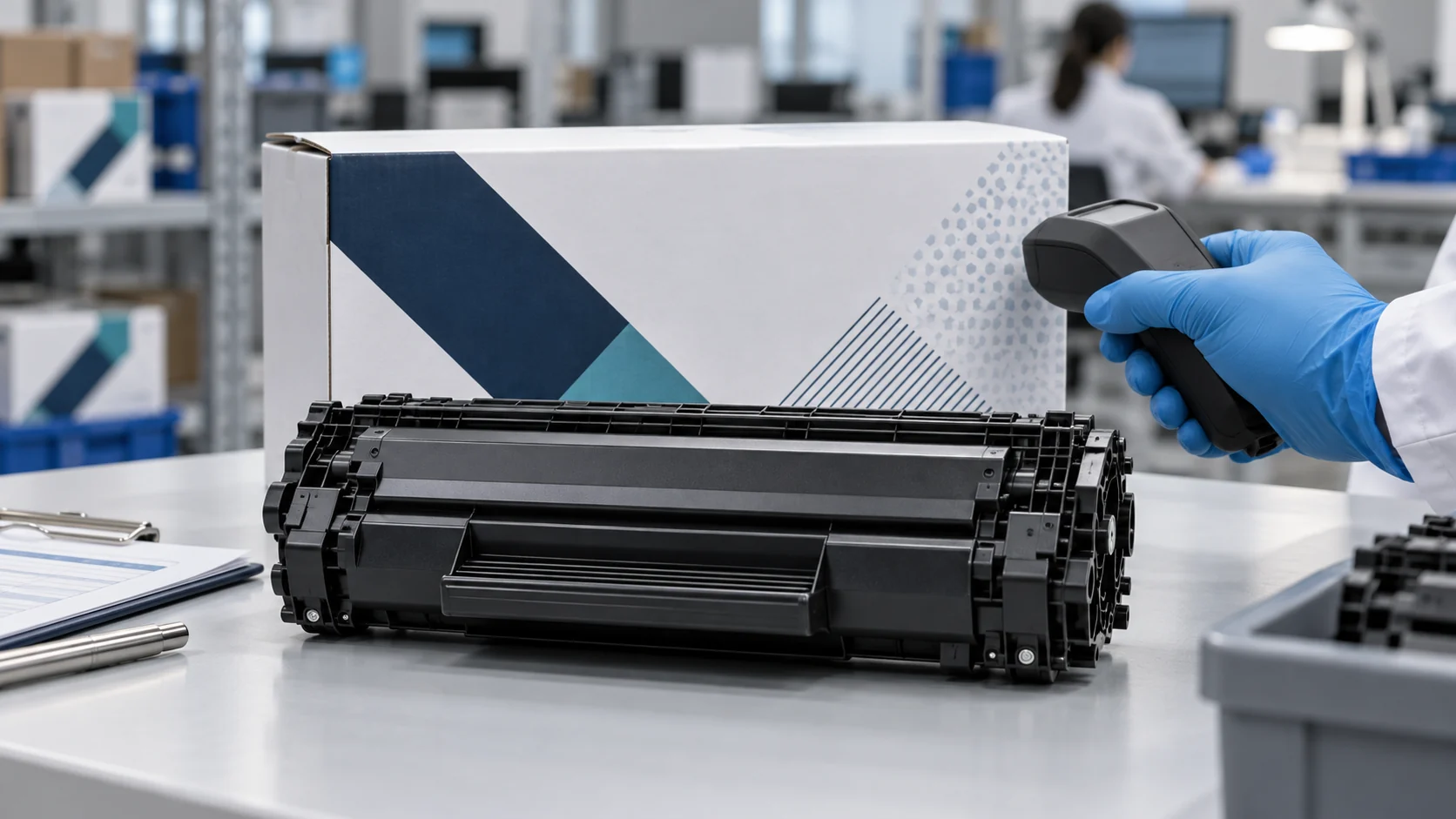
Counterfeit electronic components caused a reported 1,055 incidents in 2024 — a nine-year high, according to ERAI — and cost the semiconductor industry an estimated $7.5 billion per year. Standard incoming inspection catches many fakes, but the gap between what testing detects and what slips through keeps growing. This article examines where conventional electronic component anti-counterfeiting methods fall short and how covert material-level marking can close that gap for OEMs, EMS providers, and defense procurement teams.
Two Assumptions That Increase Your Exposure
Reality: Active components are now counterfeited at twice the rate of active parts with long lead times.
Reality: Only destructive decapsulation reveals internal die-level fraud — and you cannot decap every unit in a lot.
Where Current Electronic Component Anti-Counterfeiting Methods Hit Their Limits
The SAE AS6171 standard (with its slash sheets for visual, XRF, X-ray, DPA, electrical, and acoustic tests) is the accepted framework for counterfeit detection. It is thorough, risk-based, and backed by the defense supply chain. But it was designed to detect counterfeits after they enter the supply chain — not to prevent them from being produced in the first place.
| Method (AS6171 Slash Sheet) | What It Catches | What It Misses | Destructive? |
|---|---|---|---|
| Visual / microscopy (AS6171/2A) | Remarking, sanding, blacktopping, inconsistent fonts | High-quality re-marking with correct fonts; recycled genuine parts | No |
| XRF (AS6171/3) | Lead composition anomalies, re-tinning, RoHS non-compliance | Parts with correct alloy composition but degraded performance | No |
| X-ray (AS6171/5) | Wrong die size, missing bond wires, voids | Correct die with inferior passivation or bonding | No |
| Decapsulation / DPA (AS6171/4) | Die markings, fab ID, bond wire integrity, passivation | Nothing — but limited to sample-level testing | Yes |
| Electrical / functional (AS6171/7) | Out-of-spec parameters, dead units | Parts that meet room-temp spec but fail at operational extremes | No |
Material-Level Marking: Closing the Gap at the Source
The concept is straightforward: embed an invisible, proprietary marker into the component’s encapsulant, ink, or substrate material during manufacturing. The marker travels with the part — not on a label, reel tape, or box that can be swapped. Verification is non-destructive, takes seconds, and requires only the supplier’s proprietary reader.
This approach shifts electronic component anti-counterfeiting from reactive detection to proactive authentication. Instead of asking “Is this part fake?” at incoming inspection, the question becomes “Does this part carry the marker that only the authorized manufacturer could have applied?”
Marker Integration at Manufacturing
Mina’s ultra-invisible nano-material is added to the molding compound, conformal coating, or marking ink during the existing production process. The material is chemically inert and does not alter electrical, thermal, or mechanical properties of the component. It survives reflow soldering, wave soldering, and conformal coating application downstream.
Invisible to All Commercial Instruments
The marker operates outside UV, IR, and visible spectra. XRF, Raman spectroscopy, and FTIR — tools available to counterfeiters — cannot detect it. This is a critical distinction from fluorescent or NIR-based markers that can be identified (and potentially replicated) with commercially available equipment.
Field Verification in Under Three Seconds
Mina’s portable reader — serialized, tracked, and never sold on the open market — provides an immediate pass/fail result. No internet connection, no cloud lookup, no database dependency. The reader can be used at incoming inspection, at a distributor’s warehouse, or during a forensic chain-of-custody investigation.
Complementary — Not Competing — with AS6171
Material-level marking does not replace electrical testing, XRF, or visual inspection. It adds a binary authentication layer that existing AS6171 methods cannot provide: proof of origin embedded in the part itself.
Where Electronic Component Anti-Counterfeiting Hits Hardest: Four Sectors
Defense and Aerospace
DFARS 252.246-7007 requires counterfeit mitigation plans that flow down to every sub-tier. A covert marker embedded by the authorized fab gives prime contractors an audit-ready verification method that satisfies flowdown requirements from Lockheed Martin, RTX, L3Harris, and others — without destructive testing.
Automotive Electronics
Safety-critical ECUs, ADAS sensors, and powertrain controllers cannot tolerate recycled or remarked components. OEMs under automotive anti-counterfeiting pressure need authentication methods that survive the full vehicle lifecycle — from SMT assembly through 15+ years of field operation.
Medical Devices
FDA 21 CFR Part 820 requires documented component traceability. A covert marker provides a physical authentication layer independent of paperwork — useful when investigating field failures or auditing suppliers whose certificates of conformance may not match actual production batches.
Industrial and Energy
Power semiconductors, IGBTs, and protection relays in grid infrastructure or oil-and-gas control systems operate in harsh environments where a counterfeit component failure can trigger safety shutdowns or equipment damage costing millions. Material-level marking survives high-temperature operating conditions that destroy adhesive labels and surface markings.
Broker and Independent Distributor Vetting: A Practical Checklist
When authorized channels cannot supply an obsolete or allocated part, procurement teams turn to independent distributors. The risk profile changes immediately. Use this checklist alongside — not instead of — AS6081 Rev A compliance.
Pre-Qualification Questions for Independent Sources
- ERAI membership and reporting: Does the distributor actively report suspect parts to ERAI? Passive membership is not the same as active participation in the counterfeit-reporting ecosystem.
- In-house or contracted AS6171 testing: Does the distributor perform testing internally (ISO 17025 accredited lab) or outsource to a qualified third party? Request the lab’s accreditation certificate and scope.
- Source traceability depth: Can the distributor trace the lot back to the original manufacturer or authorized distributor? “Purchased from another broker” is not traceability.
- Right of audit: Will the distributor grant your quality team physical access to their facility and inventory management system? Reluctance is a disqualifying signal.
- Return and quarantine policy: How does the distributor handle parts that fail incoming inspection at your site? A documented quarantine-and-investigation process indicates maturity.
- Counterfeit insurance: Does the distributor carry specific liability coverage for counterfeit-related claims? Standard commercial general liability often excludes counterfeit events.
Building the Business Case: Cost of Compliance vs. Cost of Failure
Procurement teams often face internal resistance when proposing authentication programs: “We already test incoming lots — why add another layer?” The answer lies in asymmetric risk.
- Cost of a single counterfeit escape in defense: The US Senate Armed Services Committee documented cases where a single counterfeit component triggered full-lot recalls, production line shutdowns, and contract penalty clauses exceeding $5 million per incident.
- Cost of a field failure in automotive: A counterfeit power MOSFET in an ADAS module that fails at operating temperature can result in a safety recall affecting hundreds of thousands of vehicles — with per-vehicle recall costs of $200–500 before litigation.
- Cost of material-level marking: Applied at the manufacturing stage, the incremental cost per component is measured in fractions of a cent — comparable to the cost of the marking ink already applied to the package surface.
The economics of electronic component anti-counterfeiting favor prevention. A covert marker applied once at the point of manufacture eliminates the need for repeated destructive sampling at every transfer point in the supply chain.
Frequently Asked Questions
Does the covert marker affect the component’s electrical or thermal performance?
No. Mina’s nano-material is chemically inert and added in trace quantities. It does not alter dielectric properties, thermal conductivity, or any parameter measured under standard qualification testing (AEC-Q100/Q101 for automotive, MIL-STD-883 for defense).
Can the marker survive reflow soldering and conformal coating?
Yes. The inorganic material is stable well above standard reflow profiles (peak 260 °C for lead-free) and is unaffected by acrylic, silicone, or urethane conformal coatings. For high-temperature applications, Mina offers formulations validated to 1,500 °C.
How does this relate to Physically Unclonable Functions (PUFs)?
PUFs are a silicon-level authentication technology built into the die by the IC designer. Mina’s material-level marking operates at the package level and is applied by the component manufacturer or their packaging subcontractor — without requiring any change to the silicon design. The two approaches are complementary: PUFs authenticate the die; covert marking authenticates the physical package and its origin.
Is this only for new production, or can it be applied to existing inventory?
The primary application is at the point of manufacture. However, for specific use cases — such as a brand licensing control program where an OEM needs to authenticate authorized stock held by distributors — Mina can apply markers to finished packaging (reels, trays, tubes) at a controlled facility.
Which component types are compatible?
Any component with an epoxy molding compound, plastic package, conformal coating, or printed marking surface. This covers the vast majority of commercial and industrial semiconductors — ICs, discretes, passives in tape-and-reel, and power modules. Bare-die and hermetically sealed ceramic packages require case-by-case evaluation.
References
- ERAI — 2024 Counterfeit Electronic Parts Report, supplychainconnect.com
- SAE International — AS6171 Test Methods for Suspect/Counterfeit EEE Parts, sae.org
- US DFARS 252.246-7007 — Contractor Counterfeit Electronic Part Detection and Avoidance System, acquisition.gov
- OECD — Mapping Global Trade in Fakes (2025), oecd.org
- ASM International — Counterfeit Electronics Reports Reach Nine-Year High, asminternational.org
Explore Material-Level Authentication for Your Components
Mina’s technical team can assess compatibility with your component types, packaging processes, and qualification requirements. Start with a pilot evaluation on a single product line.