Agricultural inputs brand protection
Counterfeit seeds are grain, low-germination stock, or off-type seed repackaged to imitate certified hybrid varieties, sold in copied bags and tags to farmers who cannot judge quality until harvest. Surveys in East Africa have put a large share of seed and pesticide stock in some markets under the counterfeit label, and national regulators have responded with electronic verification: Nigeria’s seed council runs the SeedCodex e-label, and Kenya’s KEPHIS operates a scratch-and-SMS check. For seed companies, agro-dealers, and cooperatives, this guide explains how fake seed reaches farms, how national e-verification works, and how seed brands add layered authentication that protects the bag itself.
Failure appears at germination, weeks after sale
Fake seed erodes trust in certified varieties
Key takeaways for seed brands and agro-dealers
The fraud is invisible until germination. Seed quality cannot be inspected by eye at purchase, so a copied bag and tag sell the fake; the failure surfaces weeks later as a patchy field.
Repackaging is the core pattern. Cheap grain or failed stock dressed in printed bags and tags of popular hybrids, sometimes with copied certification labels.
National e-verification exists and works. Nigeria’s NASC SeedCodex and Kenya’s KEPHIS SMS check let a farmer confirm a lot code before planting; brands should build on it, not around it.
Public codes need analytics. A scratch code copied onto many bags resolves normally until first-query data flags duplicates; monitoring is part of the system.
Covert layers protect the inspectors. Regulators, agro-dealer networks, and brand auditors need a check counterfeiters cannot see or pre-copy, read with dedicated devices.
Authentication is not certification. Germination and varietal purity remain the regulator’s laboratory domain; identity layers prove the bag is yours.
What are counterfeit seeds?
Counterfeit seeds are planting material sold under a variety name, brand, or certification claim it does not hold: ordinary grain dressed up as hybrid maize, low-germination or off-type lots repackaged into printed bags, or expired certified stock relabeled with fresh lot codes and dates. The imitation targets the packaging, because that is what a farmer can actually inspect: the bag print, the variety name, the certification tag, and increasingly a scratch-off verification label.
The category sits beside two honest neighbors. Grain sold as grain is not counterfeit, and openly branded generic seed competes legitimately. The counterfeit steals a specific variety’s name and a certification system’s mark, which is why regulators, not just brands, police it.
The buyer problem is the timing asymmetry. A farmer judges a bag at purchase and the seed at germination, weeks later, after the money is spent and the planting window is closing. Everything in this guide exists to move verification to the point of sale.
What fake seed costs farmers, brands, and food systems
Ugandan reporting has long documented counterfeit seed keeping farmers poor: surveys reported by the region’s press have put the share of counterfeit seed and pesticide stock in some markets at as much as half, with earlier studies in the thirty to forty percent range. Whatever the precise figure in a given season, the mechanism of harm is constant: germination fails or the crop underperforms, the season is lost, and the farmer has paid for the privilege.
The damage compounds across the system. Farmers burned by a fake lot often distrust the genuine variety next season, pulling certified seed sales down with the counterfeits. Agro-dealers who unknowingly stocked fakes lose the trust of their villages. And because planting windows are short, a widespread fake-lot event translates into measurable local harvest gaps, turning a packaging fraud into a food-security event. Mina’s analysis of agrochemical packaging protection shows the same trust and channel risk across adjacent agricultural inputs.
Regulators have responded with verification infrastructure. Nigeria’s National Agricultural Seeds Council introduced SeedCodex, an electronic verification and authentication system tied to its certification process, promoted with the blunt advice that without the SeedCodex label there is no guarantee. Kenya’s KEPHIS runs a scratch-panel e-verification sticker: the farmer reveals the code and sends it by SMS to a public number, receiving instant feedback on whether the lot is genuine. These systems prove national verification at the bag level is operationally real, at the scale of millions of small purchases.
How fake seed reaches farms
1. Repackaging operations
Grain or failed lots packed into copied bags and tags of popular hybrids, ready for market days and planting seasons.
2. Informal agro-dealers
Small stalls and roving sellers stocking on price, outside official agro-dealer registers and inspector routes.
3. Seasonal surges
Short planting windows and sudden demand outstrip genuine supply, opening the door to rushed, unverified purchases.
4. Copied verification labels
The newest pattern: scratch labels copied or reused, so a fake bag answers the SMS check until analytics catch duplicates.
The fourth node is why this is an arms race rather than a solved problem: once verification labels proved they work, counterfeiters began attacking the label itself. The answer is to make the label only the public half of the system.
Verification layers for seed bags, compared
| Layer | What it proves | Main weakness |
|---|---|---|
| Certification tag (paper) | The lot claims regulator certification | Tags are copied and reused; a physical tag is a claim, not a check |
| National e-verification label | The lot code checks against the regulator’s database by SMS or app | A copied code passes until duplicate-scan data surfaces it |
| Agro-dealer registration | The seller is in the official channel | Does not police stock inside registered shops or seasonal informal sellers |
| Germination testing | What the seed actually does, in a laboratory | Slow, sampled, and post-purchase; certification domain, not point of sale |
| Mina covert mark with dedicated detection | Hidden information exists exactly where the brand placed it, on that bag | Readable only with dedicated devices held by authorized partners |
| Mina micro-chain code on bags and cartons | Invisible item-level data supporting lot and market audits | Requires device governance, like every covert layer |
The architecture that emerges across agricultural inputs is consistent: a public check the farmer can run, a covert check regulators and auditors can run, and data the brand monitors. The same layering logic Mina applies to invisible packaging codes carries directly to seed.
Layered marking on seed bags and tags
Mina applies ultra-invisible anti-counterfeiting information to the printed components a seed product already carries: the bag print, the certification tag, the carton, and case markings. The hidden information integrates into existing artwork without changing the visible design, stays invisible under normal light, ultraviolet light, and infrared light, and cannot be read by conventional equipment, so a repackaging operation copying everything visible still misses the feature that proves the bag.
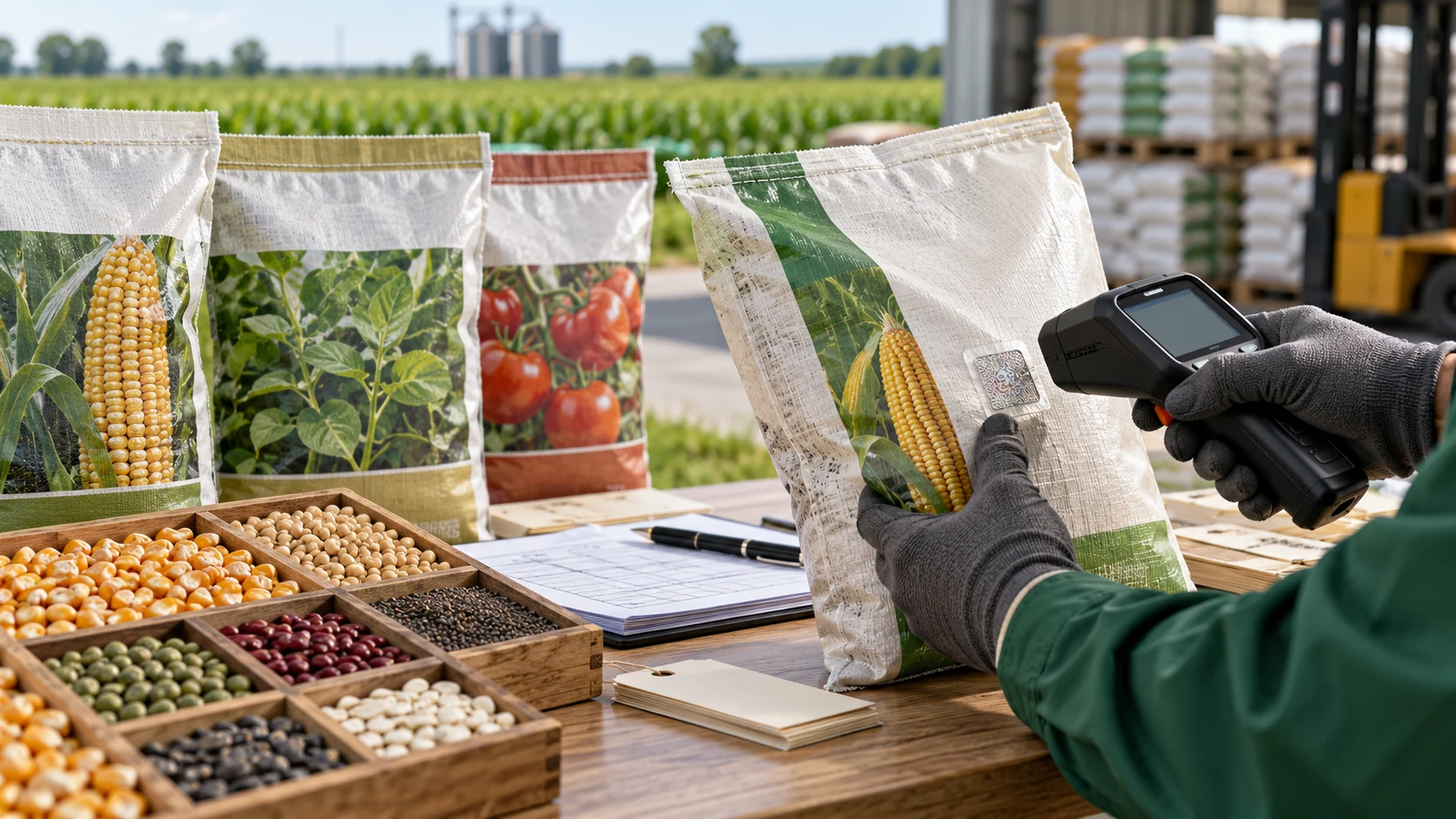
Authorized verification uses dedicated detection devices supplied only to partner clients, each with a unique identification number. Audio verification returns sound and vibration on genuine print and no reaction on fakes; image verification displays the covert information where it was placed. That fits the field reality of seed enforcement: inspectors moving through markets and stores, agro-dealer network auditors, and brand teams checking lots before distribution, all needing a binary answer in seconds without laboratory equipment.
For farmers, Mina’s phone-readable AI cloud code adds the public layer: scan with an ordinary camera and reach a verification page, with first-query time and scan counts recorded per code, the signal that exposes one code printed across thousands of fake bags. One-item-one-code data ties each bag to production and distribution records, which supports the regulator-facing work already running nationally: where a council or authority operates an e-verification scheme, the brand’s item-level data makes each lot auditable end to end. The overt and covert codes are interrelated, so a torn tag or swapped label still leaves the covert identity on the bag readable for investigation.
Boundaries: authentication proves the bag is the brand’s and the lot is the recorded one; germination, purity, and certification remain the regulator’s laboratory domain. Mina’s layer complements national e-verification schemes rather than replacing them, and marking applies to bags, tags, and packaging, never to the seed itself.
Acceptance testing workflow before a season
- 1
Map varieties, regions, and channels
Rank counterfeit exposure by variety and market, and list how farmers buy: agro-dealers, cooperatives, market stalls, seasonal programs.
- 2
Align with the regulator’s scheme
Design the public code and tag to work with national e-verification where it exists, so farmers learn one habit, not two.
- 3
Build test panels
Genuine bags, copied bags from scans, relabeled expired stock, reused-tag cases, and grain-in-brand-bags samples; every member must be called correctly.
- 4
Run season-condition trials
Verify marking and tags survive bag filling, stitching, warehouse heat and humidity, and transport on rural roads before distribution.
- 5
Prove readout and analytics
Confirm audio and image detection per device across inspectors and auditors, and validate duplicate-scan flags on the copied-code panel.
- 6
Train and launch with the season
Train agro-dealer networks and extension staff, distribute check instructions in local channels, and review scan data weekly through the planting window.
Season timing matters: a verification system launched after planting protects nothing this year. Pilot on one crop and region, then scale variety by variety.
Working with regulators, dealers, and cooperatives
Seed authentication succeeds as an ecosystem effort. Brands should share verification evidence with the certification authority, align lot coding with national e-verification databases, and support inspector training on covert checks, because regulators run the enforcement powers. Agro-dealer networks carry the point-of-sale habit: registered dealers who verify lots at intake and show farmers the scratch-and-scan step turn the label into practice.
Cooperatives and government input programs are the highest-leverage buyers. A program that verifies lots centrally before distribution to thousands of farmers removes the biggest single counterfeit opportunity, and its records give the brand and the regulator a clean chain from producer to field. Diversion control belongs in the same file: one-item-one-code distribution data shows which region each bag was packed for, and quota governance keeps authorized printers from overproducing bags and tags, the raw material of repackaging. Mina’s item-level traceability guide explains how a physical identity should connect to production and distribution records without treating the database as proof of the package itself.
Consumer education closes the loop. The Nigerian and Kenyan systems show the teaching that works: scratch the panel, send the code, plant only what answers back. Brands that add their own layer should teach the same single habit.
Limitations and risks to state plainly
Authentication proves identity, not agronomy: a genuine-marked bag still depends on the brand’s production quality and the regulator’s certification for what the seed does in the field. Public codes depend on farmers scanning; duplicate detection needs volume, so early fake lots can appear clean, and covert checks require device coverage and trained staff at the places enforcement actually visits.
The attack surface evolves: as national e-verification proves effective, copied and reused labels increase, which is precisely why a covert layer the counterfeiter cannot see belongs in the design from the start. Seasonal timing is unforgiving, and a system rolled out mid-season protects next season, not this one. And no packaging layer addresses the honest-but-poor seed problem, which is a certification and extension matter, not counterfeiting.
Cost discipline applies as in every category: the deepest stack belongs to the most-counterfeited varieties and the highest-stakes planting programs.
FAQ: counterfeit seeds
What are counterfeit seeds?
Planting material sold under a variety name, brand, or certification claim it does not hold: grain dressed as hybrid seed, low-germination lots in copied bags, and expired certified stock relabeled with fresh lot codes.
How common is fake seed?
Surveys reported in East African press have put counterfeit shares of seed and pesticide stock in some markets as high as half, with earlier studies in the thirty to forty percent range; prevalence varies by country and season.
How do national verification systems work?
Nigeria’s NASC SeedCodex issues electronic labels tied to certification, and Kenya’s KEPHIS runs a scratch-panel sticker verified by free SMS to a public number, returning instant feedback on the lot.
Can counterfeiters copy a verification label?
Yes, a public code can be copied onto many bags and will answer correctly until duplicate scans surface in the data. That is why the public label is paired with a covert layer counterfeiters cannot detect.
How do authorized teams verify a Mina-marked bag?
With dedicated detection devices supplied to partner clients: audio verification returns sound and vibration on genuine print and no reaction on fakes; image verification displays the hidden information. Each device has a unique identification number.
What should be tested before adopting covert marking?
Panels of genuine, copied, relabeled, reused-tag, and grain-in-brand-bag samples; tag and marking survival through filling, stitching, humid storage, and rural transport; per-device readout reliability; and duplicate-scan analytics validated on the copied-code panel.
Sources
- Nigeria National Agricultural Seeds Council: SeedCodex electronic verification system
- KEPHIS: seed quality stakeholders meeting and e-verification
- AllAfrica: counterfeit seed keeps Ugandan farmers poor
- AllAfrica: Ugandan farmers blame rise in fake seeds on policy gaps
- Guardian Nigeria: seed council deploys tracing technology
Make every bag answer before planting
If counterfeit seeds are circulating under your varieties, prepare a brief covering your bag and tag components, markets, dealer channels, and the regulator schemes you work with. Mina can evaluate covert marking plus farmer-scannable verification for your seed packaging and propose an acceptance test plan timed to the season. A farmer’s trust is planted with the seed; protect both.