Infant nutrition brand protection
Counterfeit baby formula is infant formula whose identity, origin, or expiry has been misrepresented: fake powder packed in copied tins, genuine tins refilled with inferior powder, or expired and diverted stock relabeled as fresh. For formula brands, retailers, and distributors, it is a category where fraud directly touches the most vulnerable consumers and where a single incident can damage trust built over decades. This guide explains how fake formula reaches shelves, which packaging layers carry the risk, and how layered authentication on tins, labels, cartons, and channels helps brands intercept it.
Five things formula brand owners should fix first
Fraud has three faces. Copied packaging, refilled containers, and relabeled or diverted stock each defeat a different control, so the program must cover all three.
The tin is the checkpoint. Parents and inspectors can only judge what they can see, which makes printed tins, seals, and labels the primary authentication surface.
Visible features get copied. Holograms and printed codes are imitation targets; a covert layer readable only with controlled devices keeps checks trustworthy.
Consumer scans need analytics. First-query time and scan counts are what expose a code copied onto thousands of fake tins.
Test before rollout. Copied, refilled, relabeled, and expired sample panels, plus storage exposure, decide whether the system works in your markets.
Authentication is not nutrition. It proves identity and source; product safety and quality systems still own what is inside the tin.
What is counterfeit baby formula?
Counterfeit baby formula is infant formula sold under false pretenses about who made it, what is inside it, or how fresh it is. The term covers three distinct fraud patterns. Copying reproduces the brand’s tin, label, and carton design and fills them with powder of unknown origin and nutritional value. Refilling collects used genuine tins or pouches and reseals them with cheaper or expired powder. Relabeling takes expired, damaged, or diverted stock and applies new labels with fresh dates; the FDA specifically warns that formula diverted from normal channels may be relabeled with counterfeit labels that misrepresent quality, identity, and use-by dates.
All three patterns exploit the same weakness: the package is the only evidence a buyer has. Powder cannot be judged by eye, and infants cannot report that a feed tastes wrong. When a fake tin looks convincing, the fraud succeeds until a child becomes ill or a consumer report exposes it, which is why prevention has to sit on the packaging itself and in the channel data around it.
The buyer problem is therefore specific: how do we make every genuine tin provable at the shelf, at customs, at the retailer’s dock, and in a parent’s hands, without slowing the line or changing the brand’s design language?
Why the stakes are higher in infant nutrition
Formula fraud concentrates where trust in local supply has been damaged and demand for trusted brands is high. In 2018, Spanish authorities supported by Europol dismantled a factory packaging fake baby milk under well-known international brands, seizing about 8 tonnes of product lacking proper nutritional controls, mostly destined for export to China. In Malaysia in 2017, raids on pharmacies and convenience stores removed 210 boxes of counterfeit formula imitating a leading brand, after parents noticed packaging differences; officials urged consumers to check packs carefully. In 2004, Chinese authorities detained dozens of people over counterfeit infant formula of such poor quality that local media linked it to infant deaths.
Regulators respond with consumer guidance rather than absolute protection. The FDA advises checking that lot numbers and use-by dates on tins match their cartons, inspecting containers for damage and fake labeling, and avoiding sellers outside reputable retail channels. Customs seizures, such as a 2019 Philadelphia interception of mislabeled formula shipped from Germany, show the import path is also policed, but inspection at the border is sampling, not a guarantee.
For the brand, the damage is asymmetric. A counterfeit incident is charged to the brand by anxious parents regardless of who made the fake, and the corrective response, batches pulled from shelves, hotlines, lab testing, is paid at brand expense. Prevention on the package is cheaper than incident response.
How fake formula reaches shelves
Counterfeit formula enters through four practical routes, each of which calls for a different control. Understanding the route determines where the authentication layer must sit.
Copied packaging imported as goods
Fake tins produced abroad and shipped through general cargo; caught only by sampling. Control: covert features verifiable by customs and distributors.
Refilled genuine containers
Used tins collected from waste and resealed. Control: tamper indication plus a covert code tied to the original fill record.
Relabeled and diverted stock
Expired or gray-market stock with new dates, as the FDA describes. Control: lot-level data checks and date-code binding that survives relabeling.
Online marketplace listings
Third-party sellers moving fakes or diverted goods during shortages. Control: consumer verification pages with first-query analytics.
Shortages sharpen every route. When genuine supply tightens, price gaps widen, parents switch to unfamiliar sellers, and enforcement attention fragments, which is exactly when counterfeit listings multiply. Brands that already have a working verification layer can react with evidence instead of panic.
Authentication layers on formula packaging, compared
No single feature answers all four routes. Industry practice combines a visible feature for shoppers, a serialized or verifiable code for the supply chain, and covert features for inspectors; major suppliers offer label-based or direct-print code programs with smartphone verification. The table compares the layers a formula brand can deploy.
| Layer | Typical use | Main weakness |
|---|---|---|
| Printed lot and date codes | Regulatory baseline, recall handling | Relabeling attacks exactly this data, as diversion cases show |
| Hologram or color-shifting feature | Quick visual reassurance at the shelf | Imitation target; quality differences are hard for non-experts to judge |
| Serialized QR with scan platform | Consumer verification and gray-market analytics | A copied code resolves normally until scan analytics flag duplicates |
| Serialization with case aggregation | Supply-chain track and trace from filler to retailer | Depends on data discipline; does not stop refilling of a genuine pack |
| Mina ultra-invisible marker in the print | Brand and inspector verification of tins, labels, and cartons | Reads only with dedicated devices held by authorized partners |
| Mina micro-chain code on cartons | Covert item-level data for case-level audits | Requires device governance, like every covert layer |
The strongest architecture layers rather than chooses: a scannable code the public can trust, aggregated data the supply chain can audit, and a covert layer counterfeiters cannot even find. Brands weighing the general trade-off between added labels and printing security into existing packaging can apply the same logic Mina describes for packaged goods authentication.
Layered marking on tins, labels, and cartons
Mina’s approach prints security into the components a formula pack already carries: the tin’s lithographed surface, the label, the sealed film print, the folding carton, and the shipping case. Ultra-invisible information integrates into existing artwork without changing the visible design, remains invisible under normal light, ultraviolet light, and infrared light, and cannot be read by conventional equipment, reducing visible clues for imitation while keeping verification under authorized control.
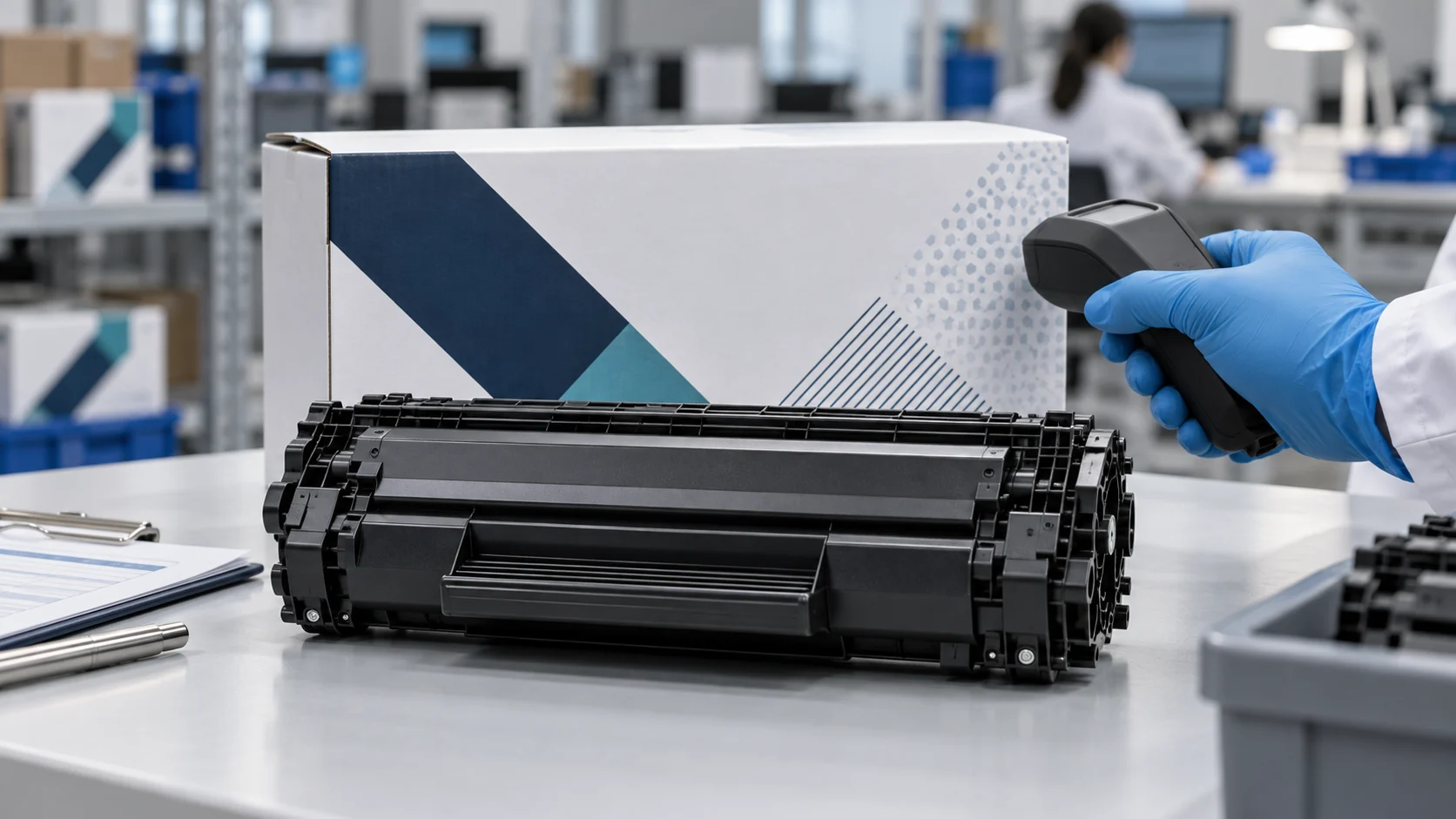
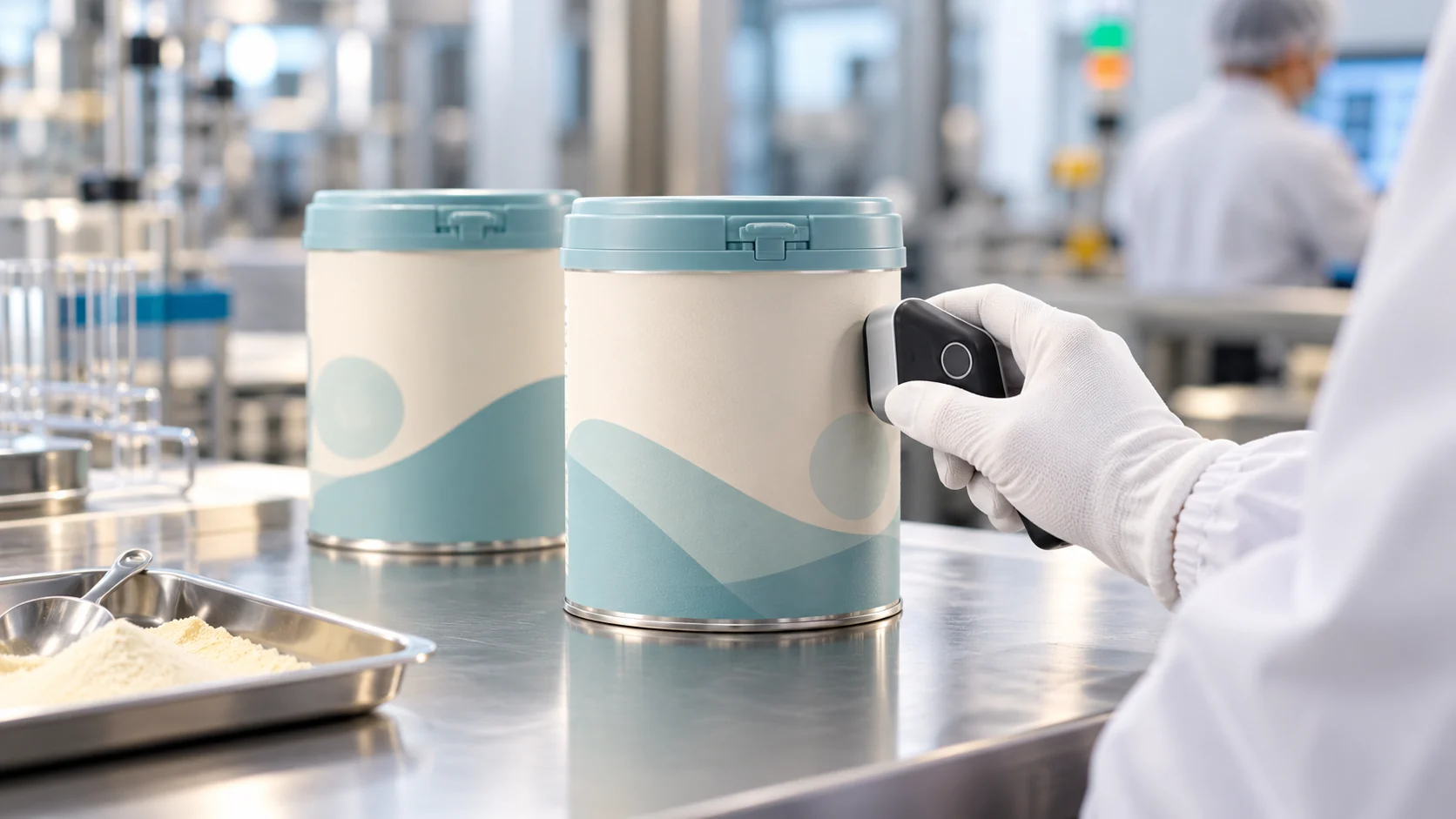
Authorized checks use dedicated detection devices supplied only to partner clients, each with a unique identification number. Audio verification returns sound and vibration on genuine print and no reaction on fakes; image verification displays the hidden information where the brand placed it. That gives customs officers, distributors, and brand inspectors a documented verification result at the dock or the shelf, with no laboratory and no judgment call about hologram quality.
For parents, a phone-readable layer closes the loop. Mina’s AI cloud code is read with an ordinary smartphone camera, and the verification service records first-query time and query counts, which is the signal that exposes one code reproduced across thousands of counterfeit tins. For the channel, one-item-one-code data links each tin to production and distribution records, and security tape on shipping cases shows where a case was opened in transit. The approach mirrors the layered label programs Mina applies to sealed consumer goods, and it extends the same covert-plus-overt logic used across food and beverage packaging.
Two boundaries keep claims honest. Marking proves identity and source; it does not test the powder, and food-safety compliance of any ink, varnish, or marker in contact with product or packaging belongs in the acceptance protocol and the regulatory file. And no feature replaces recalls: authentication narrows scope and speeds evidence when an incident happens.
Acceptance testing workflow before rollout
Qualify the program like a packaging line trial. Each step below produces evidence the quality and brand teams can sign.
- 1
Define the fraud model per market
Rank copying, refilling, relabeling, and online diversion for each market, and map which packaging component answers each.
- 2
Select marking surfaces
Tin lithography, label, film, carton, and case tape: confirm where covert information sits and where the public code sits, without redesigning the pack.
- 3
Build the sample panels
Genuine production, copied artwork from scans, refilled and resealed tins, relabeled expired stock, and damaged genuine packs. Every panel member must be called correctly.
- 4
Run process and storage trials
Verify covert information and the public code survive filling, sealing, transport, and the temperature and humidity of target markets, rechecking after simulated aging.
- 5
Prove readout and analytics
Confirm audio and image detection with each dedicated device, and validate that first-query and duplicate-scan analytics actually flag the copied-code panel.
- 6
Document governance
Register devices and holders, train inspectors and hotline staff, define escalation to quarantine and regulators, and record it all in the brand-protection file.
Launch on one market or one SKU family, review scan and inspection data for a full season, then scale. The acceptance report is the reference for every future claim that a seized tin is counterfeit.
Channel governance: making verification routine
Authentication works when checks happen where fraud happens. Retail audit teams should spot-check covert marks during store visits; customs and distributor training should cover the detection workflow; and the consumer verification page should be printed where parents actually look, with the hotline ready for mismatch reports. The FDA’s own consumer advice, matching lot numbers to cartons and inspecting containers, becomes far stronger when the brand can also verify a specific tin against its production record.
Diversion control deserves equal weight, because relabeled gray-market stock is the hardest pattern to distinguish from counterfeiting. One-item-one-code distribution data shows which market each tin was made for; ordering and quota controls keep authorized partners from overproducing packaging, the same governance Mina applies to brand licensing programs. Mina’s guide to authenticating consumer goods packaging before fakes reach shelves covers the retail-side checklist in depth.
Finally, prepare the incident playbook before the first seizure: who examines a suspect tin, who reports to food authorities, what evidence the covert verification record provides, and how parents are communicated with. Evidence handled calmly in the first 48 hours is what separates an intercepted fraud from a brand crisis.
Limitations and risks to state plainly
Authentication has edges. It proves the pack is genuine; it does not prove the powder meets specification, and it cannot compensate for a genuine but defective batch. Refilling attacks the seal as much as the print, so tamper-evidence and fill-record linkage belong in the same program.
A covert marker is only as good as access control: detection devices are partner-only by design, so coverage, custody, and training must be planned, and a failed check after damage is a quarantine signal, not automatic proof of counterfeiting. Consumer codes depend on parents scanning; analytics flag duplicates only after scans accumulate, so early counterfeit batches may look clean.
Cost discipline matters too. Layering every feature onto every SKU is expensive; the granular markets, the top counterfeit routes, and the flagship products should get the deepest stack, while low-risk lines keep the baseline. And every material that touches product or food-contact surfaces needs food-safety review and documentation before launch.
FAQ: counterfeit baby formula
What is counterfeit baby formula?
Infant formula whose identity, contents, or expiry is misrepresented: fake powder in copied packaging, genuine tins refilled with inferior powder, or expired and diverted stock relabeled with fresh dates.
How common is formula counterfeiting?
Documented cases span four continents: an 8-tonne fake-milk packaging factory in Spain, pharmacy seizures in Malaysia, repackaging cases in China, and mislabeled imports stopped by US customs. Shortages increase the risk.
How can parents spot fake formula?
The FDA advises checking that tin lot numbers and dates match the carton, inspecting seals and containers, and buying from reputable retailers; brands should add a verification code so parents can confirm each tin directly.
Do QR codes stop formula counterfeiting?
Not alone. A copied QR still resolves normally; the value comes from analytics, first-query time and duplicate scans, and from pairing the public code with a covert layer counterfeiters cannot find or copy.
How do authorized teams verify a Mina-marked tin?
With dedicated detection devices supplied to partner clients: audio verification gives sound and vibration on genuine print and no reaction on fakes; image verification displays the hidden information. Each device has a unique number.
What should be tested before adopting covert marking?
Panels of genuine, copied, refilled, relabeled, and expired packs; survival of marking through filling, sealing, and target-market storage; readout reliability per device; and duplicate-scan analytics validated against the copied-code panel.
Sources
- FDA: Questions and Answers for consumers concerning infant formula
- FDA: Handling infant formula safely
- Europol: Operation OPSON against fake and substandard food and drink
- CGTN: Factory packaging fake baby formula shut down in Spain, 2018
- BBC: Malaysia seizes suspected counterfeit baby formula, 2017
- CBP: Philadelphia seizure of mislabeled baby formula, 2019
- CBS News: Arrests in China fake baby formula case, 2004
- KURZ SCRIBOS: Counterfeit infant nutrition and brand countermeasures
Protect every tin parents pick up
If counterfeit baby formula is a live risk in your markets, prepare a brief covering your packaging components, target markets, fraud patterns seen so far, and the audiences who must verify. Mina can evaluate covert marking for your tins, labels, and cartons and propose an acceptance test plan.