Print consumables brand protection
Counterfeit toner cartridges are refilled, remanufactured, or wholly fake consumables marketed as original brand products, usually in packaging copied from the OEM’s own boxes. Counterfeit supplies can leak, produce poor print quality, or damage printer components. Coverage for resulting damage depends on the manufacturer’s warranty terms, leaving buyers exposed to service costs and disputes. This guide explains how fake cartridges reach procurement, which packaging layers carry the authentication load, and how consumable brands and large buyers can verify every box at intake.
The quick answer
Visible features such as holograms are imitation targets, and a public QR code resolves normally even on a copied box. A defensible program layers a consumer-checkable code with a covert marker checked through controlled, dedicated verification, plus delivery inspection for bulk orders.
The distinction matters: legitimate compatible cartridges are legal alternatives; counterfeits are presented as the OEM’s product. This guide is about the second category.
Key takeaways for consumable brands and buyers
- Counterfeiting is defined by deception, not by price. A refilled or cloned cartridge sold in OEM-style packaging is counterfeit even when it prints acceptably at first.
- The damage is physical and financial. Leaks, overheating, component wear, and warranty disputes land on the buyer; the brand pays in service costs and trust.
- Enforcement is active but selective. One supported program in India seized roughly 440,000 illicit items in a year, but enforcement alone cannot replace procurement checks.
- Layering beats any single feature. Public scan for buyers, covert marker for inspectors, delivery inspection for bulk, and first-scan analytics for the brand.
- Mina’s covert layer reads in seconds. Dedicated devices return sound and vibration or display hidden information only on genuine print, with no judgment call about hologram quality.
- Acceptance testing precedes rollout. Copied-box, refilled-cartridge, and transit-damaged panels must all be called correctly before scaling.
What are counterfeit toner cartridges?
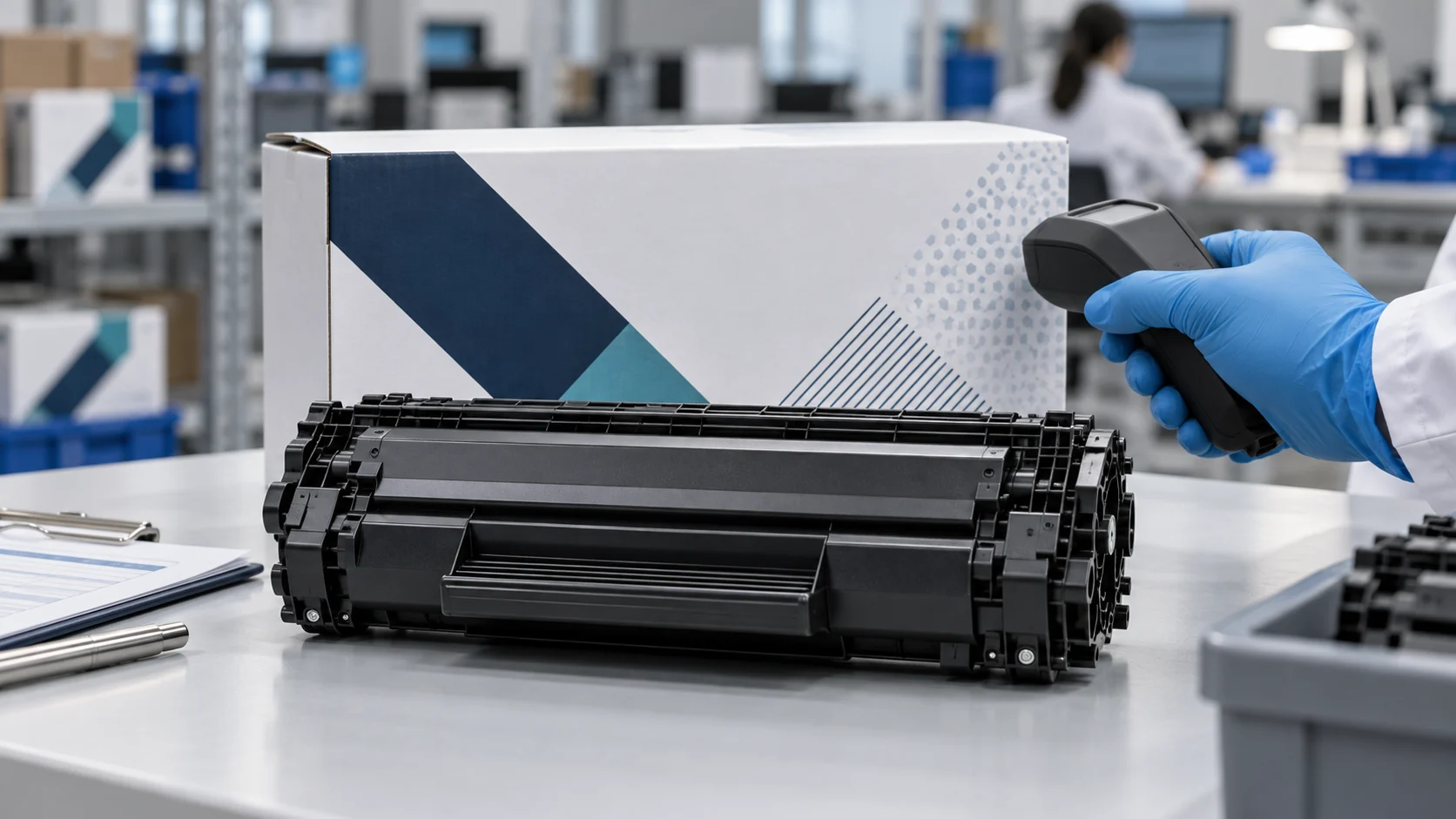
Counterfeit toner cartridges are consumables manufactured, refilled, or remanufactured and then marketed as original products of a printer brand. The copying usually focuses on the box: HP describes counterfeit cartridges as products placed in packaging resembling genuine boxes, and Canon warns that counterfeit ink and toner may compromise printer performance, produce inferior prints, and adversely affect the lifespan of printer parts. The UK Intellectual Property Office adds the practical consequences buyers report: leaking or clogging, streaky or faded output, color inaccuracy, component damage, overheating, and warranty disputes, with no compensation from the counterfeiter.
The category is distinct from legitimate third-party consumables. Compatibles and remanufactured cartridges sold honestly under their own brand are a legal market. Counterfeits steal the OEM’s identity, which is why the response belongs in brand protection and procurement controls rather than in a debate about aftermarket pricing.
For consumable brands, the buyer question is concrete: when a pallet of cartridges arrives at a distributor, a managed print provider, or a corporate receiving dock, how does anyone on the spot prove the boxes are genuine before they are paid for and installed?
Why the risk is rising and what it costs
Printing consumables are attractive to counterfeiters for structural reasons: high unit value, small size, global demand, packaging-led brand recognition, and buyers who purchase frequently on price. The UK IPO’s 2026 guidance on fake toner links the trade to organized crime and to the wider counterfeit economy, which OECD and EUIPO estimate at around USD 467 billion in global trade, and warns specifically about third-party marketplace sellers where procurement controls are weak.
Enforcement numbers show both the scale and the limits of raids. In India, a program supported by HP’s anti-counterfeit team with local law enforcement seized roughly 440,000 illicit items, including counterfeit ink and toner, worth about INR 30 crore (around USD 3.6 million) between November 2022 and October 2023, with more than 100,000 items in Mumbai alone. Raids continued monthly after that window. Each seizure removes stock already produced; none of it prevents the next production run, which is the argument for making the packaging itself carry the proof.
For buyers, the direct costs compound quietly: reprints, service calls, printhead replacement, and warranty disputes that surface months after the cheap pallet was consumed. The IPO’s summary for buyers is blunt: spend smart, not cheap, because a deal that looks too good usually is.
How fake cartridges reach procurement
Fakes enter through three main routes, and each route defines where authentication should happen.
- Online marketplaces. Third-party sellers list lookalike boxes at tempting prices; the UK IPO singles this channel out. Control: consumer verification on every box, with scan analytics flagging duplicated codes.
- Distribution and gray channels. Mixed lots where genuine and fake cartons travel together, and diverted regional stock resold with tampered labels. Control: covert verification at distributor intake and item-level distribution records.
- Bulk delivery substitution. Interception or substitution during shipping of large orders. Control: delivery inspection at receipt, supported by security tape that reveals opened cases, the same logic behind OEM on-site delivery inspection services for medium and large orders.
Managed print services and corporate buyers add a fourth exposure: cartridges that fail early or print inconsistently are often written off as quality issues rather than recognized as counterfeits, so the feedback loop back to the brand never closes. An intake check at goods receipt closes it.
Authentication layers on cartridge packaging, compared
OEM practice already combines a visible label feature with a QR scan and, for large deliveries, on-site inspection. The table compares the layers available to a consumable brand and where each is strongest.
| Layer | Typical use | Main weakness |
|---|---|---|
| Holographic security label | Quick visual check at the shelf; used by major OEMs today | An imitation target; tilt effects are hard for non-experts to judge |
| Public QR verification | Buyer scans the box and reaches the brand’s check page | A copied code may initially resolve; duplicate-scan checks depend on the verification system |
| Cartridge chip authentication | Printer firmware validates the consumable at install | Prints an error after purchase; cloners target chips; not an intake check |
| On-site delivery inspection | Trained inspection of medium and large orders at receipt | Costs staff time; only as good as the features inspectors can verify |
| Mina ultra-invisible marker | Covert information in the box print, label, and inserts | Readable only with dedicated devices held by authorized partners |
| Mina micro-chain code | Invisible item-level code for carton and case audits | Requires device governance, like every covert layer |
The strongest architecture stacks these rather than choosing: a public scan the buyer can perform, a chip the printer can read, and a covert layer that only authorized inspectors can check, so a counterfeiter must defeat three different systems to pass. Buyers comparing marking approaches in general can apply Mina’s comparison of invisible ink and anti-counterfeit labels, and the same packaging-security principles Mina summarizes for consumer goods.
Covert marking on cartridge packaging
Mina applies ultra-invisible anti-counterfeiting information to the printed components a cartridge box already carries: the carton lithography, the label, the insert or leaflet, and the shipping case. The hidden information integrates into existing artwork without changing the visible design, remains invisible under normal light, ultraviolet light, and infrared light, and cannot be read by conventional equipment. This reduces visible clues for imitation; it does not make the entire packaging system impossible to defeat.
Authorized verification uses dedicated detection devices supplied only to partner clients, each with a unique identification number. Audio verification checks for the expected response on authorized marked print; image verification displays the hidden information where the brand placed it. That suits exactly the moments that matter in consumables: distributor intake, delivery inspection of a bulk order, and market audits, where an inspector needs a documented verification result rather than relying only on visual judgment about hologram quality.
The covert and overt layers are interrelated by design. If the visible serial or QR is damaged or removed, the covert code still identifies the box and links it to its production and distribution record, and the same one-item-one-code data supports anti-diversion audits across regions. For end buyers, a phone-readable AI cloud code adds a public verification layer without special equipment, with first-query time and scan counts helping flag unusual reuse of a copied code. Security tape on shipping cases shows whether a case was opened in transit, extending the check from the box to the pallet.
Scope boundary: Mina’s layer authenticates the packaging and the record behind it. Cartridge chip security and printer firmware remain the OEM’s electronic domain, and the two layers are complementary, one catches the fake at the dock, the other at the printer.
Acceptance testing workflow before rollout
Qualify the program on one product family and one distribution region before scaling. Each step below produces evidence for the brand-protection file.
- Model the fraud routes. Rank marketplace copies, gray-channel mixing, and delivery substitution for your markets, and map each route to the packaging layer and inspection point that answers it.
- Fix marking surfaces. Confirm where covert information sits on carton, label, insert, and case, where the public code sits, and where security tape seals the case, without redesigning the pack.
- Build test panels. Use genuine production, boxes copied from scans, refilled cartridges in genuine boxes, transit-damaged packs, and expired genuine stock. Record which layers detect each failure; a packaging marker alone cannot identify every refill inside a genuine box.
- Run process trials. Verify marking survives carton conversion, shipping vibration, warehouse temperature swings, and retail handling, with readout rechecked after simulated aging.
- Validate readout and analytics. Confirm audio and image detection with each dedicated device across inspectors, and prove first-query analytics flag the copied-code panel within an agreed window.
- Write the governance. Device register and holders, inspector and hotline training, escalation to quarantine and the brand’s enforcement contacts, and quarterly review of scan and inspection data.
Keep the acceptance report. When enforcement asks why a seized box is counterfeit, the report is what makes the answer evidence rather than opinion.
Governance for brands and bulk buyers
For the OEM brand
Control identifier issuance, run covert verification in market audits, brief enforcement liaisons on the detection workflow, and treat scan analytics as an early-warning feed for new counterfeit batches.
For distributors and MPS
Verify covert marks at goods receipt, record batch outcomes, keep delivery inspection rights in supply agreements, and report anomalies to the brand instead of consuming suspect stock.
For corporate procurement
Buy from authorized channels, add authenticity language to tenders, train receiving docks on the verification step, and file suspected fakes with the brand and bodies such as industry coalitions and IP offices.
The UK IPO’s buyer advice, inspect packaging, compare prices, know your source, and quality-check output, sets a sensible floor. Layered authentication turns that advice from a judgment call into a repeatable procedure at the dock.
Limitations and risks to state plainly
Authentication proves the box and its record, not the toner chemistry; a genuine-marked box refilled after retail sale is a tamper problem for seals and channel controls, not for the marker alone. Covert verification depends on device coverage and custody, so programs must plan who checks what, where, and how often. A missing covert signal after damage is grounds for quarantine, not automatic proof of counterfeiting.
Public codes depend on people scanning. A copied QR looks valid until enough scans accumulate for analytics to flag duplication, so early counterfeit batches can appear clean. And no packaging layer catches every fraud: chip cloning, service-channel refills, and sophisticated box copying each need their own control, which is the argument for the layered stack rather than a hero feature.
Cost discipline closes the list: the deepest stack belongs on the highest-risk SKUs and regions, while low-risk lines keep the visible baseline.
FAQ: counterfeit toner cartridges
What are counterfeit toner cartridges?
Cartridges that are refilled, remanufactured, or newly made and sold as original brand products, usually in packaging copied from the OEM’s. They are distinct from honest third-party compatibles sold under their own name.
What damage can fake cartridges cause?
Documented problems include leaking, clogging, streaky or faded prints, color inaccuracy, overheating, component damage, and warranty disputes, with no liability from the counterfeiter for any of it.
How big is the problem?
One OEM-supported enforcement program in India seized about 440,000 illicit items worth roughly USD 3.6 million in a single year; the OECD and EUIPO estimate total counterfeit trade at about USD 467 billion globally.
How can buyers verify cartridges today?
Buy from authorized sellers, inspect boxes and security labels, scan the brand’s verification QR code, and use delivery inspection for large orders; the UK IPO also advises checking price, source, and print quality.
How do authorized teams verify a Mina-marked box?
With dedicated detection devices supplied to partner clients: audio verification gives sound and vibration on genuine print and no reaction on fakes; image verification displays the hidden information. Each device has a unique identification number.
What should be tested before adopting covert marking?
Panels of genuine, copied, refilled, damaged, and expired samples; mark survival through converting, shipping, and storage; per-device readout reliability; and validation that scan analytics flag duplicated codes quickly.
Sources
Make every box provable at the dock
If counterfeit toner cartridges are reaching your channels, prepare a brief covering your packaging components, distribution regions, fraud patterns seen so far, and who must verify. Mina can evaluate covert marking for your cartons, labels, and cases, and propose an acceptance test plan. Counterfeit toner survives where nobody checks; layered authentication removes that blind spot.