Counterfeit Fastener Detection: 7 Smart Wins for Construction and Infrastructure Procurement
A single high-strength bolt connects a steel beam to a column. A single anchor rod holds a bridge bearing in place. When that fastener is counterfeit — wrong grade, wrong heat treatment, wrong thread tolerance — the connection fails under exactly the load it was specified to carry. Counterfeit fastener detection has lagged behind other industrial anti-counterfeiting efforts because bolts and nuts are treated as commodity items. This guide addresses how procurement teams, structural engineers, and quality inspectors can close that gap with material-level authentication that travels with the fastener from mill to job site.
Estimated annual cost of fastener failures in U.S. infrastructure (industry studies)
Structural fastener lots flagged during audits on major infrastructure projects (ASTM reporting)
Fastener-related recalls and seizures by U.S. Customs in the past decade
How Counterfeit Fasteners Enter Construction Supply Chains
Structural fasteners — high-strength bolts (ASTM A325, A490, F3125), anchor rods (F1554), stainless steel connectors (A193/A194), and tension-control bolts — are specified by grade, material, and mechanical properties. Counterfeit versions match the external appearance but fail the performance specification. The counterfeiting methods are specific and predictable.
Grade mismarking
Grade 2 or Grade 5 bolts are stamped with Grade 8 markings. ASTM A307 low-carbon bolts carry A325 head marks. The bolt looks correct during receiving inspection, but its tensile strength is 30–50% below what the structural design assumes. Under seismic loading or fatigue cycling, this is a fracture waiting to happen.
Material substitution
Alloy steel specified for high-temperature or corrosive service is replaced with plain carbon steel. A B7 stud bolt for a pressure vessel flange is actually medium-carbon steel without the chromium-molybdenum content that provides creep resistance. The substitution is undetectable by visual inspection and may not be caught by PMI unless the inspector specifically tests for Cr and Mo content.
Heat treatment fraud
Fasteners that were never quenched and tempered, or that received inadequate treatment, carry markings claiming full compliance. The core hardness is wrong, the through-hardness is inconsistent, and the hydrogen embrittlement susceptibility is elevated. These fasteners can pass proof-load testing at the factory but fail by delayed brittle fracture weeks or months after installation — especially in galvanized or coated applications where hydrogen pickup occurs during plating.
Fraudulent test certificates
Mill test reports and certificates of conformance are cloned, altered, or fabricated entirely. Lot numbers are reused across unrelated batches. Chemical and mechanical test results are copied from legitimate reports. Without physically verifying the fastener material, the paper provides false assurance — the same document-trail vulnerability that affects electronic component authentication and other industrial sectors.
Mixed-lot contamination
Genuine and counterfeit fasteners are commingled in the same packaging. A pallet may contain 90% legitimate Grade 8 bolts and 10% Grade 5 substitutes. Random sampling catches this only if the sample happens to include the counterfeits — and at typical sampling rates (AQL 1.0, Level II per ANSI/ASQ Z1.4), a 10% contamination rate can still slip through.
Why Standard Counterfeit Fastener Detection Methods Fall Short
| Detection Method | Catches Grade Mismarking? | Catches Material Substitution? | Catches Heat Treatment Fraud? | Non-Destructive? | Field-Deployable? |
|---|---|---|---|---|---|
| Visual head-mark inspection | No — marks are stamped identically | No | No | Yes | Yes |
| Proof-load / wedge testing | Yes | Yes | Partial — catches gross deficiency only | No — destructive | No — lab required |
| Hardness testing (Rockwell/Brinell) | Yes | Partial | Yes | Yes (surface) | Portable — but slow per unit |
| PMI / XRF analysis | Partial — within same alloy family, unreliable | Yes — major substitution | No — measures chemistry, not treatment | Yes | Yes |
| Certificate / MTR review | No — documents are forged | No | No | Yes | Yes |
| Mina covert material marker | Yes — confirms authentic origin | Yes — confirms manufacturer identity | Yes — marker applied post-treatment | Yes | Yes — handheld, seconds per unit |
Hardness testing and PMI are the strongest existing tools, but each has a practical limitation: hardness testing requires surface access, operator time, and per-unit handling — impractical at volume. PMI confirms chemistry but not mechanical properties. Neither method can distinguish a genuine manufacturer’s product from one produced on identical equipment by an unauthorized third party. Counterfeit fastener detection at the material level fills exactly this gap.
Material-Level Counterfeit Fastener Detection: Mina’s Approach
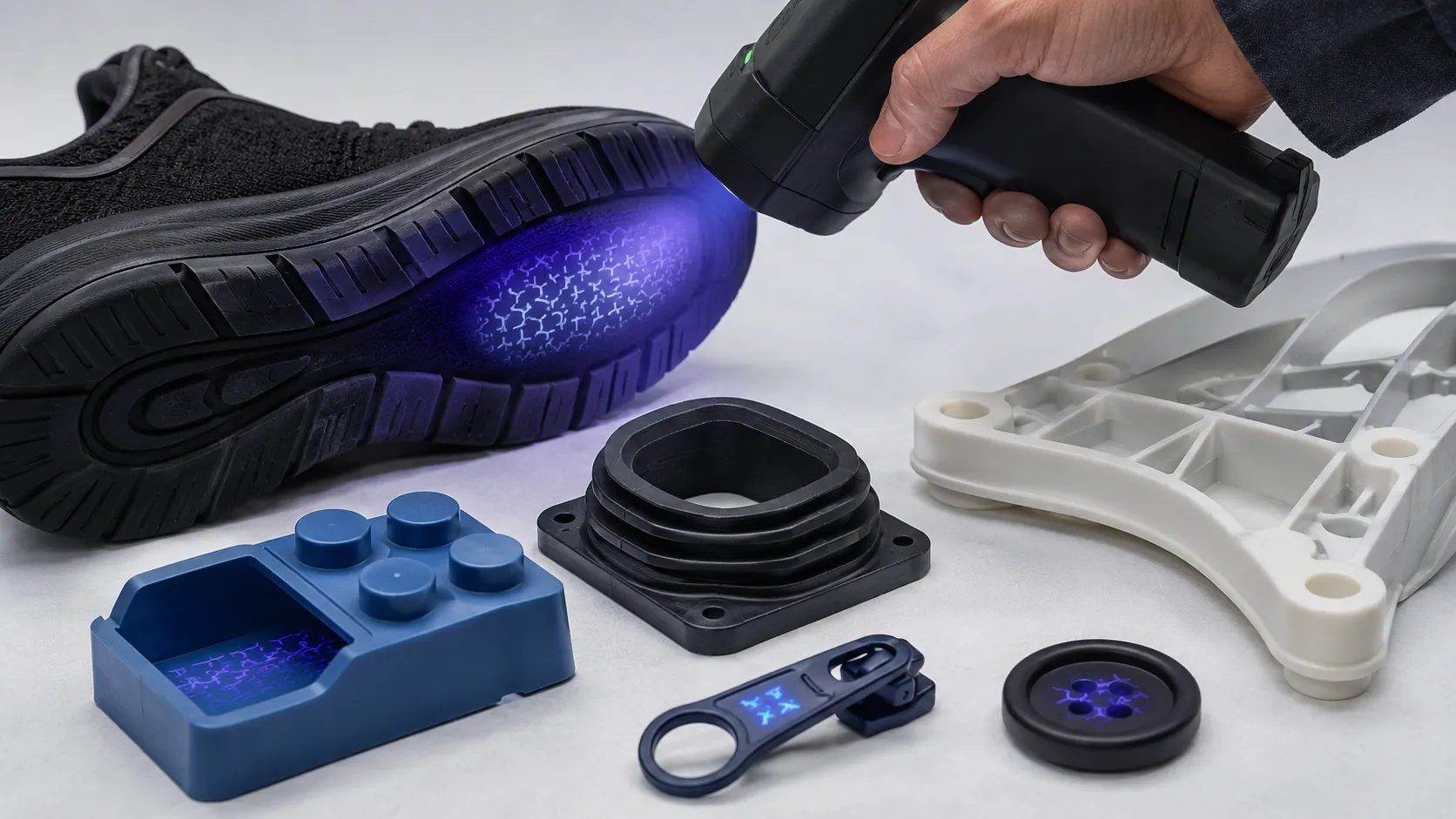
Mina’s authentication technology marks the fastener itself — not its packaging, not its certificate, not its head stamp — with an invisible code that can only be detected by Mina’s proprietary handheld reader. The marker is applied during manufacturing and cannot be seen, measured, or replicated by counterfeiters.
High-Temperature Invisible Ink for Bolts, Studs, and Anchors
Structural fasteners undergo hot-dip galvanizing (450 °C), mechanical galvanizing, zinc plating with chromate conversion, or PTFE fluoropolymer coating — all processes that destroy conventional labels and damage surface-applied codes. Mina’s high-temperature security ink bonds to the steel substrate before coating and survives temperatures up to 1 500 °C. The ink is applied to the bolt head, nut face, or anchor rod shank after final heat treatment and before surface finishing. Once coated, the marker is invisible beneath the zinc or paint layer — but fully readable through the coating by Mina’s device.
Micro-Chain Code for Per-Lot and Per-Unit Traceability
Each fastener lot — or each individual fastener in critical applications — receives a unique micro-chain code linking to a cloud record that stores the manufacturer identity, heat number, heat treatment batch, mechanical test results, and coating lot. A site inspector scans a bolt on a steel connection and confirms, in real time, that the fastener was produced by the specified manufacturer and heat-treated in the correct batch. This closes the chain-of-custody gap that forensic-level traceability demands in high-consequence applications.
Masterbatch Integration for Nylon and Polymer Fasteners
Nylon insert lock nuts, plastic expansion anchors, fiber-reinforced polymer (FRP) bolts, and engineered plastic connectors used in electrical, corrosion-prone, and lightweight applications face the same counterfeiting risk as steel fasteners — with less established inspection protocols. Mina’s anti-counterfeiting masterbatch integrates into the polymer during injection molding, distributing the marker uniformly through the fastener body. Any fragment can be authenticated. This is the same embedded polymer authentication approach used in ABS molded products, adapted here for structural polymer fasteners.
Invisible Ink for Stainless Steel and Specialty Alloy Fasteners
A193 B8M stud bolts, Inconel fasteners for offshore platforms, Monel bolts for marine environments, and duplex stainless steel connectors are high-value targets for material substitution. Because these alloys share similar visual appearance, counterfeiting requires only a grade stamp swap. Mina’s invisible ink, formulated for compatibility with passivated and pickled stainless surfaces, provides an authentication layer that is independent of the alloy composition — confirming not just what the metal is (PMI does that), but who made it and when.
Highest-Value Applications for Counterfeit Fastener Detection
Structural Steel Connections
Moment connections, braced frames, and base plates in buildings and bridges rely on high-strength bolts to transfer load. A counterfeit A490 bolt in a moment connection can lead to connection failure during an earthquake or high-wind event — the precise scenario the bolt was sized to survive.
Wind Turbine Tower and Foundation
Tower flange bolts (M36–M72, Grade 10.9) connect tower sections at 80–120 m elevation under constant fatigue loading. Foundation anchor bolts (F1554 Grade 105) hold the base to the concrete pedestal. Both are safety-critical, inaccessible after installation, and designed for 20–25 year service life. Authentication at the point of manufacture and verification during tower erection prevents counterfeit fasteners from entering a connection that will never be re-inspected. Mina’s ceramic-grade ink survives the extreme thermal and environmental conditions that these fasteners endure throughout their service life.
Petrochemical Flange Bolting
B7/2H stud bolt and nut assemblies in refinery flange connections operate under pressure, temperature, and cyclic loading. A counterfeit stud bolt with insufficient creep resistance leads to flange leakage — and in sour or toxic service, a leak becomes an environmental release or process safety incident. Covert authentication complements the multi-layered security philosophy that high-consequence industries require.
Rail and Transit Infrastructure
Rail clips, fishplate bolts, and overhead catenary fasteners must withstand millions of fatigue cycles from train passage. Counterfeit fasteners with improper heat treatment develop fatigue cracks earlier, potentially leading to rail separation or catenary failure. Authentication at the rail maintenance depot, verified during track installation, addresses this risk.
Seismic Anchorage and Post-Installed Anchors
Post-installed anchors (mechanical and adhesive) in hospitals, data centers, and emergency facilities are designed to maintain structural integrity during seismic events. Counterfeit anchors with reduced embedment strength or incorrect expansion mechanisms fail precisely when they are most needed. Authentication provides the additional layer of assurance that product-level traceability enables for safety-critical construction materials.
From Procurement to Installation: A Counterfeit Fastener Detection Timeline
Manufacturer integration (once)
Mina works with the fastener manufacturer to incorporate ink application into the post-heat-treatment, pre-coating stage. For polymer fasteners, masterbatch is added to the molding compound. Marker application adds no cycle time — it is a spray or dip step integrated into the existing finishing line.
Distribution chain tracking
Each lot’s micro-chain code is registered in the cloud database with the manufacturer’s test certificate data. As the lot moves through distributors and wholesalers, each custody transfer can be recorded against the code — creating a digital chain of custody that supplements the paper trail.
Receiving inspection at the project site
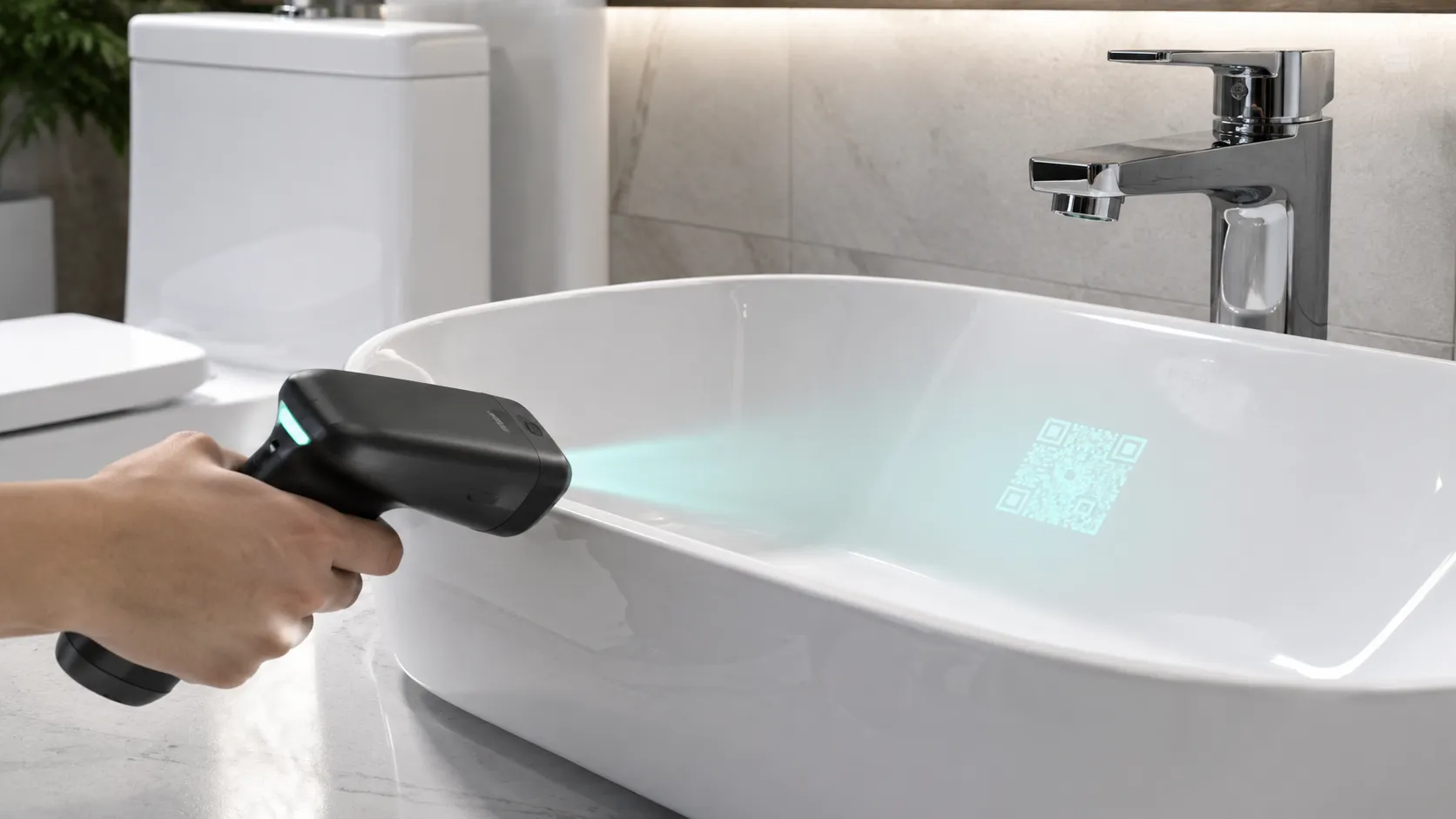
The quality inspector scans incoming fastener shipments with Mina’s handheld device. Authentic fasteners return a confirmed signal with lot data. Non-authenticated fasteners — those without the invisible marker — are quarantined. A mixed-lot contamination scenario is immediately flagged because the counterfeit bolts will not carry the marker.
Point-of-installation verification
For safety-critical connections — moment frames, anchor bolts, turbine flanges — the ironworker or inspector scans the fastener before or immediately after installation. The result is logged as part of the bolting inspection record, satisfying both QA documentation and the traceability requirements of ISO quality management systems.
Post-incident investigation
If a connection fails or a fastener fractures during service, the covert marker survives the fracture surface. A fragment recovered from the failure can be scanned to identify the manufacturer, lot, and treatment batch — accelerating root-cause analysis and establishing whether the fastener was genuine or counterfeit.
Procurement FAQ: Counterfeit Fastener Detection
Does the ink marker affect the bolt’s tensile or fatigue performance?
No. Mina’s high-temperature ink is a surface-bonded trace layer — it does not penetrate the steel grain structure, alter the heat-treatment profile, or affect the bolt’s mechanical properties. Fasteners marked by Mina can still be tested per ASTM F606 / ISO 898-1 with no deviation from baseline performance. Mina provides compliance documentation upon request.
Can the marker be read after galvanizing?
Yes. The ink is applied before galvanizing and bonds to the base metal at a molecular level. The zinc coating (hot-dip per ASTM A153 or mechanical per ASTM B695) covers the marker but does not block detection. Mina’s reader operates through the coating layer without requiring zinc removal — a significant advantage over head-mark inspection, which is often obscured or filled by zinc buildup.
How does this compare to traceability via head markings and lot codes?
Head markings and lot codes are stamped onto the fastener during manufacturing — but they are also the first thing a counterfeiter replicates. The mark itself carries no inherent security. Mina’s invisible marker is applied by the legitimate manufacturer and cannot be reproduced because the material and detection technology are proprietary. The head mark tells you what the fastener claims to be. The Mina marker tells you what it is.
What volume of fasteners can be verified during a typical receiving inspection?
Mina’s handheld device delivers a result in 2–3 seconds per fastener. For bulk shipments, statistical sampling per ANSI/ASQ Z1.4 is applied — a typical inspection lot of 10 000 bolts at AQL 1.0, Level II, requires scanning 200 units, which takes under 10 minutes. Full 100% verification is practical for safety-critical items where lot sizes are smaller (anchor bolt assemblies, turbine flange bolts).
Does Mina’s marking system work with tension-control (TC) bolts?
Yes. TC bolts (ASTM F3125 Grade A325TC / A490TC) have a spline tip that shears off during installation. The marker is applied to the bolt head and nut — both of which remain on the connection after installation. The sheared spline can also carry a marker if post-installation fragment tracing is required.
Counterfeit fastener detection at the material level turns an invisible risk into a verifiable data point. If your procurement or QA program is ready to add this layer, Mina can support a pilot — from manufacturer integration through site-level deployment.