
TCG and Collectible Card Anti-Counterfeiting: 5 Best Defenses
TCG and collectible card anti-counterfeiting has become a procurement priority for IP-licensed publishers, celebrity photocard producers, and graded-card authenticators. Modern offset and digital presses now reproduce printing dot patterns, hot foil, and holographic refraction at a fidelity that defeats unaided inspection — a trained collector with a 10x loupe can no longer reliably separate an authorized print run from a high-resolution proxy. Unauthorized night-shift overruns from contract printers compound the problem: cards printed on real stock with real inks flood secondary markets without ever appearing on a manifest. Mina builds the covert authentication layer that publishers, talent agencies, and grading houses deploy to keep card aesthetics intact while making proxy card detection deterministic.

The collectible asset vulnerability matrix
Counterfeit traffic in trading cards rarely starts at the print run that ends up on a marketplace. It starts upstream, often inside the licensed supply chain itself. Mapping where and how value leaks gives IP holders a defensible scope for TCG and collectible card anti-counterfeiting investment, rather than reacting to a graded fake on the secondary market long after losses are realized. Four stages account for nearly every documented incident.
Design and asset leakage
Authorized art files, foil dies, and pre-press outputs move through multiple suppliers — converters, foil stampers, finishers. Any one of them can hand off the assets that make a flawless proxy possible.
Night-shift overrun
Contract printers running unrecorded shifts produce real-paper, real-ink overruns that bypass quality control, finance, and licensing entirely. The output is physically identical to authorized stock.
High-fidelity proxy reprint
Independent counterfeiters with modern presses replicate dot gain, foil refraction, and rainbow holography. Inspection by loupe rarely flags the difference. Photocard authentication is especially exposed.
Secondary-market trust collapse
When grading houses encounter mixed-source submissions, slabbed prices wobble. The publisher’s catalog loses pricing authority, and brand equity erodes faster than a pull rate.
Three of the four failure stages happen inside the licensed supply chain. Anti-counterfeiting features applied only at the artwork layer cannot reach the upstream half of the problem.
Why proxy card detection has outgrown the loupe
A decade ago, hot foil registration tolerances and ink layering separated factory output from anything counterfeiters could match. That gap has closed. Three structural shifts have made unaided proxy card detection unreliable, even for full-time graders.
Press fidelity is now commodity
Mid-tier offset presses bought on the second-hand market match the registration accuracy of the licensed printer. Variable-data inkjet finishing reproduces serial numbers and fractional-rarity stamps without measurable signal from the substrate. Optical inspection has lost the asymmetry it relied on for two decades.
Foil and holographic stock leaks downstream
Holographic film and OVI inks were once gated behind security printer agreements. They now circulate as B-grade stock through specialty trade shows. Counterfeiters source the same foil dies and rainbow patterns the publisher specified, eliminating the visual tell authenticators relied on.
Capital is flowing into TCG faster than authentication evolves
Pokemon, Yu-Gi-Oh, sports rookies, and K-pop photocard secondary markets crossed multi-billion-dollar volumes in the past three years. Auction-house headlines pull professional counterfeit operations into a category that historically self-policed through community knowledge. Visual-only authentication does not scale to the submission volumes grading houses receive today.
Mina’s aesthetic-preserving security layers for premium prints
The objection IP-side art directors raise most often is that anti-counterfeit marks scar the card. They are right when the marks are visible. Mina integrates invisible security features for premium prints across three layers of the card construction, none of which alter the surface a collector sees, the foil refraction, or the touch finish. Integration runs at material level, not at art level.
UV Varnish
Surface over-print, micrograms-per-square-meter loading
Mina inorganic markers blend into the over-print UV varnish without altering gloss, matte, soft-touch, or embossed finishes. A handheld Mina reader returns the marker signature in under two seconds at the grading desk — no rework to the artwork or the foil pass.
Ink + Foil
Micro-chain code beneath the foil and CMYK stack
Micro-chain code and dot matrix code are deposited beneath the foil layer or alongside the CMYK ink stack. The code is keyed to the print run, the licensee, and the SKU. Even if a counterfeiter reproduces the artwork bit-for-bit, the absence of the encoded layer is detected at first verification.
Core Stock
Inorganic marker loaded into the paper itself
For top-tier products — chase rares, signature cards, numbered runs — the inorganic marker is loaded into the core stock during paper manufacture. The marker survives slab encapsulation, tournament shuffling, and decade-scale storage without optical drift.
The art remains the art. The card retains the visual language collectors paid for. Authentication runs as an invisible overlay that is never advertised to the counterfeiter and never seen by the buyer.
Brand licensing overrun control for IP holders
The hardest counterfeit problem for licensed TCG and photocard publishers is the one their existing supply chain creates: a contract factory that already owns the artwork, the dies, and the substrate produces additional units off-books. Conventional anti-counterfeit features cannot detect this fraud, because the cards carry every authorized feature. Detection has to happen at the material layer, before the press starts.
Mina pairs the printing partner’s substrate and ink batches with chemical markers issued only against an authorized purchase order. A factory that prints the night-shift run does not have the marker. Cards entering the secondary market without the marker are flagged automatically, without the publisher needing to prove anything about the factory’s books.
This logic mirrors what licensed brands deploy in adjacent categories. The same allocation discipline is documented in Mina’s brand licensing overrun control framework, and the covert-marker approach used to authenticate premium fashion translates directly to graded card runs — see invisible apparel authentication for the comparable supply-chain pattern.
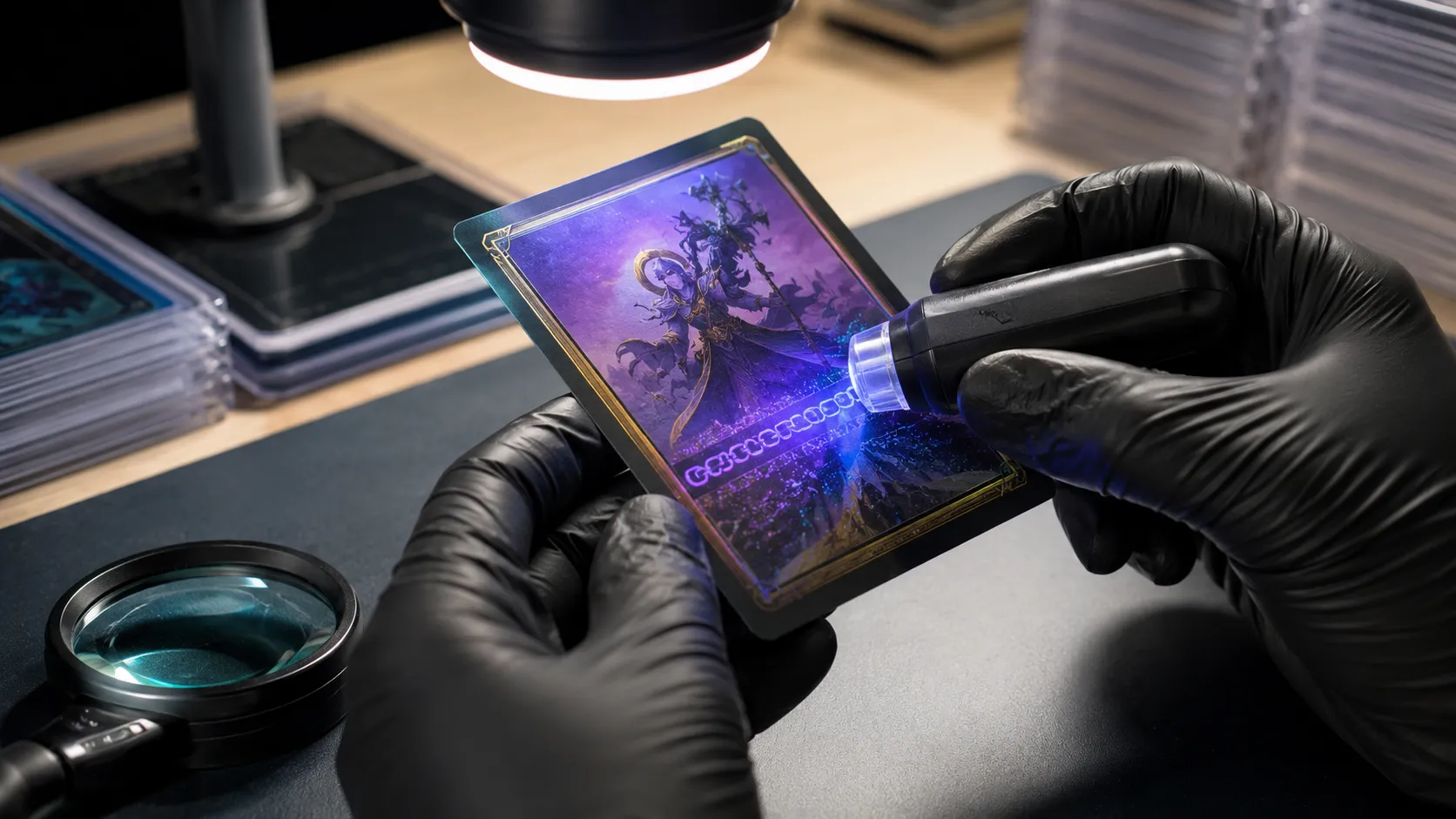
The counterfeit battlefront — proxy cards vs authenticated
Three approaches dominate the TCG security stack today. The table below benchmarks them against the two failures that matter most to publishers and graders: high-fidelity proxy card detection, and detection of real-paper, real-ink factory overruns. Aesthetic impact and verification time are weighted as procurement constraints.
| Capability | Microtext / guilloché print | OVI / thermochromic ink | Mina invisible micro-chain code + material licensing |
|---|---|---|---|
| High-fidelity proxy detection | Marginal — mid-tier presses reproduce | Partial — OVI stock now circulates | Deterministic — code absence flags fakes |
| Internal overrun detection | No | No | Yes — marker tied to authorized PO |
| Aesthetic impact on card face | Visible if scaled to readable size | Visible color shift | Zero — covert at material level |
| Field verification time | 10x loupe, trained eye | Manual heat or angle test | Handheld reader, < 3 seconds |
| Survives slab + decade-scale storage | Yes | UV / heat sensitive | Yes — inorganic, no drift |
| Visible to handler / counterfeiter | Overt | Overt | Covert |
Field verification, grading, and procurement FAQ
Six questions raised most often by TCG publishers, photocard procurement teams, and grading houses during Mina supplier evaluation. Answers reflect deployments aligned with international IP-protection guidance from the World Intellectual Property Organization and security-print conformity frameworks such as ISO 14298.
-
Q.01
Does the Mina marker affect the card’s slab grade?
PSA, BGS, and CGS grading depends on centering, surface, edges, and corners. Mina markers operate beneath the visible spectrum and at micrograms-per-square-meter loading. They do not alter color, gloss, or surface texture, and have no measurable effect on slab grading. Verification is performed before encapsulation; the slab itself is never disturbed.
-
Q.02
Can the marker be applied to existing in-market product?
The covert layer is applied during production. Cards already in circulation cannot be retroactively authenticated. Most publishers begin with the next print run of a flagship set or the next photocard release of a tour, rather than back-applying to legacy inventory. Brand licensing overrun control coverage starts at the date of the first marked print run.
-
Q.03
How does the Mina reader integrate with grading workflows?
The handheld reader returns a signature against a publisher registry maintained by the IP holder. Output exports to grading-house intake systems via API or CSV. Reading is non-destructive, takes under three seconds, and runs at the same station where centering and surface inspection already occur. No additional handling step is introduced.
-
Q.04
How do you protect against insiders cloning the marker chemistry?
Marker chemistry is manufactured at Mina facilities and shipped pre-formulated to the licensed printer. Code keys are held by the IP publisher, not by the printer. A factory cannot mix marker stock locally and cannot reverse-engineer the chemistry from finished card output. The covert security feature is decoupled from the print process itself.
-
Q.05
Does the same approach work for celebrity photocard authentication?
Yes. Photocard production volumes, lithographic finishes, and substrate stock fall within the same envelope as TCG. Mina’s micro-chain code embeds against the inkjet variable-data layer used for serialized photocards, which makes per-card verification possible at fan-meet entry, official re-sale validation, and platform listings.
-
Q.06
What pricing structure is typical for IP-licensed publishers?
Pricing is anchored to authorized print volume and the number of SKUs covered, not to per-card markup. A pilot typically scopes a single chase set, a flagship promotional run, or one photocard release cycle. Procurement engages directly with Mina at the brand or licensing-team level, not through the contract printer.
Move TCG and collectible card anti-counterfeiting into production
Implementing TCG and collectible card anti-counterfeiting as a production layer rather than a defensive feature shifts the economics of the secondary market in the publisher’s favor. Counterfeiters cannot replicate what they cannot see. Contract printers cannot overrun what they cannot mark. Grading houses gain a verification step that moves at the speed of intake, and IP holders recover pricing authority over their own catalog.
Procurement teams typically evaluate Mina across three benchmarks:
- Aesthetic neutrality on flagship and chase products
- Field verification speed at grading intake
- Overrun detection certainty against the licensed factory base
For publishers, talent agencies, and grading houses building the next generation of brand protection — including teams already evaluating anti-counterfeiting technology stacks for 2026 — Contact Us to scope a Mina pilot against your next print run.