Consumer verification program design
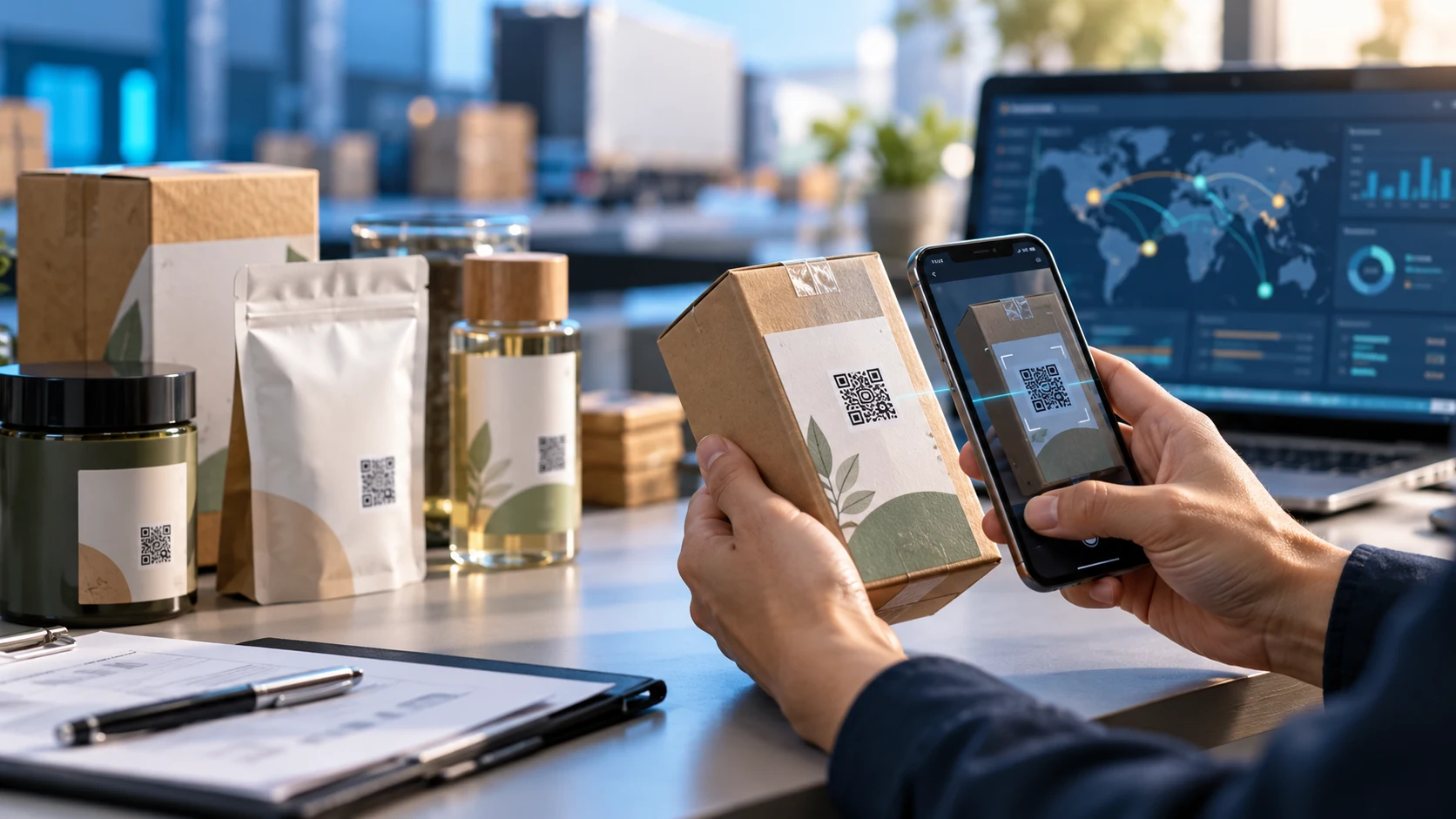
QR code authentication is a verification design in which each product carries a code that consumers or staff scan with a phone to confirm the product is genuine, with the answer coming from the brand’s server rather than anything printed on the pack. Retail is standardizing around exactly this capability: under GS1’s Sunrise 2027 initiative, point-of-sale systems worldwide are moving to 2D codes that double as web links. But a QR code is inherently copyable, so a scan-to-verify program is only as strong as the serialization, analytics, and covert layers behind the code. This guide covers the design decisions that make consumer verification work, and the failure modes that quietly break naive programs.
Working definition: QR code authentication is server-backed product verification triggered by a phone scan of a unique code, judged by what the brand’s records say about that code, when it was first scanned, and how often.
Key takeaways for brands building scan-to-verify
The code is a door, not a lock. The security lives in the server, the serialization, and the analytics; the printed QR is just the entry point a counterfeiter can photograph.
Copied codes resolve normally. A duplicated code answers the scan correctly until duplicate and first-scan data flags it, so analytics is not an optional extra.
First-scan logic has a known flaw. If a counterfeit is scanned before the genuine product, “already scanned” points at the wrong pack; pairing with covert identity resolves the ambiguity.
Retail infrastructure is arriving. Sunrise 2027 moves point of sale to 2D codes carrying GS1 Digital Link, making verification scans a native retail behavior rather than a novelty.
Codes alone do not prove the object. A scan proves a code exists in the system; pairing a public code with a covert layer proves the physical product is the one the record describes.
Privacy and data ownership decide scale. Consumer scans create personal data; retention rules and ownership boundaries belong in the program design from day one.
What QR code authentication is, and what it is not
A scan-to-verify program assigns each product unit, or each pack, a code that resolves to the brand’s verification service. The consumer scans, and the page answers with what the records support: first scan of a genuine code, expected market, production window, and product details. Done well, it turns every buyer into a sensor, at a marginal cost per pack close to zero, and every scan into data about where products, and fakes, actually travel.
The design has three moving parts, and most weak programs are missing one. Serialization: each code is unique and tied to a record, rather than one code printed identically on every pack. Server judgment: the answer comes from the brand’s system, not from anything visually encoded. Analytics: the system records when each code was first scanned, how often, and from where, because a code scanned in two countries within an hour is telling you something no single scan can.
What QR authentication is not: a physical anti-counterfeit feature. The code pattern is public, cameras copy it faithfully, and nothing about the square pattern itself resists duplication. Treating the printed code as the security, rather than the system behind it, is the defining mistake of failed programs.
How copied codes break naive programs
Photocopy duplication
A standard QR is a visible pattern; counterfeiters photograph or reprint it onto thousands of fake packs, and every copy resolves to the genuine product page.
First-scan inversion
“Valid on first scan” logic fails when the counterfeit reaches a scanner before the genuine pack: the fake is validated and the original is later called a duplicate.
One-code-fits-all printing
Programs that print a single marketing QR on every pack verify nothing; every scan, genuine or fake, returns the same success page.
Quishing and replacement
Attackers also replace or overlay codes to route scanners to phishing pages, so the verification page itself must be brand-controlled and its URL behavior consistent.
None of these failure modes argues against QR authentication; they argue for designing past them. The strongest programs treat the public code as the outermost layer of a stack: unique serialization behind it, analytics watching it, and a covert feature under it that a counterfeiter cannot even find. The industry’s own trajectory supports the investment: GS1 reports strong consumer appetite for scannable packs, with a 2025 GS1 US survey finding most shoppers more likely to buy a product carrying a QR with extra information, which means the scan habit brands spent years building is arriving, and counterfeiters know it.
Verification designs compared, from static code to covert pairing
| Design | What it delivers | Main weakness |
|---|---|---|
| Static marketing QR on every pack | Content, campaigns, product pages | Identical on fakes; verifies nothing |
| Serialized unique QR with server records | Per-unit verification answer from the brand’s system | Copied codes resolve normally until analytics flags them |
| First-scan / single-use logic | Duplicate detection per code | First-scan inversion: a fake scanned early validates itself |
| Scan analytics with geography and timing | Anomaly detection: burst scans, wrong markets, odd hours | Monitoring and thresholds need operations, not just software |
| Mina AI cloud code (phone-readable) | Unique dot-matrix code whose random point features are read by visual AI in an ordinary camera | Public layer pairs most strongly with covert identity for object-level proof |
| Public code plus Mina covert layer | Scan for consumers, dedicated-device verification for inspectors | Covert checks require device governance and authorized staff |
The pairing row is where strong programs land: the same article carries a code the public can scan and hidden information only authorized devices can read, so a copied code can be challenged by an inspector in seconds. Mina’s overview of invisible packaging codes and its guide to stopping diversion in consumer supply chains cover the same layered architecture in channel terms.
Mina’s phone-readable verification layer
Mina’s AI cloud code replaces the standard QR with a dot-matrix code generated so that each point carries random visual features, read by visual AI through an ordinary smartphone camera, without special equipment. The code carries information invisibly at high density, resists casual reproduction better than a plain printed square, and is designed for consumer-scan volumes where millions of packs must verify quickly and stably.
Behind the code sits the behavior that catches copying: the verification service records first-query time and query counts for every code. One first scan in the expected market looks right; the same code scanned across a thousand packs in a week does not, and the system surfaces the pattern for the brand’s team. For inspectors, the same product can carry Mina’s ultra-invisible layer, verified with dedicated detection devices that return sound and vibration or display hidden information only on genuine print, giving enforcement a binary answer where consumer analytics give probabilities.
Scope boundaries: the public code authenticates data about the unit; the covert layer authenticates the object. Codes and analytics belong to the brand’s program; Mina supplies the code technology, the reading experience, and the covert pairing, alongside one-item-one-code data that links each unit to production and distribution records for recall and diversion work.
Program rollout workflow
- 1
Scope the program
Choose markets, SKUs, and audiences: consumers, retail staff, inspectors, warranty teams. Define what a scan must answer for each.
- 2
Serialize and integrate
Generate unique codes per unit, tie them to production records, and integrate printing into existing packaging lines without redesign.
- 3
Build the server behavior
Design answers for first scan, repeat scan, wrong-market scan, and burst scans, with a consistent brand-controlled page and URL.
- 4
Test against attacks
Panels must include genuine packs, photocopy-cloned codes, first-scan inversion attempts, and re-printed labels; every attack should be flagged or escalated.
- 5
Pilot and monitor
Launch one market, watch scan analytics weekly, tune duplicate thresholds, and confirm the covert layer resolves ambiguous cases.
- 6
Scale and govern
Extend across SKUs, publish verification instructions in packaging and campaigns, and hand monitoring to an owned operations cadence.
One rule of thumb keeps programs honest: assume the code will be copied from the first day, and let the design prove which physical pack is real when it happens.
Retail standards alignment and data governance
Verification programs now intersect with retail infrastructure. GS1’s Sunrise 2027 initiative moves point of sale worldwide toward 2D codes carrying GS1 Digital Link, so one code can serve both checkout scanning and web-based experiences; GS1 US frames 2027 as a milestone rather than a hard deadline and recommends brands begin with codes on packaging and retailers with scanner readiness. Brands building verification should align code strategy with these standards so the same mark works at the till, in the campaign, and at the verification page.
Data governance is the other half of scale. Consumer scans create records with personal elements: device, time, approximate place. Programs need explicit rules for retention periods, aggregation for analytics, lawful handling under applicable privacy law, and clear ownership of the serial registry and scan data. A verification program that leaks trust through its data practices fails the same brand promise it was built to protect.
Finally, run verification as operations, not as a project: weekly duplicate-scan reviews, takedown evidence packs from scan clusters, and quarterly audits of the covert layer’s coverage keep the program alive after launch enthusiasm fades.
Limitations and risks to state plainly
A scan proves the code, and only the code. Without a covert pairing, the strongest claim available is statistical: this code has behaved like a genuine one. First-scan inversion is unresolvable from scan data alone, and low-scan products may take months before duplicate patterns surface.
Adoption is voluntary: consumers who never scan generate no signal, so verification coverage is partial by nature, and quishing-style attacks target the scanner’s trust as much as the code. Codes depend on print quality, packaging survival, and line integration; a code that will not scan is a recall-grade packaging defect. And analytics thresholds set too tight create false accusations against genuine buyers, which is worse for trust than the counterfeits they chase; ambiguity should route to inspection, not to consumer-facing verdicts.
FAQ: QR code authentication
What is QR code authentication?
Server-backed product verification triggered by a phone scan of a unique code on each unit, with the answer judged by the brand’s records of that code, its first scan, and its scan history, rather than by anything printed on the pack.
Can a QR code stop counterfeiting by itself?
No. A QR is a copyable pattern; duplicated codes resolve normally until analytics flags them. Strong programs pair the public code with serialization, scan analytics, and a covert physical layer.
What is the first-scan problem?
If a counterfeit pack is scanned before the genuine one, “valid on first scan” logic validates the fake and later flags the original, so first-scan logic alone cannot identify which physical pack is real.
What is Sunrise 2027?
A GS1-led industry move to 2D codes, such as QR carrying GS1 Digital Link, at retail point of sale worldwide by the end of 2027, letting one code serve checkout scanning and web-based product experiences.
How is Mina’s cloud code different from a normal QR?
It is a dot-matrix code whose points carry random visual-AI features read through an ordinary camera, and the verification service records first-query time and query counts per code, exposing duplication patterns.
What should be tested before launching a scan program?
Unique serialization per unit; server answers for first, repeat, wrong-market, and burst scans; attack panels including photocopy cloning and first-scan inversion; print survival through packaging lines; and privacy-approved data retention rules.
Sources
Build verification that survives the screenshot
If your brand is planning scan-to-verify, or your current QR program was designed before copied codes were a problem, prepare a brief covering your packaging, markets, and scan volumes. Mina can evaluate a phone-readable cloud code with first-query analytics and covert pairing for your products, and propose an acceptance test plan. QR code authentication works when the system behind the square is stronger than the copy.