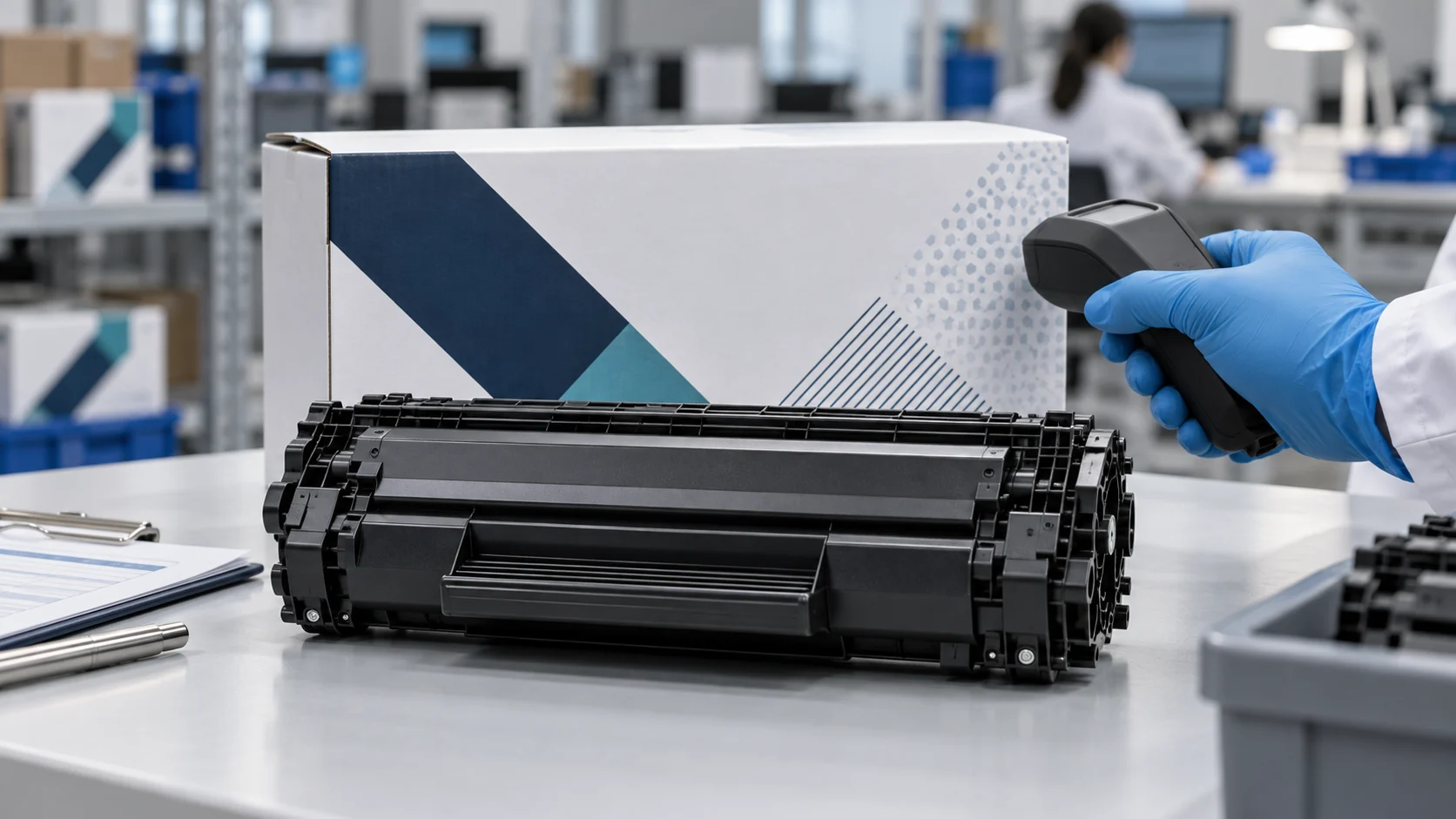
Executive Decision Overview: Global pharmaceutical compliance and packaging procurement managers face critical patient safety risks when secondary serialized cartons are discarded at hospital pharmacies or retail dispensaries. Illicit repackagers routinely insert counterfeit, sub-potent blister strips into genuine outer cartons. Because primary push-through (PTP) aluminum foil and cold-forming alu-alu laminates require strict compliance with food-contact migration limits (FDA 21 CFR, EU 10/2011, and cGMP), standard security inks risk leaching hazardous photoinitiators or heavy metals into the blister pocket. This engineering guide examines how low-migration, inorganic covert inks applied via high-speed rotogravure deliver unit-dose anti-diversion and forensic verification with zero chemical migration risk.
The Primary Packaging Vulnerability: Unit-Dose Separation from Secondary Serialized Cartons
Under global track-and-trace mandates—such as the United States Drug Supply Chain Security Act (DSCSA) and the European Union Falsified Medicines Directive (EU FMD)—pharmaceutical manufacturers are legally required to apply serialized 2D DataMatrix codes, tamper-evident seals, and human-readable National Drug Codes (NDCs) to secondary folding cartons. While these measures protect bulk warehouse distribution, they create a severe security blind spot at the point of patient dispensing.
In hospital wards, clinical care facilities, and retail pharmacies across emerging markets, secondary cartons are routinely opened, and individual push-through (PTP) blister strips or single unit-dose pockets are separated for daily patient administration. Once separated from the serialized outer box, the primary aluminum blister strip carries only generic text (active ingredient name, dosage strength, and basic lot numbers). This disconnect is aggressively exploited by organized counterfeit syndicates:
- Carton Salvaging & Blister Swapping: Illicit operators collect genuine, empty secondary pharmaceutical cartons from hospital disposal streams, insert counterfeit blister packs containing chalk, starch, or sub-potent active pharmaceutical ingredients (APIs), reseal the carton with forged adhesive tabs, and resell them to secondary distributors.
- Illicit Unit-Dose Re-blistering: Stolen bulk tablets or expired medications are re-sealed into counterfeit aluminum foil printed with falsified expiration dates, bypassing retail visual checks entirely.
- Territorial Grey-Market Diversion: Subsidized medications allocated for government health programs or institutional tenders are diverted into private retail channels, with rogue wholesalers stripping secondary outer cartons to obscure geographic distribution barcodes.
To ensure patient safety and regulatory compliance across the entire dispensing cycle, pharmaceutical quality directors and packaging development teams must implement low-migration covert authentication on primary blister packaging, embedding forensic-grade security directly onto the PTP aluminum foil.
Chemical Migration Risk: Food & Drug Contact Compliance (FDA 21 CFR & EU 10/2011)
Unlike secondary paperboard packaging, functional inks applied to pharmaceutical blister foil represent a direct product-contact risk. PTP blister foil typically consists of a multi-layer structure: outer primer layer (1.0–1.5 g/m²), hard-temper aluminum foil barrier (20 μm–25 μm), and an inner heat-seal lacquer (HSL, 4.0–6.0 g/m²) engineered to seal against PVC, PVDC, or Aclar forming films at 140°C–180°C.
During the rotary blister sealing cycle, elevated temperature and mechanical pressure can cause volatile organic components, free monomer photoinitiators (such as benzophenone or ITX), and toxic heavy metals from conventional printing inks to undergo set-off migration during foil rewinding, or vapor migration through microscopic pinholes directly into the medication cavity. If toxic migrants interact with moisture-sensitive APIs, they induce chemical degradation, alter dissolution rates, and trigger catastrophic regulatory recalls.
To eliminate migration hazards, Mina’s pharmaceutical-grade covert inks utilize high-purity, chemically inert inorganic crystal taggants compounded into certified low-migration solvent-based and water-based vehicle resins. These formulations contain zero volatile plasticizers, zero mineral oil aromatic hydrocarbons (MOAH/MOSH), and zero restricted heavy metals (lead, cadmium, mercury, hexavalent chromium), achieving complete compliance with FDA 21 CFR 175.300 and EU Regulation (EU) No 10/2011 specific migration limits (SML < 0.01 mg/kg).
Rotogravure & Flexographic Press Integration: Rheology at 150+ Meters/Minute
Pharmaceutical foil converting lines operate high-speed rotogravure and central impression (CI) flexographic printing presses at web speeds exceeding 120 to 200 meters per minute. Any functional security additive must maintain strict rheological stability without causing cylinder clogging, foaming, or drying rate variations.
Mina’s low-migration covert pharmaceutical inks are engineered with sub-micron particle sizing ($D_{50} < 1.0\ \mu\text{m}$ and $D_{90} < 2.5\ \mu\text{m}$), providing distinct mechanical and converting advantages:
- Gravure Cylinder Compatibility: Precision dispersion prevents pigment sedimentation in printing ink pans and avoids clogging shallow gravure cells (screen counts from 70 to 120 lines/cm), ensuring sharp micro-pattern reproduction.
- Heat-Seal Lacquer Adhesion & Sealing Window: The ultra-thin printed ink layer (≤ 1.2 μm dry film thickness) does not reduce the heat-seal strength between the aluminum foil and thermoformed PVC/Aclar blisters, maintaining seal integrity (>7.0 N/15mm per ASTM F88) and package leak tightness (ASTM D3078).
- Push-Through Rupture Performance: The formulation does not alter the physical bursting characteristics of hard-temper aluminum foil, ensuring consistent push-through force for pediatric and geriatric patients without tearing jagged foil edges.
Technical Comparison: Pharmaceutical Blister Authentication Technologies
The table below provides a technical decision matrix for pharmaceutical packaging engineers evaluating primary packaging security options:
| Performance & Regulatory Metric | Conventional UV Fluorescent Ink (365 nm) | Holographic Foil Demetallization | Mina Low-Migration Covert Inorganic Foil Ink |
|---|---|---|---|
| Food/Drug Contact Migration Safety | High Risk (organic dyes leach photoinitiators). | Low (physical aluminum layer; no ink migration). | Certified Zero-Migration (FDA/EU 10/2011 compliant inorganic matrix). |
| Resistance to Counterfeiter Replication | Very Low (standard UV ink widely available). | Moderate (holographic patterns copied by tooling shops). | Forensic Grade (narrow-band excitation; invisible to UV lights). |
| Impact on Heat-Seal Strength | Can degrade seal if overprinted in seal zone. | Can create micro-pinholes during embossing. | Zero Impact; preserves >7.0 N/15mm heat-seal bond. |
| Unit-Dose Serialization Capability | Limited to bulk repeating patterns. | Static holographic repeating grid only. | Discrete Micro-Chain & Dot-Matrix Serial Coding per pocket. |
| Hospital & Pharmacy Audit Speed | Requires UV blacklight in dark room. | Visual tilt check only (high human error). | Instant 0.5s Pass/Fail via Mina Handheld Optical Reader. |
| Press Converting Speed Limit | Standard solvent press speeds. | Slower speeds due to holographic registration. | Maintains Full Press Speeds (>180 m/min). |
Operational Detection Architecture: Hospital Receiving, Customs & Field Audits
A primary packaging security system must support both routine frontline verification and legally defensible forensic confirmation without compromising sterile barrier packaging:
1. Hospital Receiving & Pharmacy Point-of-Care Audits
Hospital pharmacists and procurement compliance officers scan blister strips using compact, battery-operated Mina handheld optical readers. The device non-destructively reads the covert signature directly through transparent PVC/PVDC blister domes in 0.5 seconds, verifying that the enclosed solid dose originated from an authorized manufacturing facility before administration to patients.
2. Anti-Diversion Geographic Batch Mapping
By incorporating serialized covert micro-chain codes into specific rotogravure printing cylinders, pharmaceutical manufacturers assign unique covert territory keys to specific tender markets. When diverted hospital-only blister strips appear on retail e-commerce pharmacies, auditors decode the covert markings to identify the leaking wholesale distributor.
Procurement & Engineering Due Diligence Checklist
Before issuing requests for quotation (RFQs) and conducting line trials with aluminum foil converters, pharmaceutical packaging procurement teams must verify the following core parameters:
Engineering Checklist for Blister Foil Covert Ink Qualification
- Specific Migration Testing (SML): Require accredited third-party laboratory reports (e.g., GC-MS and ICP-MS screening per EN 13130) proving total specific migration < 10 ppb in food simulants (Tenax and 95% ethanol).
- Foil Substrate Specifications: Identify exact foil structure (e.g., 20 μm hard-temper aluminum with 1.2 g/m² primer and 5.0 g/m² PVC/PVDC heat-seal lacquer).
- Ink Adhesion & Rub Resistance: Confirm ASTM D3359 cross-hatch tape test (5B rating) and Sutherland rub resistance (>400 cycles with MEK and ethanol).
- Sealing Tool Temperature Compatibility: Verify that the covert ink formulation withstands continuous platen or rotary blister sealing temperatures up to 200°C without scorching, smoking, or optical signal fading.
Structuring a 3-Phase Pharmaceutical Validation Protocol (IQ/OQ/PQ)
In adherence to Good Manufacturing Practice (cGMP) guidelines, pharmaceutical manufacturers should execute a formal qualification roadmap:
- Phase 1: Laboratory Proof-of-Concept & Migration Screening: Apply covert ink drawdowns to production-grade aluminum foil. Conduct accelerated stability chamber testing (40°C / 75% RH for 6 months per ICH Q1A guidelines) and execute extractable/leachable chemical migration profiling.
- Phase 2: Press & Packaging Machine Trial (Installation & Operational Qualification): Run a 20,000-meter commercial rotogravure printing trial on production foil converting presses. Transfer printed foil rolls to high-speed Uhlmann or Bosch blister packaging lines; verify heat-sealing window, blister pocket formation, and automated optical vision inspection rejection rates.
- Phase 3: Supply Chain Blind Trial (Performance Qualification): Distribute marked commercial blister batches through clinical supply channels alongside non-marked control samples. Validate handheld optical reader decodability, reading speed, and false-negative rates across diverse hospital ambient lighting conditions.
Safeguard Your Solid Dose Medications at the Primary Packaging Level
Eliminate unit-dose counterfeit vulnerabilities without compromising food-contact migration compliance or high-speed packaging throughput. Consult with Mina’s pharmaceutical packaging specialists to evaluate low-migration covert inks and request sample foil drawdowns for your laboratory validation.