Appliance consumables brand protection
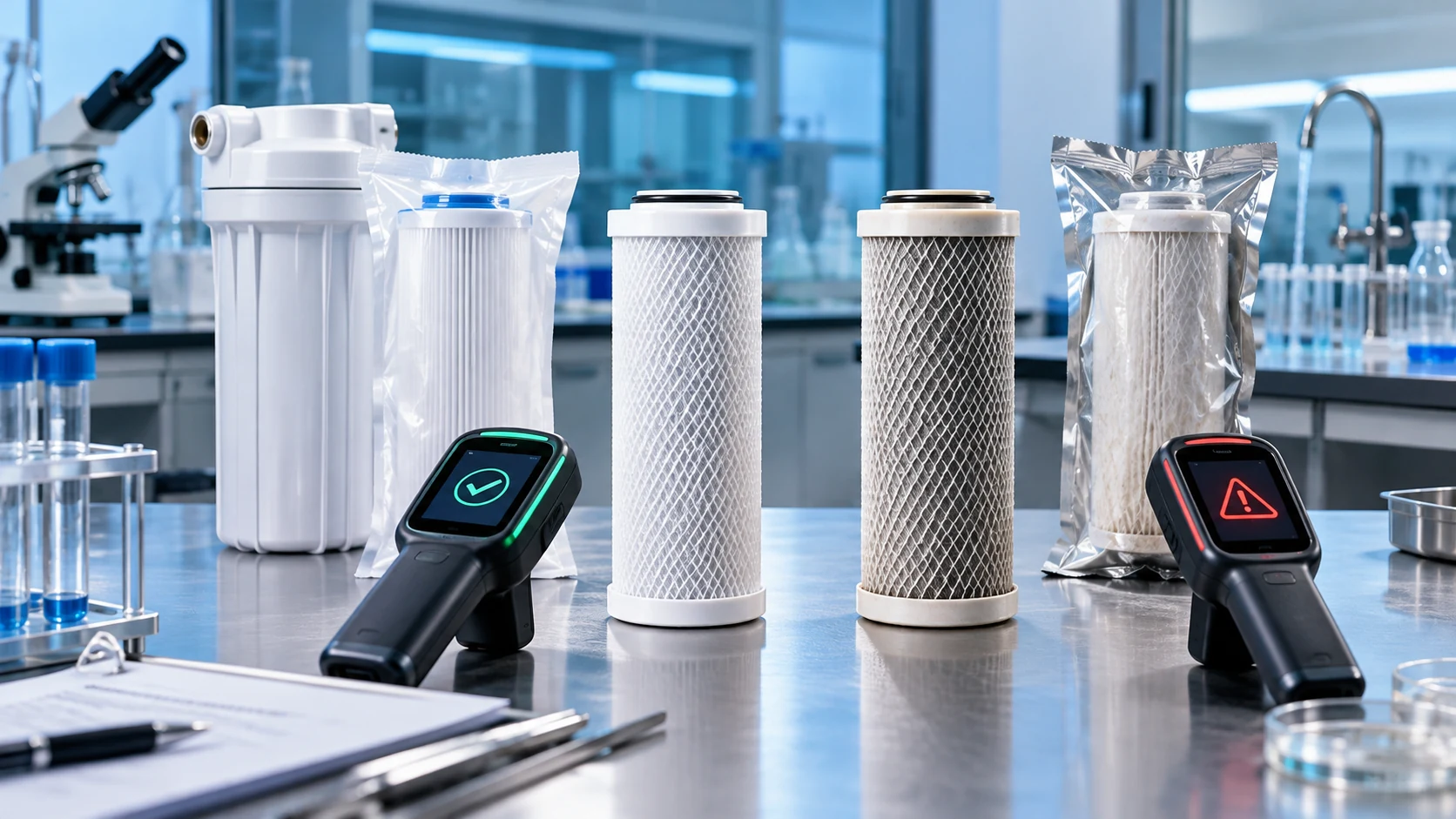
Counterfeit water filters are replacement cartridges made to imitate branded filters while skipping the certification and media quality their packaging claims. An industry-funded laboratory study of 100 known counterfeits found they underperformed genuine filters, and a trade association warned some were introducing contaminants into otherwise clean water. For appliance brands, filter manufacturers, and the retailers and service channels that sell replacements, this guide explains how fake filters reach households, why certification logos alone have not stopped them, and how layered authentication on filter packaging closes the gap.
Official red flags, summarized
- Blurry print, misspellings, off-color logos
- Missing or questionable certification logos
- Unsealed packs and low-quality cardboard
- Prices far below brand cost
- Shipments from outside expected regions
- Unknown sellers with vague contact details
Key takeaways for filter brands and buyers
The fake is in the packaging, not just the plastic. Counterfeits copy boxes, holograms, and certification symbols so well that a trade association called them almost impossible to distinguish visually; the fight has to move to features counterfeiters cannot copy.
Health risk is documented. Lab testing of 100 counterfeit filters found performance below genuine filters and, in the association’s warning, cancer-causing chemicals introduced into clean water; genuine filters failed to be outperformed by no counterfeit tested.
Certification marks get forged too. NSF publishes public notices about unauthorized use of its mark; a logo on a box is a claim, not proof, and should be checked against the certifier’s database.
Marketplaces are the main gateway. Official guidance points at unknown third-party sellers, too-good pricing, and overseas shipment as the pattern; authorized-seller controls are the first defense.
Layered authentication works at every step. A consumer scannable code on each pack, a covert marker for brand inspectors, and first-scan analytics for the brand expose fakes at purchase, at retail audit, and in bulk intake.
Authentication complements certification. It proves the specific pack is the brand’s product; NSF/ANSI certification remains the authority on what the filter does to water.
What are counterfeit water filters?
Counterfeit water filters are replacement cartridges, most commonly refrigerator filters, sold under the appearance of an established brand without being made, tested, or authorized by it. The imitation operates at the packaging layer: boxes, holograms, model numbers, and certification symbols are copied onto products whose filter media and housings never passed the claimed evaluations. They are distinct from compatible filters sold honestly under their own brand names, which compete legally on price and performance claims of their own.
The pattern follows consumable economics. Refrigerator filters are replaced on six-month cycles, purchased by model number, and bought sight-unseen online, which makes lookalike boxes at a discount an easy fraud to move. Whirlpool’s guidance for its everydrop line lists the telltales: blurry print, misspellings, off-color logos, unsealed packaging, questionable certification logos, nonstandard model numbers, and prices that seem too good to be true.
The buyer problem is that those telltales describe the bad copies. The better copies defeat visual inspection entirely, which is what the industry’s own testing found.
The documented hazard: what 100 counterfeit filters revealed
An investigation broadcast across US regional television and informed by the Association of Home Appliance Manufacturers traced counterfeit filters from a fake Brooklyn return address to households from Michigan to New York. A customer’s order arrived bearing an everydrop label; the trade association’s representative said the counterfeit and genuine filters were almost impossible to tell apart, with matching logos, stickers, markings, and certification symbols.
The association funded laboratory testing of 100 known counterfeit filters. The fakes underperformed brand-name filters across the tested categories, and the association warned the study found counterfeits putting cancer-causing chemicals into clean water. For a category whose entire purpose is contaminant reduction, a filter that adds contaminants inverts the product’s promise.
The consequences spread across the chain. Households drink compromised water while believing they are protected. Refrigerators can leak from poorly fitting housings, and brands report warranty disputes from counterfeit damage. Appliance makers have pursued sellers in court over counterfeit filters, trademark infringement, and patent violations, and certification bodies publish public notices about unauthorized use of their marks. Every one of those responses happens after the fake has already been sold.
How fake filters reach households
Counterfeit filters reach consumers through three practical routes, each documented in official guidance and reporting.
- Third-party marketplace listings. Unknown sellers, generic storefronts, and vague return policies move lookalike boxes at discounts; official guidance tells buyers to confirm the seller is the brand or an authorized retailer before ordering.
- Overseas shipment paths. Approved sellers for the brand’s line are domestic, so packages shipped from unexpected regions signal risk; the broadcast investigation traced one operation to a nonexistent return address.
- Gray and expired stock. Older or discontinued packaging and model numbers resold through unofficial channels, blending genuine and fake inventory into one doubtful pool.
Replacement cycles amplify all three routes: every six months, every household with a filtered refrigerator re-enters the market and many search on price alone. The demand that makes genuine filters a good business makes their counterfeits one too.
Verification layers for filter packaging, compared
Brands can deploy several layers, each answering a different question. The table compares them at the point where fakes are actually stopped: before installation.
| Layer | What it proves | Main weakness |
|---|---|---|
| Packaging inspection | Print quality, seals, and model formats look right | High-quality copies defeat inspection; experts needed close study to separate documented fakes |
| Certification logo check | The pack claims NSF/ANSI or equivalent evaluation | Logos are copied; certifiers publish notices about unauthorized mark use |
| Certifier database lookup | The model is certified by the listed body | Validates the model listing, not the physical pack in hand |
| Authorized-seller controls | The channel is one the brand stands behind | Does not police diverted or forged goods inside authorized channels |
| Mina covert marker with dedicated detection | Hidden information exists exactly where the brand placed it | Readable only with dedicated devices held by authorized partners |
| Mina scannable code with scan analytics | Each pack verifies on a phone; copied codes surface in scan data | Depends on consumers scanning and on monitoring the analytics |
The pattern generalizes across packaged consumables: document checks prove claims about the product, physical covert layers prove the object itself. The same logic underpins Mina’s guidance on modern brand-protection technologies and its approach to molded plastic products, where housings and packaging carry identity without redesign.
Covert marking on filter packaging
Mina applies ultra-invisible anti-counterfeiting information to the printed components a filter already carries: the carton, the label, the insert, and shipping cases. The hidden information integrates into existing artwork without changing the visible design and stays invisible under normal light, ultraviolet light, and infrared light, so a counterfeiter copying the box cannot detect what to copy.
Authorized verification uses dedicated detection devices supplied only to partner clients, each with a unique identification number. Audio verification returns sound and vibration on genuine print and no reaction on fakes; image verification displays the hidden information where it was placed. That suits retail audits, marketplace enforcement sampling, and bulk intake at service distributors, where a binary answer in seconds replaces expert inspection of holograms.
For consumers replacing filters at home, a phone-readable code closes the loop without any device: scan at purchase, reach the brand’s verification page, and let first-query time and scan counts flag the pack whose code has already been scanned elsewhere. One-item-one-code data links each filter to production and distribution records, which supports both recall precision and channel audits. The overt and covert codes are interrelated, so a swapped or damaged label still leaves the covert identity readable.
Scope boundaries: marking is applied to outer packaging, labels, and printed components, not to water-contact media or housings, and food-contact and drinking-water compliance of inks and materials belongs in the acceptance protocol and the regulatory file. Certification of filtration performance remains with certification bodies; covert identity proves the pack is the brand’s, not what the media removes.
Acceptance testing workflow before rollout
- 1
Define fraud exposure
Rank marketplace copies, gray stock, and cross-region diversion for each market, and list where buyers purchase: brand store, retail, marketplace, service channel.
- 2
Choose marking surfaces
Fix where covert information and the consumer code sit on carton, label, insert, and case, without changing pack design or water-contact components.
- 3
Build test panels
Genuine production, copied boxes from scans, older-discontinued packaging, and relabeled stock; every panel member must be identified correctly.
- 4
Run environment trials
Verify marking survives carton converting, shipping, warehouse humidity, and the wet, cold environments filters are stored and installed in.
- 5
Prove readout and analytics
Confirm audio and image detection per device across inspectors, and validate first-scan analytics flag the copied-code panel within an agreed window.
- 6
Document governance
Device registers, inspector training, marketplace takedown evidence packs, and quarterly review of scan data by region and seller.
Keep the acceptance report as the reference for enforcement takedown requests and legal follow-up: it documents, before any incident, what distinguishes a genuine pack.
Channel governance and consumer education
Technical layers work inside a governed channel. Brands should maintain and publicize authorized-seller lists, require marketplace storefronts to identify themselves, and route buyers to brand-owned or identified-retailer listings, as the official guidance already does. Enforcement evidence, covert verification records, and scan analytics give takedown requests and legal filings substance beyond lookalike screenshots.
Consumer education is the second half. The industry’s campaign against counterfeit filters teaches buyers to buy direct, check certification claims against certifier databases, and distrust deep discounts. A scannable code on every pack turns that education into action at the moment of purchase, on the device already in the buyer’s hand.
For service channels and property managers buying filters at scale, add intake verification to procurement: covert checks on sampled cartons per delivery lot, records tied to purchase orders, and quarantine rules for failed checks. The same records then answer warranty disputes with evidence.
Limitations and risks to state plainly
Authentication proves the pack, not the filtration: a genuine-marked filter still depends on the brand’s own certification and quality systems for what it removes from water. A covert layer needs device coverage and custody, and a failed check after damage is a quarantine signal, not automatic proof of counterfeiting.
Consumer codes depend on buyers scanning; analytics flag duplicates only after scans accumulate, so the earliest fake batches can look clean. Authorized-seller controls do not catch diversion inside approved channels, and no single feature stops a determined copier: the documented counterfeits matched logos, stickers, and certification symbols. The layered stack, physical covert identity plus public code plus channel data, is what makes defeating one layer insufficient.
Cost discipline applies: the deepest stack belongs to the highest-volume, most-counterfeited SKUs and regions; low-risk lines can keep the visible baseline.
FAQ: counterfeit water filters
What are counterfeit water filters?
Replacement cartridges, usually refrigerator filters, packaged to imitate an established brand without being made or certified by it. They are distinct from honest third-party compatibles sold under their own names.
Are counterfeit filters actually dangerous?
Documented testing of 100 known counterfeits found performance below genuine filters, and the trade association warned some introduced cancer-causing chemicals into clean water; poor-fitting housings can also cause refrigerator leaks.
Can you spot a fake by looking?
Only the poor copies. Industry reporting says convincing counterfeits matched logos, stickers, markings, and certification symbols so closely that visual separation is nearly impossible, which is why covert, non-copyable features matter.
Does an NSF logo prove a filter is genuine?
No. Certification logos are copied, and NSF publishes public notices about unauthorized use of its mark. Check the model against the certifier’s official database, and verify the pack itself with the brand’s authentication layer.
How do authorized teams verify a Mina-marked pack?
With dedicated detection devices supplied to partner clients: audio verification returns sound and vibration on genuine print and no reaction on fakes; image verification displays the hidden information. Each device has a unique identification number.
What should be tested before adopting covert marking?
Panels of genuine, copied, discontinued-packaging, and relabeled samples; mark survival through converting, shipping, and humid storage; per-device readout reliability; and validation that scan analytics flag duplicated codes quickly.
Sources
- Whirlpool product help: how to avoid purchasing counterfeit filters
- InvestigateTV/Action News 5: counterfeit refrigerator filters investigation, with AHAM testing
- NSF public notices on unauthorized use of the NSF mark
- CIP Lawyer: Whirlpool lawsuit over counterfeit refrigerator water filters
- EveryDrop Water: official replacement filter information
Make every replacement pack provable
If counterfeit water filters are appearing under your brand, prepare a brief covering your filter packaging components, markets, sales channels, and the counterfeit patterns you have seen. Mina can evaluate covert marking plus scannable verification for your filter packaging and propose an acceptance test plan. Counterfeits win where a box is the only evidence; layered authentication changes the evidence.