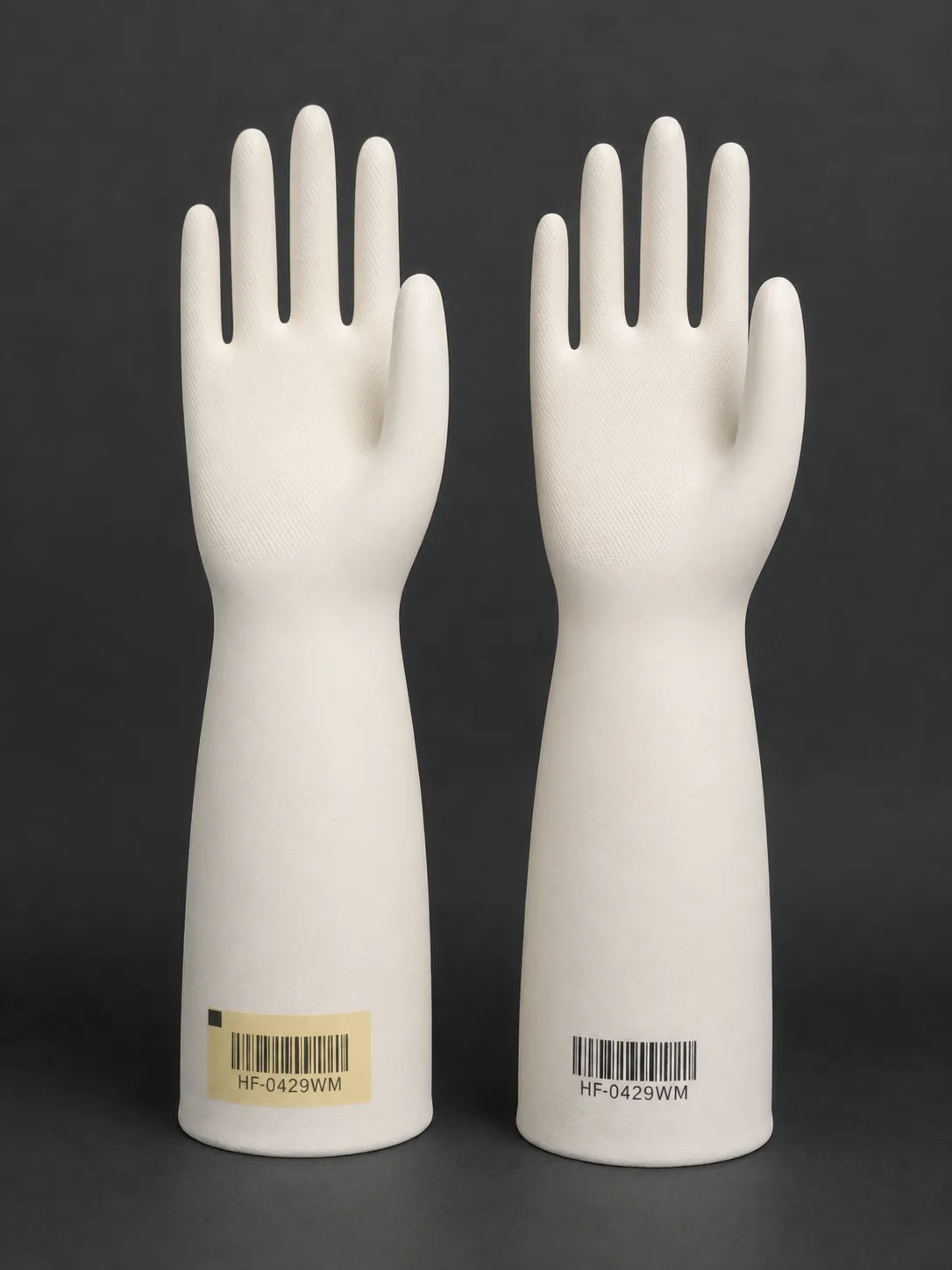
Ceramic hand former traceability begins the day a former leaves the kiln and only becomes valuable if the mark on it can survive glaze correction firing, thermal shock in the acid pit, and hundreds of thousands of glove-dipping cycles at the customer plant. For ceramic hand former manufacturers, a visible high-temperature code applied at the mold plant is the anchor that keeps kiln batch, glaze recipe, cavity ID, and dispatch record connected to a specific hand for its entire service life.
Glaze lot linkage
Dispatch serialization
Warranty evidence
Return handling
What this guide covers
- Why ceramic hand former plants need serialized, in-body marking rather than batch tags or paper travelers
- The real thermal and chemical envelope a mark has to survive between glaze firing and end-of-life stripping
- Where paint stamps, laser etching, adhesive tags, and glaze inlays fail in practice
- How Mina’s high-temperature visible-code decal is designed for the ceramic hand former surface
- The data model, in-factory workflow, and warranty loop that turn a code into a business record
Why ceramic hand former traceability matters at the mold plant
A modern glove dipping line runs 15,000 to 45,000 ceramic hand formers per line, cycles them every 40 to 90 seconds, and expects each former to survive 100,000 to 200,000 dips before retirement. That volume conceals a lot of ambiguity for the ceramic hand former manufacturer. When a batch of gloves is rejected for pinholes, thin fingertips, or splay marks, the glove factory needs to know whether a specific hand or a group of hands caused the defect. When a former cracks after 8,000 cycles instead of the specified 100,000, the ceramic plant needs to prove the kiln profile, glaze recipe, and firing date to defend a warranty claim.
Without a durable, unique mark on the former itself, both sides fall back on paper travelers, pallet tags, and verbal history. The result is a familiar loop: the glove factory sends back a mixed pallet of “problem” hands, the ceramic plant cannot identify their kiln lot, and neither party can close the corrective-action ticket. Ceramic hand former traceability solves this by attaching a permanent, machine-readable identity to every former at the moment it is fit for dispatch.
The rubber glove sector makes the volume real. According to the Malaysian Rubber Glove Manufacturers Association, Malaysia alone accounted for more than half of global rubber glove exports in recent years, with production volumes measured in hundreds of billions of pieces per year. Every one of those pieces was formed on a ceramic hand. When a former plant supplies even a single mid-size customer, it is shipping tens of thousands of hands per order — and each of those hands should be individually accountable.
What the mark has to survive
Ceramic hand former traceability fails when the mark is chosen for the shipping environment rather than the operating environment. Once the former leaves the mold plant, it enters a chemical and thermal cycle that erases most factory markings within weeks.
| Stage | Temperature | Chemistry | Erosion risk |
|---|---|---|---|
| Initial kiln firing | 1,150 – 1,300 °C | Feldspar / kaolin body, oxidizing atmosphere | Any organic mark burns off; only ceramic pigments survive |
| Glaze correction refire | 950 – 1,100 °C | Silicate glaze | Second exposure erases any mark not fired into the glaze |
| Acid pit / initial cleaning | Ambient – 60 °C | Dilute HCl or HNO₃ | Adhesives and low-grade inks dissolve |
| Coagulant dip on the glove line | 60 – 70 °C | Calcium nitrate in alcohol | Solvent attack on soft coatings |
| Latex or nitrile dip | 25 – 35 °C | Compounded latex | Physical build-up over the mark |
| Leaching tank | 50 – 60 °C | Hot water | Repeated wet–dry stress |
| Vulcanising oven | 110 – 160 °C | Convective hot air | Adhesive creep, ink oxidation |
| Stripping and brush wash | Ambient – 40 °C | Detergent, abrasion | Mechanical wear |
| Refurbishment refire | 800 – 1,050 °C | Occasional | Anything short of a ceramic-bond mark is lost |
The design brief for a former mark is therefore not “print quality” but “survives every one of the above, thousands of times, without becoming unreadable.” That is a materials problem before it is a printing problem.
Where common marking methods fall short
Ceramic hand former plants have tried almost every marking route. Each has a specific failure mode.
| Method | What it delivers | Where it fails | Fit for hand formers |
|---|---|---|---|
| Paint stamp on the wrist | Batch colour, simple ID | Erodes within 500–2,000 dips; no unique serial | Not suitable |
| Laser engraving on ceramic | Permanent mark, no coating | Depth stress raiser; often obscured by latex build-up; slow line rate at scale | Limited |
| Cold-glue paper label | Barcode, easy to change | Peels in coagulant; ink runs in leach tank; life measured in hours | Not suitable |
| Metal insert or RFID tag | Digital identity | Insert cavity weakens ceramic; RFID chip survival past 130 °C repeated cycling is unreliable at commercial cost | Case-by-case |
| Underglaze cobalt paint before firing | Fired-in, indestructible | Batch-level only; cannot serialize individually at production speed; requires kiln re-planning | Batch only |
| Overglaze decal after firing | Detailed graphics | Standard commercial decals scorch or lift at glove-oven temperatures | Standard decals only |
| Mina high-temperature visible-code decal | Fired-in ceramic bond, individual serial, human-readable and machine-readable in one mark | Requires a firing pass at the mold plant, but no capex on new kilns | Designed for this use |
Related reading for procurement teams evaluating high-temperature marking chemistry: high-temperature security ink for anti-counterfeiting and traceability and how high-temperature security ink protects products from counterfeiting. For pure porcelain applications, see ceramic high-temperature invisible code for porcelain tableware and advanced ceramics.
The Mina high-temperature visible-code decal for hand formers
Mina’s high-temperature visible-code decal is a ceramic-bonded printed marker applied to the finished hand former and fired into the glaze surface. The visible content — human-readable serial, batch code, cavity ID, and a scannable dot-matrix or micro-chain code — is formulated with inorganic pigments and a low-temperature glaze frit that fuse into the existing glaze during a low-temperature firing pass (typically in the 700 – 900 °C range, depending on the base glaze).
Because the code becomes part of the ceramic surface rather than a coating on top of it, the mark tolerates the full thermal and chemical cycle described above. The visible content stays readable to line operators for cycle counting and sortation. A covert layer, added when the customer requires anti-diversion controls, remains available for the ceramic plant’s own inspection.
The pattern here mirrors the same durability requirement Mina addresses in high-temperature invisible codes for ceramic tile anti-counterfeiting, extended to a curved, hand-shaped substrate that must remain uniform across tens of thousands of pieces.
The code is not a sticker in the retail sense. It is a printed transfer that fires into the glaze in the same way a decorative tableware decal fires — engineered instead for the mechanical, chemical, and thermal load of a glove production line.
What the code should encode
A ceramic hand former only needs a few fields to unlock a real traceability program. Over-designing the field structure is the most common cause of failed roll-outs.
MNA-K27-GLZ4B-C08-L-M-260707-088221
- MNA
- Ceramic mold plant identifier — protects against imitation orders on the secondary market
- K27
- Kiln batch identifier — links back to firing profile, atmosphere, and kiln load position
- GLZ4B
- Glaze recipe and lot — captures raw-material batch data for defect correlation
- C08
- Cavity ID from the pressure-casting or slip-casting mould
- L
- Left / right and size code
- M
- Model or product line — nitrile examination, surgical, industrial, etc.
- 260707
- Dispatch date in YYMMDD
- 088221
- Order line number — links to the customer, plant, dipping line, and quantity
Every field maps to a business decision the mold plant already has to make. The code simply anchors those decisions to a physical part.
In-factory workflow at the ceramic hand former plant
Post-firing inspection
Formers exit the primary kiln and go through visual and dimensional inspection. Accepted pieces enter a batch queue keyed to the kiln batch identifier already recorded on the traveler.
Decal print and apply station
A code print unit prints the visible-code decal with the serial data for the current batch, cavity assignment, and dispatch order. An operator or robot applies the transfer to the wrist area of each former.
Low-temperature firing pass
Marked formers go through a decal firing kiln at the temperature specified for the base glaze. The transfer fuses into the surface. No change to the main firing line is required.
Verification and pairing
Each fired former is scanned. The scanner writes back to the plant MES: serial ↔ kiln batch, glaze lot, cavity, size, model, dispatch order, pallet ID.
Dispatch and shipping record
Pallets and containers are labelled with the range of serials they contain. The customer receives a digital manifest that resolves down to individual hand formers.
Return and warranty handling
When a customer returns defective or worn hands, the plant scans the code on arrival. The full firing, glaze, and dispatch history for those specific pieces is retrieved in seconds instead of days.
Closing the QC feedback loop with the glove factory
The most valuable outcome of ceramic hand former traceability is the closed loop between the mold plant and the glove factory. When an unusual glove defect pattern appears — clustered pinholes, glaze flake contamination, or premature latex adhesion — the glove factory can now report back a specific set of serials rather than a general complaint. The ceramic plant queries those serials and often finds a common root cause: a single kiln position, a specific glaze lot, or one cavity that shifted dimensionally.
This is the same principle applied elsewhere in industrial anti-counterfeiting and traceability programs — see best anti-counterfeiting technologies for brand protection in 2026 — and it applies just as directly to a B2B component such as a hand former.
Anti-diversion: why the covert layer matters for hand former plants
Ceramic hand formers move through customs channels, contract manufacturers, and secondary rework shops. Where a mold plant has invested in a particular glaze recipe or a proprietary cavity design, unauthorized reproduction is a genuine risk. A visible-code decal is enough for open traceability, but the same decal can carry a covert authentication layer that only the mold plant’s inspection tools can read.
This makes the visible code do double work. Operators, buyers, and QA can read the plain serial for cycle counting and defect reporting. The mold plant retains a covert channel to detect grey-market or copied formers if a competitor tries to imitate its product. The pattern is directly analogous to the licensing-control model used in packaging and premium goods — see brand licensing control: how to prevent unauthorized overproduction.
Procurement questions before you commit to a marking supplier
- What is the maximum firing temperature the decal has been proven at, and on which glaze systems?
- Does the supplier ship pre-printed decals with unique serials, or provide an in-house print engine?
- What is the shortest and longest character length supported at the required print resolution?
- How is the decal application station integrated with the plant MES, and what is the data handoff format?
- What is the read rate of the visible code under wet, dusty, and latex-contaminated conditions?
- Is there an authenticated covert layer, and who controls the reader?
- What is the guaranteed unreadable-defect rate per 10,000 fired decals?
- What is the plan when a former is refurbished and refired at 800 – 1,050 °C?
- How does the supplier handle warranty on decal failure, separately from ceramic failure?
- What is the smallest pilot order and typical lead time?
Frequently asked questions
Can Mina’s high-temperature decal survive the glove dipping oven?
Yes. The visible code decal fires into the ceramic glaze at 700 – 900 °C during application. Glove dipping ovens operate at 110 – 160 °C, well below the decomposition point of the fired ceramic pigments and glaze bond used in the decal.
What happens when a former is stripped for refurbishment?
Standard stripping (brushing, mild detergents, mild acid) does not touch a properly fired decal. If the former is refired for glaze correction, the decal survives temperatures up to and above typical repair-fire profiles. If a customer specifies a full re-glaze that resurfaces the wrist area, the decal must be reprinted, which is a controlled process step.
Can the code be individually serialized at production speed?
Yes. The decals are digitally printed with variable data, so each unit carries a unique serial without a physical plate change. Application throughput is set by the decal apply station and the low-temperature firing kiln.
Do we need a new kiln to fire the decals?
No. Most ceramic hand former plants already operate a small kiln or intermittent kiln capable of the 700 – 900 °C decal firing temperature. Mina can specify a firing schedule that matches the existing kiln.
Is the visible code readable after latex build-up?
The visible code sits at the wrist area, which sees the least latex loading and is routinely brushed clean during stripping. Scanner tolerance to residual film is factored into the code geometry.
References
- Malaysian Rubber Glove Manufacturers Association — global glove production statistics
- International Rubber Study Group — natural and synthetic rubber demand data
- ASTM D3578 Standard Specification for Rubber Examination Gloves
- ISO 11193-1 Single-use medical examination gloves
- Mina — high-temperature security ink for anti-counterfeiting and traceability
- Mina — ceramic high-temperature invisible code for porcelain and advanced ceramics
Bring individual accountability to every hand former you ship
A ceramic hand former plant that can prove kiln batch, glaze recipe, cavity origin, and dispatch record for every piece changes the conversation with its customers. Warranty claims stop being disputes and start being data queries. Defect corrections become targeted rather than sweeping. And unauthorized reproduction of your proprietary designs becomes traceable.
Mina supplies the high-temperature visible-code decal, the covert authentication layer, and the application and verification workflow that fit into an existing ceramic mold plant with no kiln capex.