Life-safety equipment procurement
Counterfeit fire extinguishers are extinguisher units made, labeled, or recharged to look like certified products from established brands, carrying copied or fake certification marks and sometimes duplicate serial numbers. A counterfeit unit has never passed the safety evaluations its labels claim, and documented counterfeits have been found with non-extinguishing powder, unreliable gauges, and unapproved cylinders. For building owners, fire protection contractors, marine and industrial buyers, this guide explains how fakes reach procurement, how to verify units and service records at intake, and what a layered authentication program looks like.
Duplicate serial numbers on fakes
Fake service tags and inspectors reported
Key takeaways for fire safety buyers
A fake extinguisher is a latent failure. It looks ready for years and is only tested by the fire it fails to fight; US Coast Guard-documented counterfeits held non-extinguishing powder and faulty gauges.
Certification marks are copied. UL has published a notice on extinguishers bearing counterfeit UL marks; visual inspection of a mark is not proof of certification.
Duplicate serials betray fakes. Marine investigators found many counterfeit units sharing serial numbers; genuine units carry unique identities, which is exactly what one-item-one-code marking enforces.
Service records are counterfeited too. Fake inspectors and bogus maintenance tags are documented fraud patterns; annual inspection regimes only protect buildings if the tag and the record are real.
Verify at intake and at service. A covert layer read with dedicated devices gives a binary answer in seconds, at delivery, at installation, and at every inspection visit.
Authentication complements certification. Marks like UL, ULC, or CE prove evaluation; covert identity proves the specific unit in front of you is the one its record describes.
What are counterfeit fire extinguishers?
Counterfeit fire extinguishers are units that misrepresent who made them, what certifications they hold, or what is inside them. The pattern takes four forms: complete fake units built to imitate established brands; genuine-looking cylinders filled with non-extinguishing powder or improperly charged agent; units labeled with copied or counterfeit certification marks such as UL, ULC, or CE; and relabeled or re-badged stock passed off as newer, certified equipment. In a 2019 public notice, UL described a carbon dioxide extinguisher bearing the names of two established companies with counterfeit UL and ULC marks for the US and Canada, a unit UL said was never evaluated and should be removed from service.
The category sits beside a second, closely related fraud: counterfeit service. Extinguishers must be inspected periodically, typically annually, and serviced on multi-year cycles. Documented scams include fake inspectors invoicing for inspections that never happened and maintenance tags attached to equipment nobody serviced. A building can be fully equipped, tagged, and audit-passing, and still be unprotected if either the units or the service records are fake.
The buyer problem is therefore double-sided: prove each physical unit is the certified product its label claims, and prove each service event actually happened to that unit.
Documented cases and why the hazard is severe
Case: counterfeit UL marks, Costa Rica distribution
UL’s 2019 notice identified a CO2 extinguisher labeled “Fire Equipment Company” and “Amerex” that neither company made, carrying counterfeit UL and ULC certification marks and a misspelled label detail. UL stated the unit had never been evaluated for safety and recommended removing it from service; distribution was documented in Costa Rica, possibly beyond.
Case: marine counterfeits with duplicate serials
A US Coast Guard safety alert republished by the Nautical Institute warned that counterfeit extinguishers may contain a powder that is not a fire-extinguishing agent, carry non-approved cylinders, and show gauges that fail or give false readings. Investigators found many fakes sharing the same serial numbers, while genuine approved units each carry a unique serial; the alert named specific counterfeit serial strings imitating two US brands.
Case: fake inspectors and maintenance tags
US fire departments and city fraud-prevention units have documented scammers posing as inspectors, performing phantom inspections, and leaving bogus tags or invoices. Prevention guidance is consistent: fire departments do not service extinguishers, inspectors carry verifiable credentials, and licensed service companies tag equipment with dates that should match real records.
What makes the hazard severe is latency. A counterfeit helmet or glove usually reveals itself in use; a counterfeit extinguisher can hang on a wall for years, passing visual audits, and be tested only once, by a fire. Every control in this guide exists to move that test earlier: from the fire, to the audit, to the dock, to the day of purchase.
How counterfeit extinguishers reach buildings and vessels
Fakes enter through the same channels as many counterfeit industrial goods, with one addition unique to this category: the service loop.
- Online and regional resellers. Lookalike units at tempting prices, the pattern the Coast Guard alert tied to too-good-to-be-true pricing; buyers for vessels and small facilities often buy from the nearest or cheapest listing.
- Import lots and marine supply. Documented counterfeit distribution crossed borders before reaching end users; marine and offshore buyers are a specific target because of strict carriage requirements and remote purchasing.
- Gray-channel mixing. Genuine and counterfeit units mixed in distributor stock, defeating spot checks that only sample a few cylinders.
- The service loop. Fake inspectors, recycled tags, and falsified maintenance records; every annual inspection cycle is a fresh opportunity for fraud unless the tag is bound to the unit and to a verifiable record.
The service loop is also the opportunity. Unlike most products, extinguishers are revisited by professionals on a fixed schedule, which means an authentication system installed once is exercised repeatedly, at every inspection, for the life of the unit.
Verification options for extinguishers and tags, compared
Buyers can draw on several verification layers. The table compares what each proves, and what it cannot.
| Option | What it proves | Main weakness |
|---|---|---|
| Serial number inspection | A unique serial is present and consistent with the brand’s format | Duplicate serials only surface when someone compares units; counterfeit serials imitate real formats |
| Certification mark check | The brand and mark look correct (UL, ULC, CE, and regional marks) | Marks are copied, as UL’s counterfeit notice documents; visual checks miss skilled fakes |
| Online certification lookup | A model or file number appears in a certification database | Validates the model, not the physical unit in hand |
| Service tag with date and company | Someone left a tag claiming service occurred | Tags are exactly what fake inspectors counterfeit |
| Mina covert mark with dedicated detection | Hidden information exists exactly where the brand placed it, on that unit | Requires controlled devices and trained, authorized staff |
| Mina one-item-one-code service linkage | Each inspection event binds to that unit’s identity and record | Depends on adoption by service companies and building owners |
The pattern across the table is consistent: document-based checks prove the paper, not the object. Pairing them with a covert physical layer closes that gap, the same layered logic Mina describes for adjacent safety categories like counterfeit PPE detection and for incoming inspection of safety-critical cables.
Unit identity and service-record linkage
Mina’s one-item-one-code technology gives each extinguisher a unique identity carried in two related layers: an overt code for everyday administration and an ultra-invisible code integrated into the unit’s label and printed components. The covert information is invisible under normal light, ultraviolet light, and infrared light, and cannot be read by conventional equipment, reducing visible clues for imitation and supporting controlled checks against recorded unit identities.
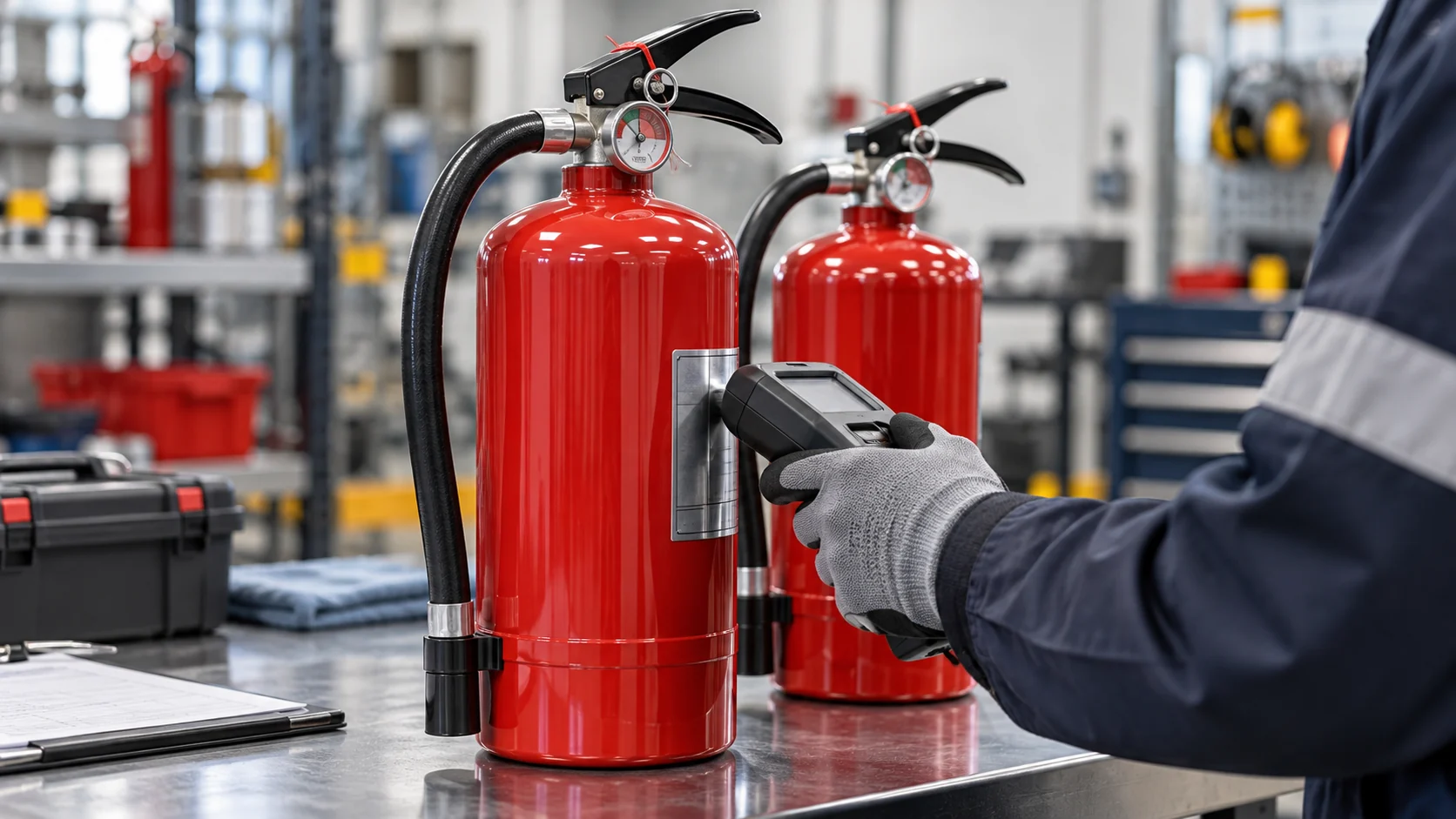
Authorized verification uses dedicated detection devices supplied only to partner clients, each device carrying a unique identification number. Audio verification returns sound and vibration on a genuine unit and no reaction on a fake; image verification displays the hidden information where it was placed. For receiving docks, fire contractors, and inspectors, that converts a judgment call about label quality into a documented check within an agreed verification procedure.
The same identity extends across the unit’s life. The overt and covert codes are interrelated: if a label is damaged, abraded, or swapped, the covert code still ties the cylinder to its recorded production lot and distribution history. At each service visit, the technician verifies the unit’s identity and the service event binds to that identity, producing an auditable chain: manufactured on a recorded date, shipped to a recorded channel, inspected on recorded dates, by recorded companies. A forged tag on an unmarked unit, or a genuine tag on a swapped unit, breaks the chain visibly. Building owners can additionally use a phone-readable verification code so facility teams can confirm units and log checks between professional inspections.
Scope boundaries keep this honest. Mina’s layer authenticates identity and records on labels, tags, and packaging; it does not certify extinguisher performance, and certification marks remain the province of certification bodies. Marking is applied to printed components and labels, never as a structural modification to the cylinder or its pressure-bearing parts.
Acceptance testing and deployment workflow
- 1
Map units, channels, and service partners
List the unit families purchased, the supply and service channels in each region, and where counterfeits or fake service have been seen or suspected.
- 2
Define marking surfaces
Fix where the overt and covert codes sit on labels, tags, and packaging, and how the service tag carries its link, without altering cylinder structure.
- 3
Build test panels
Genuine units, units with duplicate serials, relabeled and re-badged cylinders, forged service tags, and damaged labels; every panel member must be identified correctly.
- 4
Run environmental trials
Verify marking and label adhesion through transport, wall-mounted years of dust and cleaning, humidity, and the temperature ranges of installed locations.
- 5
Prove readout across staff
Confirm audio and image detection with each dedicated device across multiple inspectors and service visits, including rechecks after simulated aging.
- 6
Pilot the service loop
Run one region’s inspection cycle with unit-bound service records, then audit: can your team reconstruct each unit’s full history and flag every forged-tag panel member?
- 7
Document and scale
Record device governance, inspector training, escalation to quarantine and authorities, and roll out market by market with quarterly data review.
Inspection regimes, procurement clauses, and governance
Regulation already creates the cadence; governance should use it. Many jurisdictions require annual inspection and multi-year servicing of portable extinguishers, and city fraud-prevention guidance adds practical controls: verify inspector credentials and licenses before allowing service, never pay cash on the spot for unsolicited inspections, keep records of extinguisher numbers, service dates, and replaced parts, and treat any tag that cannot be matched to a company record as suspect.
Procurement can harden the same points contractually. Specify that supplied units carry unique, verifiable identities; that service companies log each visit against unit identities; that tags reference retrievable records rather than standing alone; and that suspect units are quarantined and reported rather than consumed. For marine and offshore buyers, add verification at delivery to the vessel, where the Coast Guard alert’s pricing warning applies most strongly.
Data governance completes the loop: who owns the unit registry, how long service and verification records are retained, and in what form authorities can query them after an incident. In a fire’s aftermath, those records answer the question no label can: was this unit, on this wall, the certified product it claimed to be, serviced when its tag said.
Limitations and risks to state plainly
Authentication proves identity and record integrity, not fire performance: a genuine-marked unit still requires proper certification, correct agent, and competent service, which belong to certification bodies and licensed servicers. A covert layer also depends on device coverage and custody; programs must plan who checks what, and a missing signal after physical damage is grounds for quarantine and expert review, not automatic proof of counterfeiting.
Serial and identity systems deter duplication most effectively when issuance is controlled end to end; if service companies or distributors can print their own tags without brand governance, the service-record chain weakens at its weakest link. Consumer-grade verification helps facility teams but does not replace professional inspection, and no layer catches every fraud pattern, refills, gray stock, and fake inspectors each need their own control.
Finally, legacy fleets: units already installed can be enrolled at their next service cycle, but until then they carry only their original labels, so phased rollouts should prioritize the highest-risk buildings and vessels first.
FAQ: counterfeit fire extinguishers
What are counterfeit fire extinguishers?
Units that misrepresent their maker, certification, or contents: complete fakes imitating major brands, cylinders filled with non-extinguishing powder, units carrying copied UL or ULC marks, and relabeled stock, plus the related fraud of fake service tags and inspectors.
How were counterfeits identified in documented cases?
UL flagged a unit with counterfeit certification marks and label misspellings; Coast Guard-linked investigators found duplicate serial numbers, simplistic labels, and construction differences. Duplicate serials are a hallmark, since genuine units carry unique identities.
Why is a fake extinguisher worse than most counterfeits?
It is rarely detected in use until a fire occurs. Documented fakes held powder that was not a fire-extinguishing agent and gauges that could give false readings, so the failure surfaces at the worst possible moment.
How do fake service tags put buildings at risk?
They create the appearance of compliant inspection without the service. Documented scams involve fake inspectors and bogus maintenance tags, so a tag should always be bound to a verifiable unit identity and company record.
How do authorized teams verify a Mina-marked extinguisher?
With dedicated detection devices supplied to partner clients: audio verification returns sound and vibration on genuine units and no reaction on fakes, and image verification displays the hidden information. Each device has a unique identification number.
What should buyers test before adopting covert marking?
Panels covering genuine, duplicate-serial, relabeled, and forged-tag cases; label and marking survival through years-equivalent aging and cleaning; per-device readout reliability across inspectors; and a pilot service cycle proving unit-bound service records.
Sources
- UL: counterfeit UL marks on fire extinguishers, public notice 19PN-11
- Nautical Institute MARS 201336: danger of fake fire extinguishers
- US Coast Guard Safety Alert 01-13: counterfeit fire extinguishers
- City of Fountain Valley: fire inspection fraud prevention
- ABC7 Chicago: UL warns of counterfeit fire extinguishers
- Fireproof: spotting non-compliant fire safety products online
Make every unit provable, at purchase and at every inspection
If counterfeit fire extinguishers or fake service records are a risk in your portfolio, prepare a brief covering your unit families, supply and service channels, and the inspection regime you operate under. Mina can evaluate one-item-one-code marking for your extinguisher labels and service documents and propose an acceptance test plan. Counterfeit extinguishers hide in plain sight until the day they are needed; layered authentication removes the hiding place.