Counterfeit brake pad authentication is the single most overlooked safety gap in the automotive aftermarket today. U.S. Customs and Border Protection seized more than 211,000 counterfeit automotive parts in fiscal year 2024 alone, nearly double the prior year. Brake pads, calipers, and rotors rank among the most frequently counterfeited components. Mina has developed an invisible, media-free anti-counterfeiting material that integrates directly into brake pad friction compounds. It does not alter braking performance. It cannot be seen with the naked eye. And it can only be identified by Mina’s proprietary detection equipment. This article explains why brake manufacturers need this capability, how it works, and what it means for post-accident investigations, supply chain control, and brand enforcement.
Why Counterfeit Brake Pads Are a Growing Crisis
Brake friction products are a USD 12.9 billion global market. The aftermarket segment, where independent distributors, online sellers, and workshops source parts from a broad and often opaque supply base, is where most counterfeit brake pads enter circulation.
The numbers tell a serious story. CBP has seized more than 839,000 counterfeit auto parts over the past five years, with a combined retail value exceeding USD 60 million. The U.S. Homeland Security Investigations (HSI) unit currently has approximately 40 open criminal cases involving counterfeit automotive parts. Between June 2023 and March 2024, at least three fatalities and two life-altering injuries were directly linked to counterfeit automotive components in the United States.
Globally, the picture is worse. In India, an estimated 20% of road accidents involve counterfeit parts. The OECD has consistently identified automotive components among the top product categories in worldwide counterfeit seizure data. The aftermarket brake pad segment is especially vulnerable because counterfeit manufacturers have become extremely good at copying packaging, logos, part numbers, and even holographic stickers.
5 Real Scenarios Where Counterfeit Brake Pad Authentication Matters
These are the situations that make counterfeit brake pad authentication indispensable. Each represents a concrete risk that brake manufacturers and their customers face today.
Scenario 1: The Post-Accident Investigation
A delivery van crashes at an intersection. The driver reports that the brakes faded and then failed under repeated hard stops. An insurance investigator examines the brake pads. They look correct: right shape, right markings, right packaging in the glovebox. But were they genuine? Without embedded authentication, nobody can prove whether the pads were real or counterfeit. The brake manufacturer faces a potential product liability claim for a failure they did not cause. With Mina’s invisible anti-counterfeiting material embedded in the friction compound, a single scan with Mina’s proprietary detector gives a definitive answer: genuine or fake. The manufacturer can clear its name in minutes instead of months.
Scenario 2: The Super-Fake Problem
Major brake brands like Brembo have documented three tiers of counterfeiting: from crude plastic caliper covers (Level 0) to convincing replica calipers for cars (Level 2). At the highest tier, counterfeiters replicate the exact shape, color, engravings, and packaging. Visual inspection is unreliable. Serial number databases can be cloned. Even experienced mechanics cannot distinguish super-fakes from genuine parts by appearance alone. An authentication marker embedded within the friction material itself, invisible and undetectable without Mina’s proprietary equipment, creates a verification layer that counterfeiters simply cannot replicate, no matter how closely they copy the surface.
Scenario 3: The Fleet Liability Exposure
A logistics company operates 2,000 trucks and replaces brake pads on a rolling schedule through regional distributors. If even 5% of incoming brake pads are counterfeit, that means 100 trucks running on substandard braking. A single failure during emergency braking could result in fatalities, lawsuits, and regulatory action. Counterfeit brake pad authentication at the receiving dock, using Mina’s handheld detection device, gives the fleet manager a binary genuine-or-fake result in seconds. No lab testing required. No shipment delays. Just scan and accept, or scan and reject.
Scenario 4: The Online Marketplace Trap
A workshop owner orders brake pads from a well-known online marketplace. The listing shows the correct OEM part number, professional product photos, and hundreds of positive reviews. The pads arrive in branded packaging with holographic seals. Everything looks right. But the friction material uses a cheaper compound that overheats and glazes under heavy braking. The Automotive Anti-Counterfeiting Council (A2C2) has documented counterfeit automotive parts listings across multiple e-commerce platforms, often sold at prices close enough to genuine parts to avoid suspicion. For brake manufacturers with Mina’s authentication built into the product, a quick scan separates genuine from fake before installation.
Scenario 5: The Distributor Overproduction Fraud
A brand licenses its brake pad formulations to a contract manufacturer in another country. The agreement covers 500,000 units per year. But the manufacturer secretly produces 700,000, selling the extra 200,000 through unauthorized channels. The overproduced units use the correct formulation and pass all visual and performance tests. Traditional anti-counterfeiting labels can be reprinted by anyone with access to the label design. Mina’s invisible material, mixed into the raw compound at a controlled dosage, carries unique encoded information that the contract manufacturer cannot reproduce independently. The brand can audit any pad, anywhere in the world, and verify whether it came from an authorized production run.
Why Existing Anti-Counterfeiting Methods Fail for Brake Components
Brake pads operate in one of the harshest environments of any automotive component. They endure temperatures above 300°C during normal driving and can exceed 600°C during aggressive braking. They are exposed to water, road salt, brake dust, and constant mechanical abrasion. Any authentication method that relies on surface-level marking, an adhesive label, a printed code, or an engraved serial number faces a fundamental problem: the authentication feature is destroyed during normal use.
| Method | Survives Installation? | Survives Brake Heat? | Counterfeiter Barrier | Post-Accident Readable? |
|---|---|---|---|---|
| Holographic label on box | No (box discarded) | Not applicable | Low | No |
| QR code on packaging | No (box discarded) | Not applicable | Very low | No |
| Laser engraving on caliper | Yes (caliper body) | Yes | Low to medium | Yes, if not damaged |
| RFID tag on pad backing | Possible | Limited (most tags fail above 200°C) | Medium | Unlikely |
| Mina media-free material (in friction compound) | Yes (part of the pad) | Yes (stable above 1,500°C) | Very high | Yes |
The key difference is where the authentication lives. Labels, codes, and tags sit on or next to the brake component. Mina’s anti-counterfeiting material is mixed directly into the brake pad friction compound during manufacturing. It becomes part of the product. The physical and chemical properties of Mina’s inorganic anti-counterfeiting materials are exceptionally stable. They do not react with the resin binders, metal fibers, or abrasive fillers in a typical brake pad formulation. They do not alter friction coefficient, wear rate, noise characteristics, or thermal behavior. The material is invisible under normal light, UV light, and infrared light. It can only be detected by Mina’s exclusive proprietary devices, which use image recognition, sound, and vibration-based detection methods.
How Mina’s Invisible Authentication Works Inside a Brake Pad
- Material integration during compounding. Mina’s ultra-invisible nano-scale anti-counterfeiting material is added to the brake pad raw mix at a precisely controlled ratio. It blends with the standard friction compound ingredients: phenolic resin, aramid fibers, metal particles, graphite, and mineral fillers.
- Normal manufacturing continues. The compound is pressed, molded, and cured at standard temperatures and pressures. The Mina material withstands temperatures well above 1,500°C, so the standard curing process (typically 150°C to 250°C) has zero effect on it.
- Invisible after production. The finished brake pad looks, feels, weighs, and performs exactly like an unauthenticated pad. No visible marks, no texture change, no color difference. Even a laboratory microscope will not reveal the authentication layer.
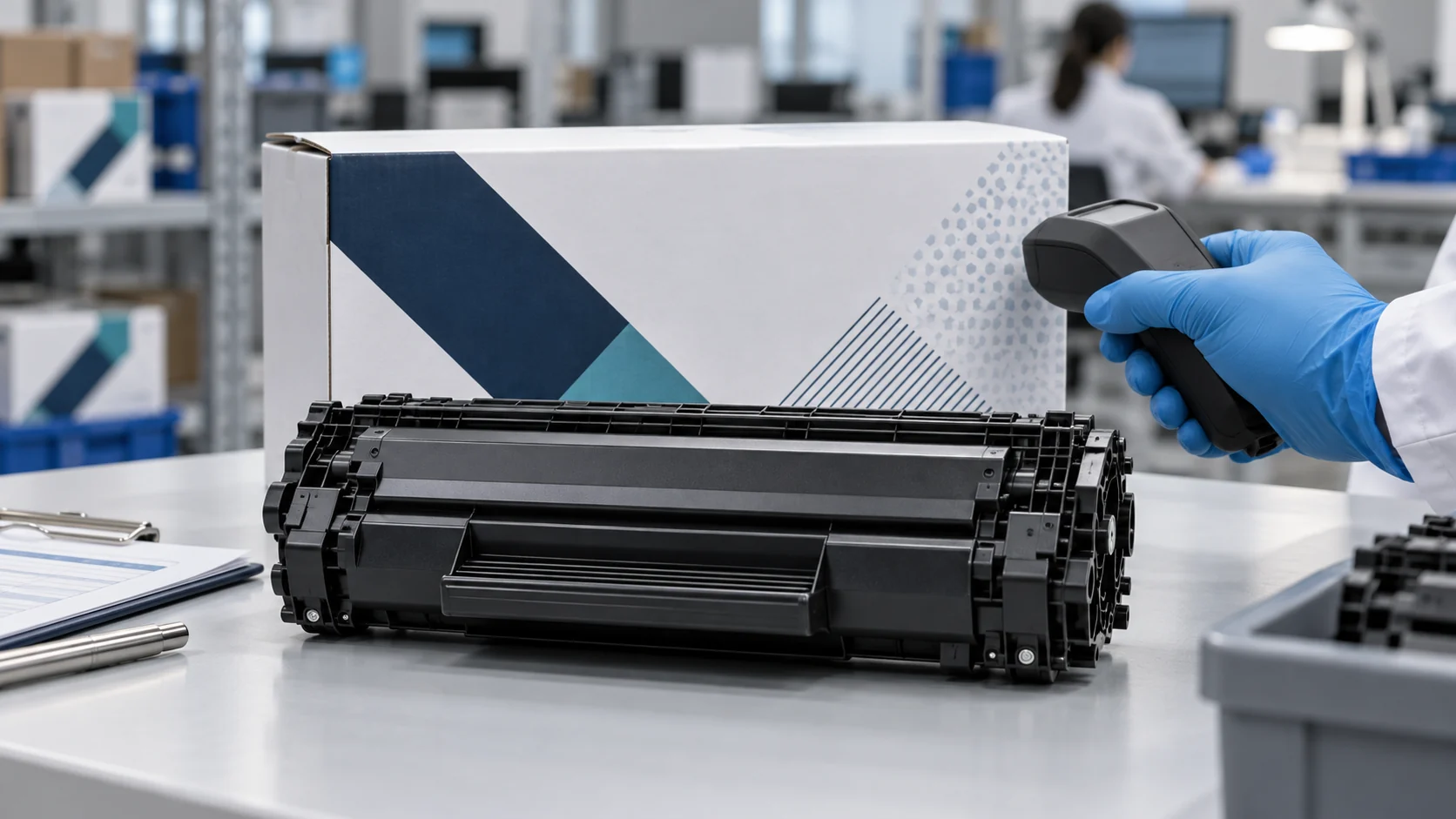
- Detection on demand. When verification is needed, a Mina proprietary handheld detector is placed against the brake pad surface. Depending on the detection method, the device reads the embedded information via image capture or audio-vibration response. The result is instant: authentic or not.
- Survives the entire product lifecycle. Because the material is part of the friction compound, it remains detectable after installation, after thousands of kilometers of braking, and even after an accident. This makes post-incident forensic investigation straightforward.
Beyond Anti-Counterfeiting: Supply Chain and Distributor Management
Counterfeit brake pad authentication solves more than the fake-parts problem. When Mina’s invisible material carries encoded batch and production-line data, it becomes a powerful tool for production management and channel control.
Production Output Verification
Brake pad brands that use contract manufacturers often struggle to verify actual production quantities. A contract manufacturer that secretly overproduces and diverts excess inventory into gray-market channels undermines the brand’s pricing, warranty obligations, and market strategy. When every authorized brake pad contains Mina’s encoded material, the brand can audit any pad from any channel and verify whether it belongs to an authorized production batch. Unauthorized overproduction becomes immediately detectable.
Distributor Compliance Auditing
Regional distributors sometimes mix genuine and counterfeit inventory to improve margins. Others divert products outside their assigned territory. With Mina’s media-free authentication embedded in each brake pad, brand enforcement teams can conduct field audits at any point in the distribution chain. A single scan confirms whether the product is genuine and whether it belongs in that market.
Warranty and Recall Accuracy
When a brake manufacturer issues a recall, identifying which specific pads in the field belong to the affected batch is a major operational challenge. If the brake pads carry Mina’s invisible encoded information, recall teams can scan individual pads and confirm batch identity on site, without relying on packaging, invoices, or distributor records that may be inaccurate or unavailable.
The Forensic Advantage: Settling Disputes After an Accident
Post-accident brake component analysis is one of the most underserved areas in automotive safety. As The BRAKE Report has noted, after an accident, it is very rare for anyone to examine the brake parts to determine whether they are genuine. Brand owners typically only become involved when a clear pattern of failures emerges.
This delay creates two problems. First, counterfeit brake pads continue circulating while investigations are slow. Second, genuine brake manufacturers carry the reputational and legal burden of failures caused by products they did not make.
Mina’s embedded authentication changes this dynamic. A forensic investigator, an insurance adjuster, or a brand protection officer can scan a brake pad from a damaged vehicle and get an immediate answer. If the material responds to Mina’s detector, the pad is genuine. If there is no response, the pad is counterfeit. There is no ambiguity, no need for expensive laboratory metallurgy, and no months-long wait for test results.
This capability is especially valuable for high-profile cases. When a commercial fleet accident results in injuries or fatalities, the brake manufacturer’s reputation is at stake from the first news headline. The ability to confirm within hours that the installed pads were counterfeit, not genuine, can prevent millions in brand damage and legal exposure.
Procurement Evaluation: What Brake Manufacturers Should Ask
- Does the material survive your curing and sintering temperatures? Mina’s inorganic anti-counterfeiting material is stable above 1,500°C. Standard brake pad curing (150°C to 250°C) and sintered metal pad production (up to 1,000°C) are well within range. Request test certificates showing thermal stability at your specific process temperatures.
- Does it affect friction performance? Request independent dynamometer test data comparing authenticated vs. non-authenticated pads under ECE R90 or SAE J2430 protocols. The Mina material should produce no measurable difference in friction coefficient, fade resistance, or recovery characteristics.
- What is the detection method and field equipment? Mina offers image-based and audio-vibration-based detection. Evaluate which method suits your field conditions: warehouse receiving docks, workshop environments, or post-accident forensic settings. Test detection speed and reliability under realistic conditions.
- How is the material supplied and dosed? Understand the integration point in your manufacturing process. The anti-counterfeiting material is typically added during raw material compounding. Clarify dosage rates, mixing procedures, and quality control checkpoints.
- Can encoded data support serialization? If your brand needs batch-level or unit-level traceability, discuss how Mina’s encoded information can carry production batch numbers, factory identifiers, or date codes within the embedded material.
- What is the confidentiality model? Mina’s detection devices are exclusively provided to partner clients. Each device carries a unique identification number. The devices are not available on the open market, which prevents counterfeiters from reverse-engineering the detection method.
Frequently Asked Questions
Can Mina’s anti-counterfeiting material really be mixed into brake pad compounds without affecting performance?
Yes. Mina’s material is an inorganic compound with stable physical and chemical properties. It does not react with standard friction compound ingredients such as phenolic resin, aramid fibers, or metal powders. It does not change the coefficient of friction, noise profile, or thermal resistance of the finished pad. Brake manufacturers can verify this through standard dynamometer testing under ECE R90 or SAE J2430 protocols.
How does Mina’s approach differ from serial numbers or QR codes on brake packaging?
Serial numbers and QR codes sit on the packaging or on labels attached to the product. Once a mechanic opens the box and installs the brake pad, the packaging is discarded. The authentication is gone. Mina’s material is part of the brake pad itself. It survives installation, use, and even post-accident conditions. It is readable at any point in the product’s lifecycle.
What detection methods does Mina use for brake pad authentication?
Mina offers two primary detection methods: image-based detection, where the proprietary handheld device reads invisible encoded information from the pad surface, and audio-vibration detection, where the device emits a sound and vibration response when it contacts an authenticated pad. Both methods give instant results in the field.
Can counterfeiters replicate Mina’s invisible material?
No. Mina’s ultra-invisible nano-scale material is produced using proprietary formulations protected by more than 40 patents. The material cannot be detected by UV light, infrared light, or any commercially available testing equipment. The detection devices are exclusively distributed to Mina’s partner clients and are not sold on the open market. Without knowing what the material is and without access to the detection equipment, counterfeiters cannot even confirm its presence, let alone reproduce it.
Is this approach suitable for both organic and semi-metallic brake pads?
Yes. Mina’s material integrates with a wide range of base compounds, including organic (NAO), semi-metallic, low-metallic, and ceramic brake pad formulations. The material’s inert chemical properties ensure compatibility across formulation types.
How does this help with insurance and legal disputes after a brake failure?
After an accident involving brake failure, a forensic scan with Mina’s device can confirm within minutes whether the installed brake pads are genuine or counterfeit. This eliminates months of laboratory analysis and gives brake manufacturers immediate evidence to defend against product liability claims caused by counterfeit products they did not manufacture.
References
Related Resources from Mina
Protect Your Brake Products from Counterfeiting
If your brake pad or caliper brand faces counterfeiting in the aftermarket, Mina can evaluate how invisible, media-free authentication integrates into your specific friction compound formulation. Prepare a brief with your pad types (NAO, semi-metallic, ceramic), production volumes, and distribution channels.
Contact Us to discuss counterfeit brake pad authentication for your brand.