Brand protection · Cables & wires
Anti-counterfeit marking for cables and wires can add an origin check to procurement and distribution controls. It does not establish conductor quality, insulation performance, fire performance or suitability for installation. Buyers still need the applicable certification, supplier records and independent electrical or material tests. This guide explains how to scope the additional authentication layer without confusing it with cable safety approval.
Why cables are a high-priority target for counterfeiters
Cable procurement needs controls for material substitution, misleading markings and incomplete records. Problems may be difficult to investigate once products are installed in conduits or concealed spaces. Authentication therefore needs to be planned alongside supplier qualification, receipt checks, sample retention and applicable technical testing; it should not replace them.
BASEC documents counterfeit and substandard cable problems, including misleading markings and construction defects. Its guidance distinguishes supplier claims from demonstrated compliance. Use that distinction when defining an authentication project: a mark or scan is one input to a wider acceptance decision.
The safety dimension
Brand authenticity and electrical safety are separate inspection questions. A covert mark may support an origin investigation after the marker and reader have been qualified. It cannot establish that conductor resistance, insulation, construction or fire performance meets the required standard. Suspect cable should be assessed through the qualified technical and safety channels specified for the project.
How counterfeit cables pass incoming inspection today
Understanding how fakes get through is the prerequisite for specifying markings that stop them. Most construction procurement teams rely on a combination of four checks at the receiving dock. Each one has a known failure mode that counterfeiters exploit.
| Check | What it catches | How counterfeiters defeat it |
|---|---|---|
| Visual inspection of print legend | Missing brand name, wrong color coding, misspelled standards | High-quality inkjet reproduction of the brand legend on genuine-looking sheath |
| Paper test certificate | Missing or obviously forged documentation | Scanned and reprinted certificates with altered batch numbers and lab logos |
| Diameter and weight spot check | Grossly undersized conductor or insulation | Slightly undersized conductor with foam-injected insulation that maintains outer diameter |
| Resistance test (if performed) | Copper-clad aluminum posing as solid copper | A test result is meaningful only for the sample, method and acceptance criteria used; representative testing is required |
No single receipt check covers every failure mode. Visual inspection, document verification, appropriate electrical testing and a qualified authentication feature can answer different questions. Define what each check establishes, its limitations, and the escalation route when results disagree.
Covert vs. overt marking: which layer solves which problem
Cable brands and procurement teams face a decision early in the specification: should the anti-counterfeit feature be visible or hidden? The answer, for most credible programs, is both — but each layer serves a different audience and a different enforcement pathway.
Overt marking
- Visible holographic tape or color-shifting ink stripe on the cable sheath
- Audience: site electrician, receiving-dock inspector
- Strength: immediate visual deterrent
- Weakness: must be tested against relevant reproduction attempts
- Enforcement: requires supporting evidence and jurisdiction-specific review
Covert marking
- Invisible inorganic marker in the sheath compound or under the print legend
- Audience: brand-protection auditor, project-acceptance inspector, forensic lab
- Strength: restricted inspection requires a qualified feature, reader and workflow
- Weakness: requires a reader or lab access; not useful for the electrician on-site without training
- Enforcement: may support an investigation; admissibility requires jurisdiction-specific review
A layered specification may combine a visible feature, an authorized covert check and identifiers linked to issuance and delivery records. None of these automatically creates legal proof. Record custody, test validation, access controls and the applicable legal requirements determine how the resulting evidence can be used.
Mina’s role in the covert layer
Mina can discuss covert marking and material-integration options for a cable project. Compatibility with PVC, XLPE, LSZH or another formulation must be confirmed for the actual compound, processing conditions and reader. Do not assume service-life readability, outdoor durability or post-fire recovery without project-specific evidence. Related approaches are discussed in Mina’s rubber and plastic authentication guide and high-temperature security ink guide.
Five points where anti-counterfeit marking for cables adds value
Incoming goods inspection
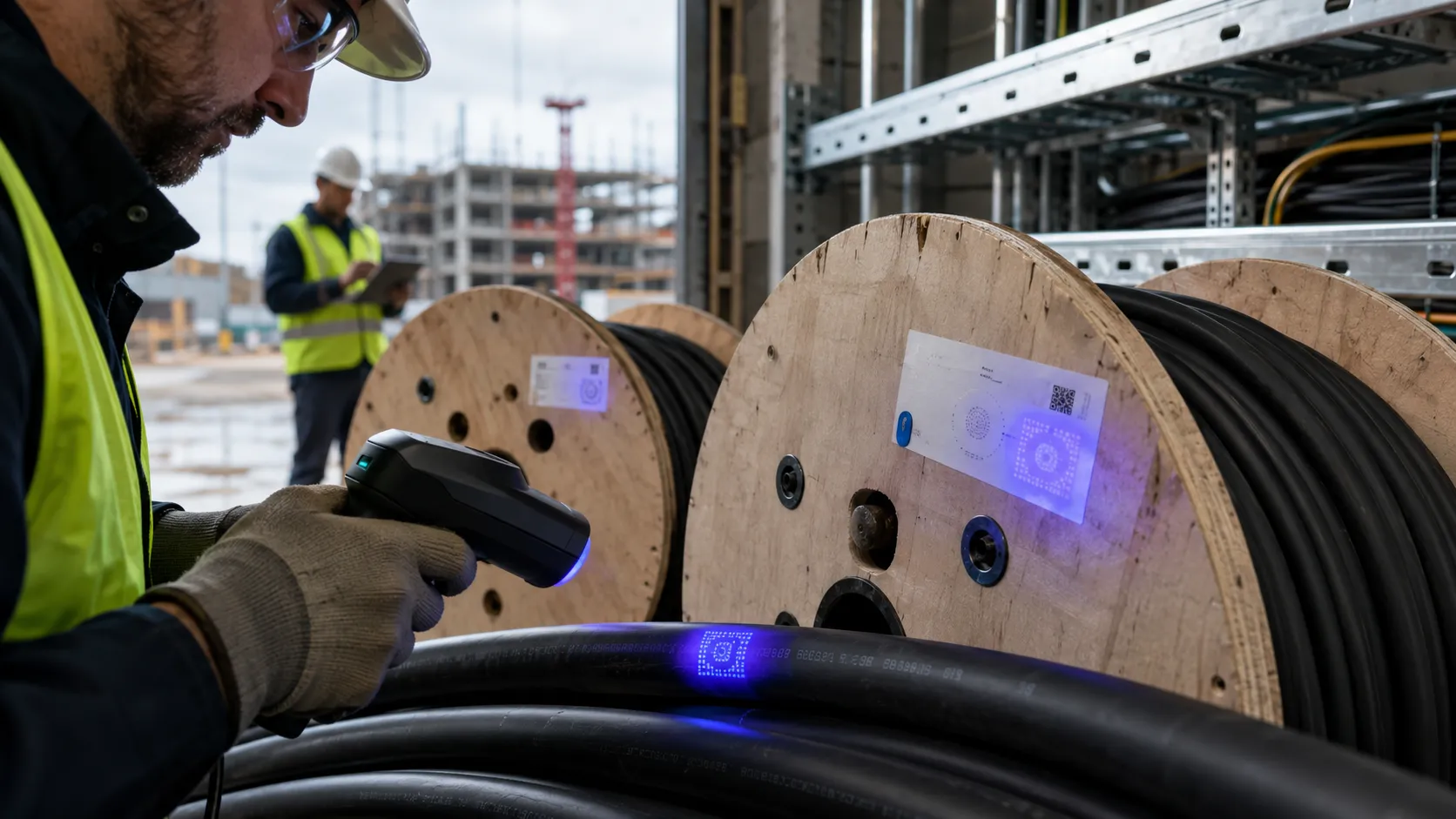
The receiving team checks the specified mark against an approved reference using the qualified reader and procedure. An unexpected result should trigger the agreed review or quarantine process. A positive authentication result does not waive the project’s electrical, material or certification checks; inspection time must be measured during the pilot.
Installed-cable spot audit
Where access and safe working arrangements permit, an authorized inspector can evaluate whether the specified mark is detectable on an installed cable sample. The procedure must define reader access, reference samples and limitations. Do not treat an unavailable or unreadable mark as a complete diagnosis of the cable’s origin or safety.
Project-acceptance verification
At handover, agree which authentication checks and records belong in the acceptance file. Time, location, operator and sample references may be recorded where the deployed system supports them. Those records supplement the project’s required technical documentation; they do not themselves establish compliance.
Post-incident forensic analysis
After a failure, preserve the sample and its custody records for the qualified investigation team. Whether a marker remains detectable after heat, smoke, abrasion or chemical exposure is an application-specific question. Do not promise post-fire identification or use an authentication result to infer the cause of a fire.
Anti-diversion and channel control
Serialized codes on each drum link to the destination distributor and project. When drums surface outside their authorized territory, the scan log provides the evidence for contractual enforcement. For the logic behind scan-based anti-diversion, see our writeup on invisible cryptographic anti-diversion codes.
Authentication is useful when its decision, evidence and limitations are defined before rollout. It complements supplier qualification and testing; it does not replace a cable-safety assessment.
Specifying anti-counterfeit marking for cables: a decision matrix
The matrix below maps each threat scenario to the marking layer that addresses it. Use it to scope the program with your cable supplier and security-feature provider.
| Threat scenario | Overt feature | Covert marker | Serialized code |
|---|---|---|---|
| Full-clone cable with reproduced print legend | Partial | Primary | Supporting |
| Conductor substitution (CCA for Cu) | Not a material test | Not a conductor-composition test | Records only; verify construction independently |
| Post-delivery site substitution | Partial | Primary | Primary |
| Grey-market diversion across regions | No | Supporting | Primary |
| Post-fire origin investigation | Readability uncertain | Requires validated recovery tests and expert assessment | Record availability depends on implementation |
| Project-acceptance material audit | Supporting identification | Supporting origin check only | Supporting records; technical tests still required |
Project-acceptance checklist for cable authentication
Construction project managers and third-party inspectors can use this checklist during the handover process to verify that anti-counterfeit marking for cables and wires has been correctly implemented.
Confirm covert marker reads positive on a random sample of installed cable runs (using a sampling plan agreed by the responsible project specialists)
Cross-reference serialized drum codes against the project bill of materials and delivery records
Verify that the scan log (timestamps + GPS) covers all major cable zones in the building
Retain representative cable samples of the type and length specified by the testing laboratory, with covert marker verified, as part of the handover file
Confirm that the cable brand’s verification platform grants the project owner read access to the scan history
File the portable-reader calibration certificate alongside the cable test reports in the acceptance pack
Common mistakes in cable anti-counterfeit programs
- Relying on the print legend alone. The brand name on the sheath is the easiest element for a counterfeiter to reproduce. It is identification, not authentication.
- Paper certificates without digital cross-check. A certificate is only as trustworthy as the lab that issued it. Linking the certificate to a scannable code on the drum creates a verifiable chain.
- Overt hologram on the spool label, not the cable. The spool is discarded after installation. Any authentication feature on the spool alone is worthless for installed-cable verification.
- No post-installation verification plan. If the marking is never checked after the cable is pulled, it provides no deterrent against site substitution.
- Ignoring processing conditions. Validate the actual marking formulation, substrate, loading and extrusion conditions. Neither an organic nor an inorganic classification alone establishes process compatibility.
- Sequential drum serial numbers. Predictable sequences allow counterfeiters to generate valid-looking codes. Cryptographic generation is required.
How Mina supports anti-counterfeit marking for cables and wires
Mina provides two layers to cable brand-protection programs:
- Covert sheath marker. Discuss the proposed compound, marking location, reader and inspection workflow with Mina. Qualify processing compatibility, abrasion and weathering performance on representative samples. No service-life, post-fire or sub-two-second detection guarantee is established here.
- Serialized traceability. Agree how identifiers will be issued, linked to production and delivery records, and accessed by authorized users. Verify the required platform functions in the pilot before relying on location alerts or diversion reports.
Assess integration with the cable manufacturer and the security-feature provider before committing to rollout. Processing compatibility, reader access and record interfaces must be demonstrated on the proposed line; no unchanged-line or no-converter-change guarantee is established here.
Anti-counterfeit marking for cables and wires protects what is hidden after installation
Cables may become difficult to inspect after installation. Plan access, reference samples, supplier records and any authentication checks before rollout. Mina can discuss a marking trial, while qualified cable specialists remain responsible for the applicable electrical, material and fire-performance assessments.
To scope a covert marking and serialization program for your cable products, contact the Mina brand-protection team at minananotech.com/contact-us.