Executive Decision Overview: Heavy industrial plant managers, wind turbine operators, and precision machinery OEMs face multi-million-dollar catastrophic downtime caused by counterfeit precision rolling bearings. Illicit refurbishment workshops collect discarded, fatigued industrial bearings, grind away surface corrosion and old serial numbers, re-polish the raceways, apply counterfeit laser engravings of premium Tier-1 brands (e.g., SKF, FAG, NSK), and re-box them. Because standard cardboard packaging and external laser etchings can be effortlessly cloned or duplicated, mechanical engineers require immutable, direct-on-metal authentication. This technical guide examines how chemical passivation taggants and covert lubricant markers withstand 200°C+ operating friction, extreme contact pressure, and heavy industrial grease environments.
The Industrial Catastrophe: Refurbished Clones in Heavy Rotating Machinery
In heavy industrial sectors—including mining draglines, continuous steel casting lines, thermal power generation, railway bogies, and multi-megawatt offshore wind turbine gearboxes—rolling element bearings operate under extreme mechanical stresses. Bearings manufactured by certified Tier-1 foundries utilize vacuum-degassed high-carbon chromium steel (such as 100Cr6 / SAE 52100) subject to precision martensitic or bainitic through-hardening (60–64 HRC) to achieve predictable L10 fatigue lifespans exceeding 50,000 to 100,000 operating hours.
However, the global bearing aftermarket is heavily contaminated by sophisticated counterfeit syndicates. The primary threat vector is not crude casting, but industrial refurbishment and re-branding:
- Regrinding & Acid-Etch Disguise: Illicit machine shops acquire scrap, end-of-life bearings from demolition yards. They chemically remove rust in acid baths, grind away outer ring identification markings, re-machine worn raceways to non-standard clearances, install cheap mild-steel cages, and re-polish surfaces to a mirror-like commercial finish.
- Laser Serial Cloning & Forged Packaging: Using inexpensive fiber laser engraving machines, counterfeiters etch genuine OEM font types, precision tolerance classes (e.g., ISO P4 / ABEC 7), and serialized matrix codes onto the bearing outer ring faces. They pack the refurbished hardware in forged cardboard boxes complete with counterfeit holographic seals.
- Premature Spalling & Catastrophic Seizure: When installed in heavy rotating machinery, these structurally fatigued bearings suffer subsurface micro-cracking and rapid fatigue flaking within hundreds of hours. This leads to catastrophic raceway spalling, sudden spindle seizure, production line fires, and millions of dollars in unscheduled downtime.
When catastrophic failure occurs, plant maintenance directors and equipment OEMs face immense liability disputes. Because external packaging is discarded upon installation and laser markings mimic OEM formatting, engineers cannot prove counterfeit origin using visual inspection alone.
Why External Laser Engraving and Protective Packaging Fail
Traditional brand protection strategies focused on serialized cartons, QR codes on plastic wrapping bags, or surface fiber laser etching fail under industrial operating conditions:
- Packaging Disconnect at Installation: Bearings are unpacked in greasy maintenance bays; protective plastic bags and cardboard cartons are immediately thrown into trash bins. Once installed inside a closed gearbox or pillow block, all outer packaging evidence is permanently lost.
- Surface Laser Erasure by Counterfeiters: Standard laser engravings only penetrate 10 to 30 μm into the steel surface. Refurbishers effortlessly grind away OEM markings on surface grinding machines without compromising outer boundary dimensions.
- Grease & Extreme Thermal Degradation: Inside active bearing housings, synthetic polyurea or lithium complex greases operate continuously at 90°C to 160°C with localized flash temperatures exceeding 250°C under elastohydrodynamic (EHD) lubrication regimes. Conventional adhesive labels or organic paint dots dissolve, wash off, or carbonize into abrasive particles that contaminate the raceway.
To establish permanent traceability, bearing manufacturers must move to direct-on-metal covert passivation and lubricant-integrated authentication, embedding the security marker directly into the chemical surface finish and internal grease matrix.
Chemical Passivation & Heavy Lubricant Taggant Science
Mina’s industrial metal anti-counterfeiting solution operates through two complementary, non-destructive chemical vectors that integrate seamlessly into standard bearing manufacturing without altering sub-micron machining tolerances:
- Anti-Corrosion Chemical Passivation / Phosphating Taggants: During the final anti-rust surface treatment (manganese phosphating, black oxide, or water-displacing anti-corrosion oil application), inorganic covert crystal taggants are bonded directly into the micro-porous surface conversion layer. The inorganic taggants achieve mechanical and chemical interlock within the metal crystalline matrix (layer thickness 1.5–3.0 μm) without altering ground raceway dimensional tolerances (DIN 620 tolerance Class Normal to P4).
- Synthetic Grease & Lubricant Fingerprinting: For factory-sealed deep groove ball bearings and spherical roller bearings, covert inorganic micro-taggants are compounded into the synthetic polyalphaolefin (PAO) or mineral grease during lubricant formulation. The sub-micron inorganic particles ($D_{50} < 0.8\ \mu\text{m}$) are chemically inert and non-abrasive, exhibiting zero catalytic breakdown of anti-wear (ZDDP) or extreme pressure (EP) additive packages.
Technical Comparison: Industrial Bearing Authentication Methods
The matrix below compares performance metrics across authentication techniques used on heavy industrial bearings:
| Engineering Evaluation Metric | Conventional Surface Laser Engraving | Outer Box Hologram & Mobile QR Code | Mina Covert Passivation & Lubricant Tagging |
|---|---|---|---|
| Resistance to Raceway Regrinding | Zero (ground away on surface grinders). | N/A (packaging discarded prior to install). | Immune (deeply integrated in chemical surface layer and internal grease). |
| Thermal Stability Under Friction | High (metal surface), but easily cloned. | Zero in-bearing retention. | Stable to 800°C+; impervious to heavy operating flash temperatures. |
| Impact on Lubricant Rheology (NLGI) | None. | None. | Zero Impact on grease penetration, dropping point, or 4-ball wear. |
| Post-Catastrophic Failure Audit | Markings destroyed by seizure heat and galling. | Lost upon box disposal. | 100% Verifiable from Residual Metal / Grease Residue via handheld reader. |
| Field Inspection Speed | Visual inspection only (readily fooled by clone fonts). | Requires smartphone barcode scan in clean room. | Instant 0.5s Pass/Fail at warehouse or gearbox inspection hatch. |
Tribological Integrity: 4-Ball Wear & Anti-Corrosion Compliance
In high-speed precision bearing applications, any particulate additive must undergo rigorous tribological qualification to prove that it does not act as an abrasive abrasive grit or induce micro-spalling in the raceway contact zone (Hertzian contact pressures up to 3.0 GPa):
1. Tribological & Mechanical Testing
- Four-Ball Wear Test (ASTM D2266 / DIN 51350-5): Average wear scar diameter remains ≤ 0.45 mm under 40 kg load at 75°C for 60 minutes, demonstrating zero abrasive penalty.
- Four-Ball Extreme Pressure (EP) Weld Load (ASTM D2596): Weld point exceeds 3,150 N, preserving extreme-load capability.
- Vibration & Noise Testing (Anderon Meter / SKF BeQuiet+): Verified noise levels remain in low-band Anderons (Class B/C), proving zero sub-surface acoustic noise generation.
2. Corrosion & Chemical Resistance
- Salt Spray Corrosion Resistance (ASTM B117): Preserves >120 hours rust-free performance on phosphated and oiled outer rings.
- Copper Strip Corrosion (ASTM D130 / DIN 51811): Rating 1a (no discoloration), proving complete chemical neutrality.
- Emulsification Resistance: Impervious to water washout in heavy paper mill wet-end environments (ASTM D1264).
Field Inspection Protocol: Receiving Audits, Gearbox Hatches, and Forensic Evidence
Deploying covert passivation and lubricant tagging enables industrial operators to execute proactive quality control and legally defensible warranty audits:
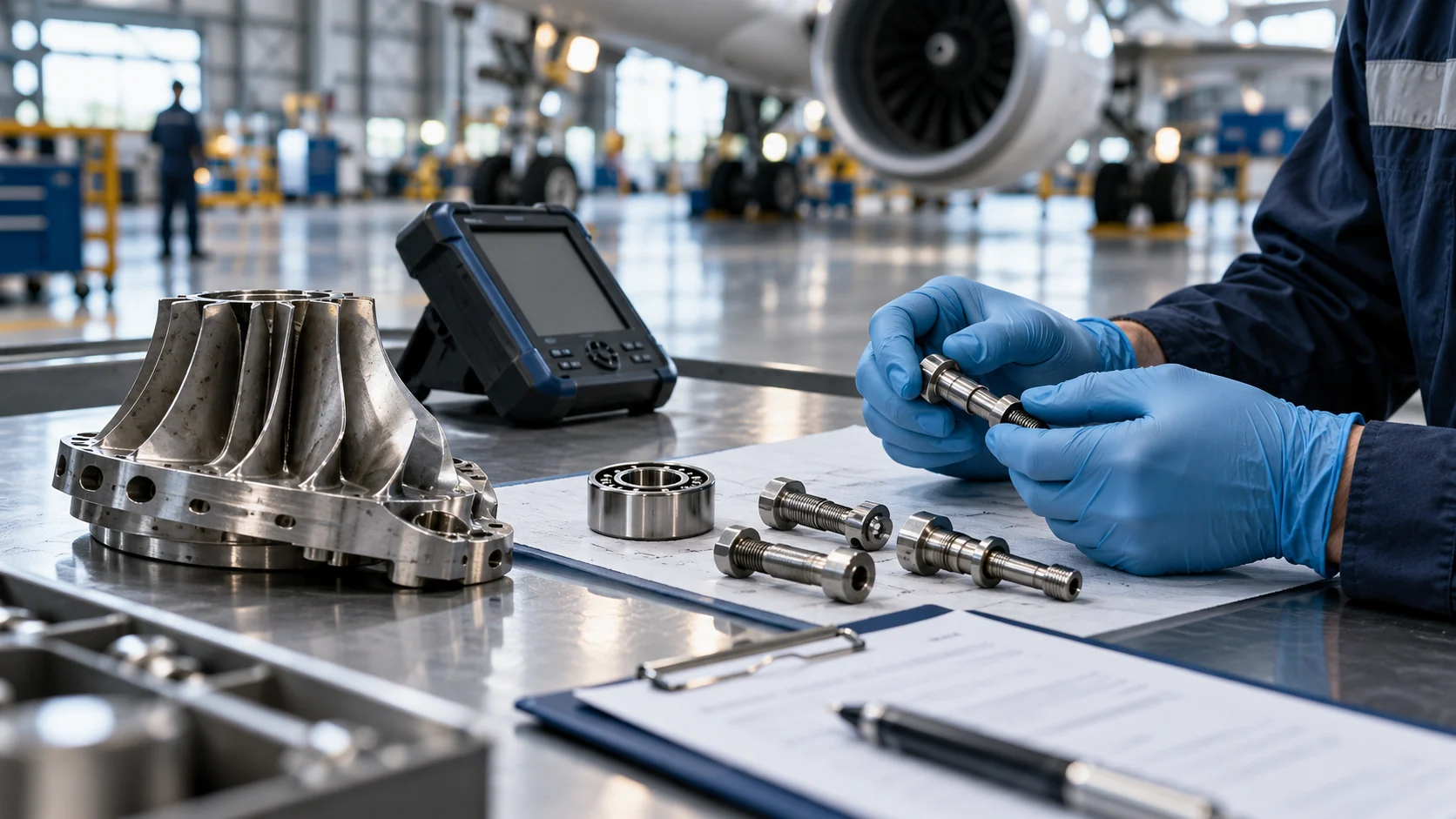
- Warehouse Receiving Inspection: Maintenance engineers swipe the optical probe of the Mina handheld detector across the outer ring face or grease seal of unboxed bearings. In 0.5 seconds, the detector confirms authentic Tier-1 factory origin before the hardware is installed into critical machinery.
- In-Situ Inspection Through Gearbox Hatches: During routine vibration monitoring or endoscopic gearbox inspections, technicians insert a flexible optical probe through the inspection port, testing the grease film on bearing cages without disassembling the heavy transmission.
- Defensible Legal Defense in Failure Investigations: In the event of a catastrophic industrial breakdown, forensic teams collect scrap metal shavings or grease residue from the seized housing. Spectroscopic analysis provides court-admissible proof of counterfeit origin, legally protecting genuine OEMs against multi-million-dollar warranty claims.
Procurement Guidelines: Engineering Due Diligence Checklist
Before standardizing covert passivation taggants or lubricant markers across manufacturing lines, bearing engineering and procurement directors should verify the following baseline parameters:
Engineering Checklist for Precision Bearing Authentication Trials
- Chemical Surface Finish Compatibility: Specify exact anti-corrosion chemistry (e.g., light mineral oil dip, solvent-based rust preventative, manganese phosphating, or black oxide conversion) to calibrate taggant dispersion.
- Lubricant Base Oil & Thickener Match: Ensure taggants are pre-dispersed in an oil carrier identical to the base lubricant (e.g., synthetic PAO, ester, or mineral oil) to prevent grease bleeding or thickener separation.
- Particle Size Spectrum: Verify that $100\%$ of inorganic taggants are sub-micron ($D_{99} < 1.5\ \mu\text{m}$) to guarantee zero abrasive indentation on micro-finished raceways ($R_a < 0.05\ \mu\text{m}$).
- Dual-Custody Supply Governance: Establish secure chain-of-custody protocols for delivering covert additive concentrates to approved bearing manufacturing facilities.
Structuring a 3-Phase Bearing Qualification Roadmap
Bearing manufacturers should execute a rigorous qualification protocol prior to commercial roll-out:
- Phase 1: Tribological Bench Testing & Rheology Profiling: Compound 0.5% taggant concentrate into standard factory grease. Execute Four-Ball wear tests, copper corrosion testing, and rheometer viscosity profiling. Verify baseline optical excitation response.
- Phase 2: Full-Scale Bearing Endurance Testing (L10 Life Testing): Assemble 100 deep groove ball bearings (6205-2Z) and spherical roller bearings (22210) using marked grease and passivated rings. Run on high-load bearing test rigs (R2F / L10 endurance rigs) at 3,000 RPM under heavy radial/axial loads for 1,000 hours. Measure raceway micro-wear via optical profilometry.
- Phase 3: Field Pilot & RMA Simulation: Distribute marked bearing batches to key industrial customer sites. Execute blind receiving audits using handheld optical readers to verify 100% detection accuracy under real-world maintenance conditions.
Protect Your Heavy Rotating Machinery from Refurbished Counterfeit Bearings
Ensure that every bearing installed in mission-critical equipment delivers genuine Tier-1 metallurgical integrity and fatigue lifespan. Consult with Mina’s precision engineering materials specialists to evaluate covert passivation and lubricant tagging solutions for your bearing manufacturing lines.