Filtration and rotating parts procurement
Counterfeit oil filters are replacement filters made to imitate branded parts while skipping the media, bypass-valve engineering, and quality control inside. Documented cases include a Toyota engine damaged by a fake filter and counterfeit components arriving in lookalike brand packaging that only an expert could distinguish. For parts brands, distributors, and workshop networks, this guide explains how fake filters and similar filtration parts reach the aftermarket, why packaging and print checks alone fail, and how layered authentication protects the box, the workshop, and the engine.
The workshop question
A box arrives at the parts counter. It looks right. Inside is a filter that will sit between the oil pump and the bearings for the next service interval. How does anyone at the counter prove it is genuine before it is fitted?
Key takeaways for parts brands and workshops
Damage is internal and delayed. A fake filter can circulate unfiltered oil, shed media, or starve the engine; the failure surfaces thousands of kilometers after fitting.
Packaging is copied convincingly. Counterfeit parts have arrived in traditional brand boxes; OEMs themselves warn that the box alone is not proof.
OEMs are moving to digital verification. DENSO has deployed QR-code and blockchain-based authenticity checks for its parts, showing where the industry is heading.
Marketplaces mix real and fake stock. Community and trade reports describe counterfeit branded filters surfacing through third-party online sellers.
Layer the checks. A scannable code for the counter, a covert marker for auditors and customs, and scan analytics for the brand close the gaps one layer leaves.
Authentication is not filtration engineering. Bypass-valve design and media quality remain the manufacturer’s and certifier’s domain; covert identity proves the part is yours.
What are counterfeit oil filters?
Counterfeit oil filters are replacement filtration parts, spin-on canisters or cartridge elements, manufactured to imitate a branded filter while substituting inferior components: thinner or fewer pleats, weak end caps, missing or badly calibrated bypass valves, and poor canister seams. The same pattern covers air, fuel, and cabin filters, and extends across the service parts shelf. The imitation is concentrated in the visible layer, the paint, print, label, and box, because that is what the counter, the fitter, and the buyer inspect.
They differ from honest aftermarket filters, which sell under their own brands and compete openly. A counterfeit steals the OEM or parts-brand name, and with it the expectation of engineered filtration performance the fake never delivered.
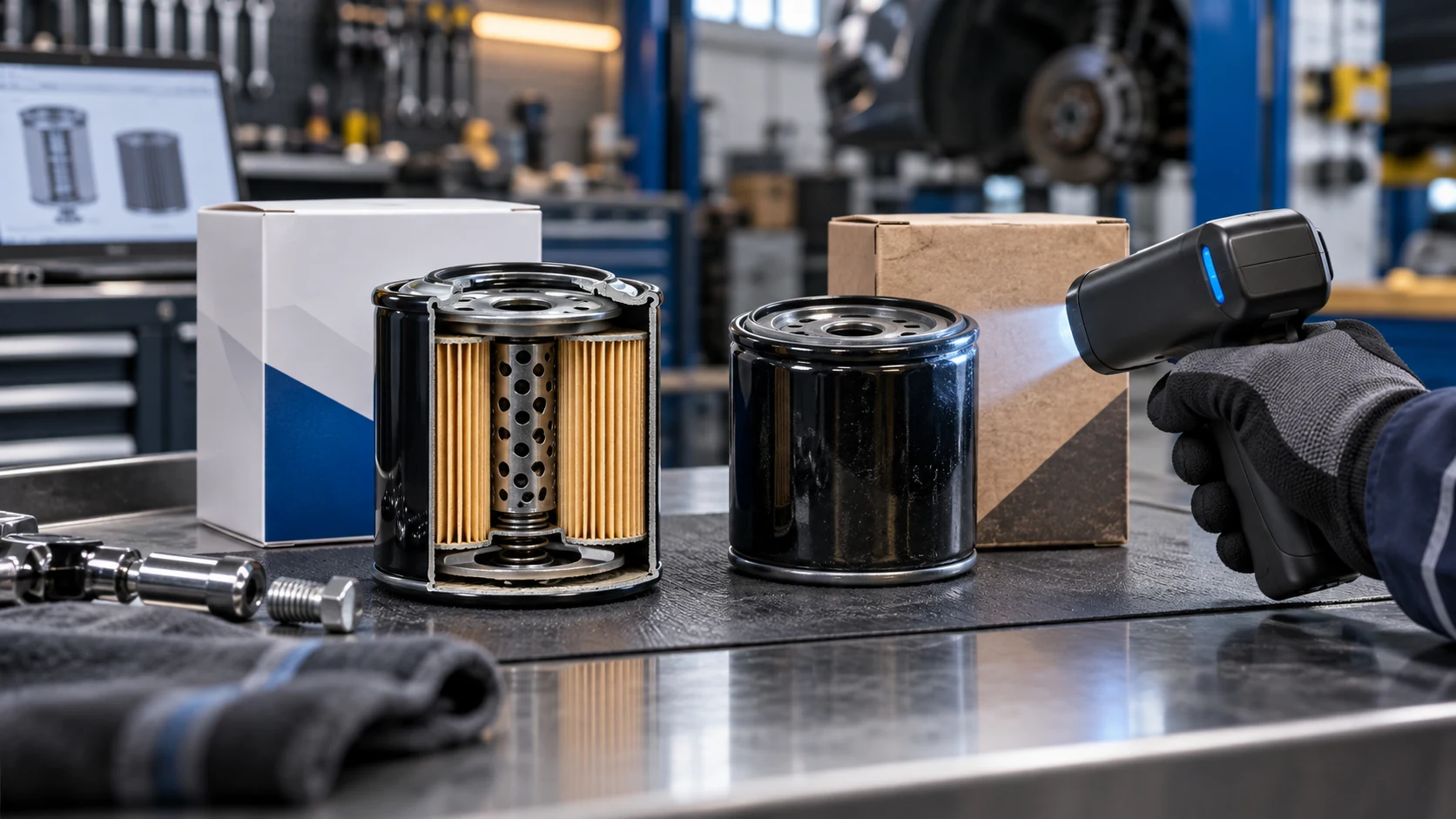
The buyer problem is hidden inside the canister. A workshop cannot cut open every filter before fitting it, and a driver never sees the part at all. Verification therefore has to live on the packaging and the part’s visible surfaces, where a check can actually happen.
Documented damage and OEM warnings
The consequences are recorded in trade and owner documentation. A widely reported Toyota case attributed engine damage to a counterfeit oil filter, and a detailed owner-forum teardown of a counterfeit cartridge filter described internal disintegration that starved the variable-valve timing system, an expensive repair from a cheap part. Filter engineers’ guidance on how fakes fail is consistent: unfiltered oil circulates through a stuck-open or absent bypass valve, media sheds debris into the oil stream, and canister seams or center tubes collapse under pressure.
Suppliers have responded at the packaging level. DENSO has alerted garage owners about counterfeit parts arriving in traditional brand boxes, warning that counterfeit units can lack safety features, perform below engineering standards, and fail only after installation, and urging technicians to compare fixings, labels, and data before fitting. The same company has moved authentication digital, publishing its use of QR codes with blockchain-based records to verify genuine parts and trace them through the chain, a clear signal that even major OEMs no longer treat printed packaging as sufficient proof. The same delayed-failure problem appears in counterfeit brake pad authentication, where identity must be checked before installation.
For brands, the cost profile mirrors other safety parts: warranty disputes on damage caused by parts never made by the brand, service-network confidence eroded by failed “genuine” parts, and enforcement that finds stock only after it has been fitted to customer vehicles.
How fake filters reach the aftermarket
- Online marketplaces. Third-party sellers offer branded filters at aggressive prices; trade and community reports describe counterfeit “genuine” filters surfacing through big retail marketplaces, mixing with legitimate stock.
- Gray distribution. Diverted and mixed lots move through informal channels where lookalike boxes pass unquestioned because the paperwork looks normal.
- Fast-moving service demand. Filters are replaced constantly across every vehicle parc; volume plus low unit price plus rushed counter staff is the environment counterfeiting prefers.
- Copying the visible layer. Print, labels, and boxes are replicated well enough that OEMs publish comparison guides for their own technicians, effectively conceding visual inspection is unreliable.
The entry pattern defines the defense: wherever the fake relies on looking right, the answer is a feature that cannot be copied because it cannot be found.
Verification layers for filter boxes and parts, compared
| Layer | What it proves | Main weakness |
|---|---|---|
| Box and print inspection | Colors, fonts, and layout look right | Counterfeits arrive in convincing brand boxes; OEMs issue comparison guides because eyes fail |
| Part-number lookup | The catalog says the number fits the vehicle | Says nothing about the physical part in the box |
| Hologram or print security feature | A visible feature is present | Imitation target; quality differences are hard for counter staff to judge |
| QR code with digital record | The code resolves to the brand’s verification record | A copied code resolves normally until scan analytics flag duplicates |
| Mina covert marker with dedicated detection | Hidden information exists exactly where the brand placed it | Readable only with dedicated devices held by authorized partners |
| Mina micro-chain code on cartons | Invisible item-level data for case and lot audits | Requires device governance, like every covert layer |
Digital-first verification and covert physical identity are converging across the aftermarket. Mina’s guidance on automotive parts anti-counterfeiting covers the wider parts shelf and the procurement controls that support filter authentication.
Marking boxes, labels, and housings
Mina applies ultra-invisible anti-counterfeiting information to the printed surfaces a filter product already carries: the canister label and print, the carton, the insert, and case markings. The hidden information integrates into existing artwork without changing the visible design and remains invisible under normal light, ultraviolet light, and infrared light, unreadable by conventional equipment, so the copying operation that duplicates the box misses the feature that would have exposed it. The choice between a label and a direct mark should follow the product surface and attack path; Mina’s covert marking decision framework explains that distinction.
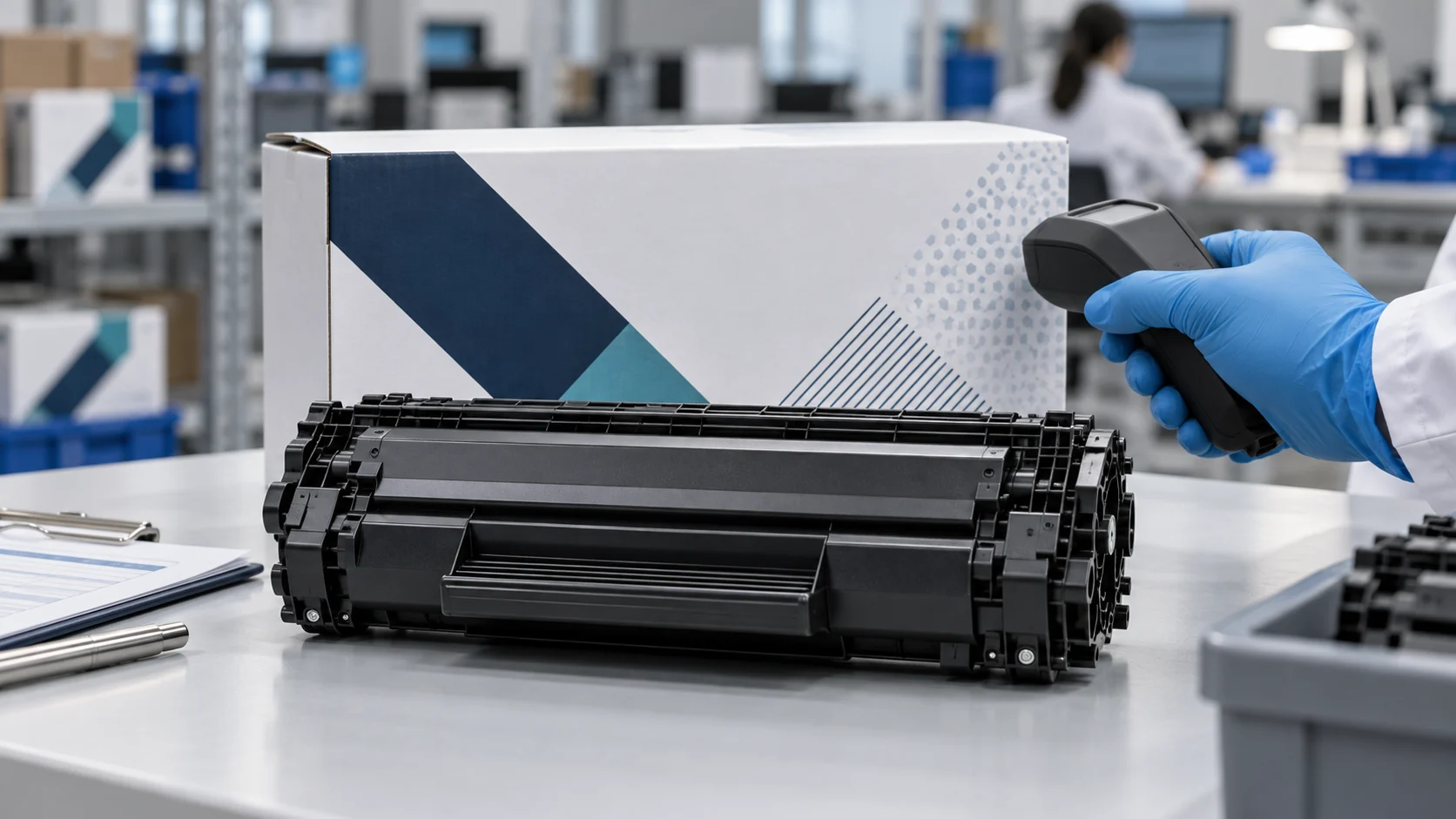
Authorized verification uses dedicated detection devices supplied only to partner clients, each with a unique identification number. Audio verification returns sound and vibration on genuine print and no reaction on fakes; image verification displays the covert information where it was placed. For parts distributors receiving pallets, workshop networks auditing stock, and customs or brand inspectors sampling marketplaces, that converts authentication into a seconds-long binary check at the point of decision.
The consumer-facing layer completes the system: a phone-readable code on every box, backed by first-query time and scan-count records that expose a code printed across thousands of counterfeit cartons. One-item-one-code data ties each filter to production and distribution records, supporting both warranty triage and regional diversion audits. The overt and covert codes are interrelated, so a swapped label or re-boxed part still carries a readable covert identity for investigation.
Boundaries: Mina authenticates the printed identity of the part and its packaging, not the filtration engineering inside. Media specification, bypass-valve calibration, and burst performance remain the manufacturer’s and testing bodies’ domain, and marking is applied to labels, coatings, and packaging, never as a modification of the filter’s pressure-bearing structure.
Acceptance testing workflow before rollout
- 1
Map SKUs and channels
Rank counterfeit exposure by filter line and market, and list the buying paths: distributors, workshop networks, retail shelves, online marketplaces.
- 2
Fix marking surfaces
Decide where covert information and the public code sit on label, canister print, carton, and case, without redesigning the pack or touching the filter structure.
- 3
Build test panels
Genuine production, cloned boxes from scans, re-boxed genuine boxes around fake filters, and gray-stock samples; every member must be called correctly.
- 4
Run workshop-condition trials
Verify marking survives label application, oil-mist exposure at the parts counter, carton handling, and years-equivalent shelf storage.
- 5
Prove readout and analytics
Confirm audio and image detection per device across counter and auditor staff, and validate duplicate-scan flags on the cloned-code panel.
- 6
Document governance
Device registers, distributor and workshop training, takedown evidence packs, and quarterly scan-data review by region and seller.
Roll out on the most-counterfeited SKU families first, and let the acceptance report anchor every later enforcement claim.
Workshop and channel governance
Workshops are the last checkpoint before the part meets the engine, so governance should equip them. Supply agreements can require intake verification of filter lots, with results logged against purchase orders and suspect stock quarantined. Counter staff need one habit: scan the box, and if the code or the covert check fails, stop the fitting. OEM guidance to compare fixings, labels, and data before installation fits the same slot, and becomes decisive when the comparison has a machine-grade answer behind it.
For parts brands, distribution data closes the loop. One-item-one-code records show which region each carton was packed for, quota governance keeps authorized printers from overproducing boxes, and scan analytics flag duplicate codes as counterfeit batches move. Enforcement teams then act on evidence, not screenshots, and warranty teams can separate genuine-part claims from counterfeit damage quickly, protecting the service budget.
Finally, teach the market. The brands that publish verification instructions, reward dealers who check, and answer counterfeit reports quickly make their packaging the most expensive thing in the category to copy.
Limitations and risks to state plainly
Authentication proves identity, not filtration: a genuine-marked filter performs only as well as the brand’s own engineering and quality systems. Covert verification requires devices and trained hands, and a missing signal after physical damage is grounds for quarantine and review, not automatic proof of counterfeiting.
Public codes depend on staff and buyers scanning, and analytics need volume before duplicates surface, so early counterfeit batches can look clean. Gray-channel goods are genuinely made but wrongly sold, a channel problem that identity data reveals rather than prevents. And the visible layer will always be attacked: the documented fakes copied boxes well enough to fool quick inspection, which is the standing argument for pairing every visible feature with a hidden one.
FAQ: counterfeit oil filters
What are counterfeit oil filters?
Replacement filters imitating branded parts with inferior media, end caps, and bypass valves, sold in convincing brand packaging. They differ from honest aftermarket filters sold under their own names.
What damage can a fake filter cause?
Documented cases include engine damage attributed to a counterfeit filter and internal disintegration starving variable-valve timing; typical failure modes are unfiltered circulation, media debris, and collapsed seams or tubes.
Can you tell a fake from the box?
Not reliably. Counterfeits have arrived in traditional brand boxes, and OEMs publish comparison guides for trained technicians; visual inspection is exactly the check counterfeiters optimize against.
Are OEMs doing anything about it?
Yes. DENSO has warned garages about counterfeit parts in brand boxes and deployed QR-code verification with blockchain-based records for genuine parts, signaling the industry’s move to digital-plus-physical authentication.
How do authorized teams verify a Mina-marked filter?
With dedicated detection devices supplied to partner clients: audio verification returns sound and vibration on genuine print and no reaction on fakes; image verification displays the hidden information. Each device has a unique identification number.
What should be tested before adopting covert marking?
Panels of genuine, cloned, re-boxed, and gray-stock samples; marking survival through counter handling, oil-mist exposure, and shelf aging; per-device readout reliability; and duplicate-scan analytics validated on the cloned-code panel.
Sources
- TorqueNews: fake oil filter caused Toyota engine damage
- PMM Online: DENSO alerts garage owners about counterfeiters
- DENSO: QR codes and blockchain against counterfeit products
- Owner-forum teardown: counterfeit oil filter disintegration and VVT-i damage
- Bob Is The Oil Guy forum: counterfeit Toyota-marked filter reports
Verify the part before it meets the engine
If counterfeit oil filters or lookalike filtration parts are reaching your channels, prepare a brief covering your filter packaging components, markets, distribution network, and the counterfeit patterns seen so far. Mina can evaluate covert marking plus scannable verification for your labels, cartons, and cases, and propose an acceptance test plan. The cheapest part on the shelf should not be the weakest link in the engine.