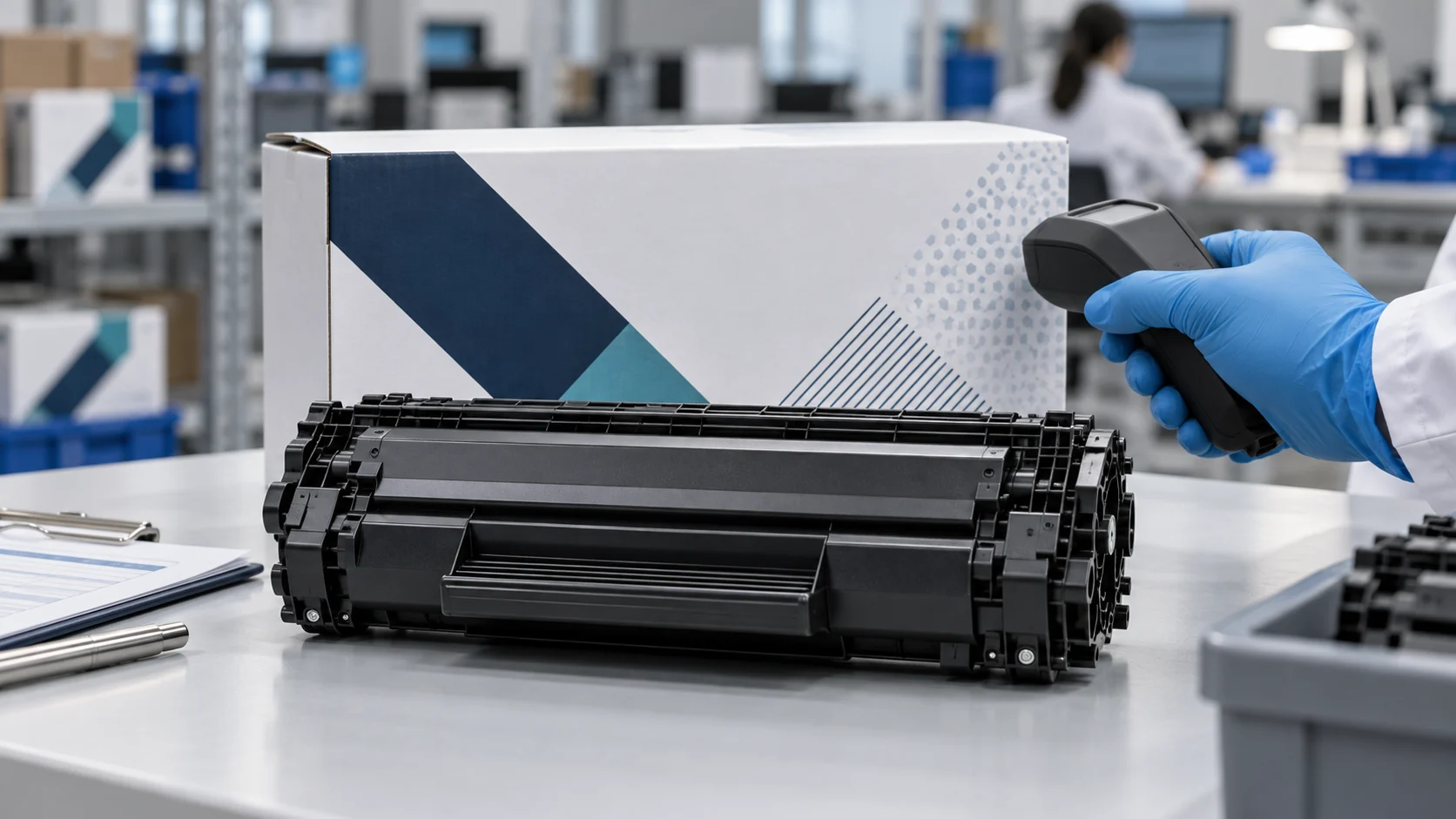
Executive Decision Overview: Electric vehicle (EV) automotive OEMs, battery gigafactory quality directors, and energy storage system (ESS) integrators face catastrophic thermal runaway fire risks, regulatory penalties under the EU Battery Passport mandate, and fraudulent warranty claims caused by degraded B-grade and retired secondary cells re-packaged as brand-new Tier-1 cells. Because lithium-ion cells operate in harsh environments—including aggressive organic carbonate electrolytes ($LiPF_6$), dielectric potting foams, and thermal runaway flash temperatures—conventional surface stickers and fiber laser marks fail or can be buffed off. This engineering procurement guide examines how chemically inert, electrolyte-resistant covert inorganic inks and blue PET cell-wrapping taggants provide permanent cell-level traceability across 800V automotive lifecycles.
The 800V Fire & Liability Risk: Retired Cell Harvesting and Repackaged B-Grade Modules
In the rapidly expanding electric mobility and utility battery energy storage (BESS) sectors, lithium-ion battery packs represent over 30% to 40% of the total bill of materials (BOM). Premium automotive battery cells—such as prismatic lithium iron phosphate (LFP) and high-nickel nickel-manganese-cobalt (NMC 811) chemistries—undergo stringent cleanroom manufacturing and formation aging to guarantee 8-year/160,000 km warranty retention and zero internal micro-short circuit risks.
However, the rapid growth of EV battery retirement streams and factory production scrap has spawned a dangerous grey-market re-packaging industry:
- Retired & Scrapped Cell Harvesting: Counterfeit workshops purchase degraded battery packs from insurance salvage yards and factory formation scrap bins. Cells that have suffered dendrite growth, severe capacity loss (<70% state-of-health SOH), or internal impedance shifts are extracted, buffed on belt sanders to erase original laser QR codes, and re-wrapped in counterfeit blue PET shrink films.
- Cloned OEM Nameplates & Forged DataMatrix Codes: Counterfeiters apply fake laser engravings of Tier-1 brands (e.g., CATL, LG Energy Solution, Panasonic), forging serial numbers and capacity ratings (e.g., re-labeling a 100Ah degraded cell as a brand-new 280Ah high-capacity prismatic cell) to sell to unsuspecting ESS integrators and aftermarket EV battery rebuilders.
- Thermal Runaway & OEM Liability in Vehicle Fires: When these internally damaged cells undergo high-C-rate fast charging, localized lithium plating causes internal separators to puncture. The cell enters violent thermal runaway, releasing toxic gases ($HF, POF_3$) and triggering multi-module chain-reaction fires. When an EV burns down on the highway, fire investigators inspect the scorched wreckage. If the cell’s origin cannot be definitively proven, the genuine automotive OEM faces multi-million-dollar product liability lawsuits and mandatory recall orders.
To ensure regulatory compliance under the incoming EU Battery Regulation (Regulation (EU) 2023/1542) and protect corporate warranty reserves, battery engineers must implement electrolyte-resistant covert cell-level authentication directly onto the aluminum cell can and internal structural insulations.
Why External Laser Codes and Adhesive PET Stickers Fail in Battery Modules
Automotive battery packs traditionally rely on 2D DataMatrix codes etched onto the aluminum terminal top-cover or barcode stickers pasted on the outer blue insulation film. Under battery module assembly and operating conditions, these methods exhibit critical vulnerabilities:
- Surface Grinding & Re-Polishing by Counterfeiters: Standard laser engravings only penetrate 15 to 25 μm into the aluminum alloy cell casing (AA3003). Grey-market recyclers effortlessly grind away surface laser markings on precision orbital sanders and re-etch fraudulent QR strings without puncturing the 0.8 mm aluminum wall.
- Chemical Dissolution by Organic Carbonate Electrolyte: During cell filling or minor vent weeping, aggressive liquid electrolytes (dimethyl carbonate DMC, ethylene carbonate EC, and lithium hexafluorophosphate $LiPF_6$) rapidly dissolve standard adhesive label polymers, washing away printed ink text.
- Structural Potting Resin Encapsulation: In cell-to-pack (CTP) and structural battery pack designs, hundreds of prismatic cells are permanently potted in polyurethane (PU) structural adhesive or silicone thermal conductive potting foam. Once cured, outer cell labels are completely inaccessible and impossible to inspect without mechanically cutting open the pack.
To eliminate these vulnerabilities, battery manufacturers must embed covert inorganic taggants directly into the aluminum cell conversion coating, the insulating UV dielectric varnish, and the blue PET shrink wrap matrix.
Electrolyte-Resistant Inorganic Chemistry: UV Varnishes & PET Film Masterbatch
Mina’s EV battery anti-counterfeiting solution integrates thermally stable, chemically inert inorganic crystal taggants across two primary battery manufacturing interfaces:
- Dielectric UV/Thermal Covert Insulation Varnish: Formulated for high-speed roller coating directly onto the bare aluminum prismatic cell can (replacing or augmenting traditional blue PET shrink wrap). The inorganic crystal taggants achieve permanent chemical adhesion with the passivated aluminum substrate. The cured coating provides $>3,000\ \text{V DC}$ dielectric insulation breakdown resistance while embedding an invisible, machine-readable spectral signature that survives exposure to liquid organic electrolytes ($LiPF_6$ in EC/DMC) and operating temperatures up to 300°C.
- In-Film Blue PET Shrink Wrap Masterbatch: Compounded at 0.5% to 1.5% by weight into biaxially oriented polyethylene terephthalate (BOPET) masterbatch during film extrusion. The inorganic taggant is homogeneously locked within the molecular polymer chains of the blue insulation film, ensuring that any counterfeit re-wrapping attempt using generic commercial film is immediately detected during automated optical battery audits.
Technical Comparison: EV Battery Cell Authentication Technologies
The matrix below compares performance metrics across authentication techniques used in automotive battery manufacturing and energy storage systems:
| Performance & Safety Metric | Top-Cover Fiber Laser Etching | Conventional Adhesive PET Barcode Sticker | Mina Electrolyte-Resistant Covert Taggant System |
|---|---|---|---|
| Resistance to Surface Orbital Grinding | Zero (ground off and re-etched by counterfeiters). | Zero (sticker peeled and replaced). | Immune (deeply integrated in dielectric coating & film matrix). |
| Resistance to $LiPF_6$ Electrolyte Spills | High (bare metal). | Very Low (electrolyte dissolves adhesive). | 100% Inert (inorganic crystal matrix impervious to $LiPF_6$/DMC). |
| Dielectric Breakdown Voltage | None (conductive exposed metal). | Standard insulation. | Maintains $>3,000\ \text{V DC}$ (prevents 800V high-voltage arcing). |
| Post-Thermal Runaway Forensic Proof | Fails if top terminal melts or oxidizes. | Completely incinerated. | Inorganic Taggants Survive $>800^\circ\text{C}$ for crash forensic investigation. |
| Module Assembly Line Audit Speed | Requires optical camera focal alignment. | Barcode camera scanning. | Instant 0.5s Pass/Fail via automated optical probe or handheld reader. |
Dielectric, Thermal & Chemical Compliance: IEC 62660 and UL 9540A Standards
In high-voltage automotive battery systems (400V to 800V architectures), any additive incorporated into cell coatings must undergo rigorous qualification to ensure zero risk of dielectric breakdown, outgassing, or chemical contamination:
1. High-Voltage Electrical & Dielectric Integrity
- Dielectric Withstand Voltage (IEC 62660-3): Preserves $>3,000\ \text{V DC}$ dielectric insulation across the 50 μm coating thickness, preventing arcing between adjacent prismatic cell aluminum cans.
- Volume Resistivity (ASTM D257): Maintains volume resistivity >$10^{15}\ \Omega\cdot\text{cm}$, preventing micro-amp leakage currents in high-density cell-to-pack (CTP) configurations.
- Thermal Conductivity Compatibility: Zero impact on thermal transfer efficiency to liquid cooling cold plates (thermal conductivity $\kappa \ge 0.25\ \text{W/m}\cdot\text{K}$).
2. Chemical Resistance & Fire Safety
- Electrolyte Immersion Resistance: Submerged in 1.2M $LiPF_6$ in EC:EMC:DMC (1:1:1 vol) at 60°C for 30 days with zero coating swelling, blister formation, or taggant leaching.
- Thermal Stability (UL 94 V-0): Self-extinguishing; does not contribute combustible fuel during localized battery venting events.
- Extreme Fire Residue Retention: Inorganic crystal markers retain distinct spectroscopic emission curves even after exposure to 800°C direct flame for 30 minutes.
Battery Passport Compliance & Post-Crash Warranty Investigation Workflow
Deploying covert cell-level authentication enables battery manufacturers, automotive OEMs, and recyclers to implement an unalterable lifecycle audit framework:
- Gigafactory Cell-to-Pack (CTP) Assembly Audit: As prismatic cells exit automated dielectric coating lines, high-speed optical vision sensors scan the covert signature at speeds exceeding 120 cells/minute, confirming authentic chemical composition and binding the physical cell to its digital EU Battery Passport blockchain registry.
- Aftermarket ESS Battery Intake Screening: Energy storage system integrators scan incoming bulk cell pallets using portable Mina handheld readers. The detector reads through transparent blister trays, instantly flagging scrapped B-grade cells or counterfeit re-wrapped units before they are welded into 100 kWh commercial battery strings.
- Post-Crash Fire Forensic Evidence: In legal product liability investigations following a vehicle thermal runaway incident, forensic engineers collect scorched cell can fragments or melted insulation residue. Spectroscopic laboratory analysis provides court-admissible proof that the failed cell was an uncertified, counterfeit re-packaged unit, legally shielding the genuine OEM from unwarranted recalls.
Procurement Guidelines: Engineering Due Diligence Checklist
Before standardizing covert dielectric coatings or PET film taggants across battery gigafactory lines, battery procurement and process engineering managers should verify the following baseline parameters:
Engineering Checklist for EV Battery Taggant Qualification
- Aluminum Surface Passivation Match: Verify coating adhesion across specific aluminum cell can surface finishes (AA3003 with chemical conversion coating or plasma treatment per ASTM D3359 5B rating).
- Electrolyte Chemical Compatibility: Require certified GC-MS and ICP-OES test reports proving zero taggant extraction or catalytic reaction with $LiPF_6$, $LiFSI$, and organic carbonates.
- Coating Line Speed & Curing Windows: Ensure UV or thermal curing kinetics match high-speed automated cell coating line speeds (>60 to 120 parts/minute) with zero residual monomer outgassing.
- Dual-Custody Material Governance: Enforce strict batch serialization and security supply chain custody for all covert ink deliveries to authorized cell manufacturing facilities.
Structuring a 3-Phase Battery Manufacturing Validation Roadmap
Battery cell and pack manufacturers should follow a disciplined qualification roadmap prior to commercial integration:
- Phase 1: Laboratory Coating Plaque & Electrolyte Immersion: Apply 50 μm covert dielectric coating drawdowns to AA3003 aluminum test plaques. Submerge in active lithium battery electrolyte at 60°C for 30 days. Test dielectric breakdown voltage (ASTM D149) and verify zero optical signal loss.
- Phase 2: Pilot Cell Assembly & Formation Trial (500 Prismatic Cells): Manufacture 500 complete 100Ah/280Ah prismatic test cells using marked dielectric coatings and PET films. Run through full factory formation, degassing, and C-rate capacity cycling. Benchmark automated vision scanner read rates on active pack assembly conveyors.
- Phase 3: Thermal Abuse (Nail Penetration) & Forensic Simulation: Subject test cells to UL 9540A / UN 38.3 thermal abuse and nail penetration tests. Collect burned residue from post-test cell canisters; verify 100% spectroscopic identification accuracy using handheld and laboratory forensic readers.
Protect Your EV Battery Supply Chain from Counterfeit & Recycled Cell Fraud
Ensure that every cell inside your high-voltage battery packs delivers genuine Tier-1 electrochemical safety and full Battery Passport traceability. Consult with Mina’s energy storage materials specialists to evaluate electrolyte-resistant covert dielectric inks and request sample coated test plaques for your laboratory validation.