Executive Decision Overview: Automotive original equipment manufacturers (OEMs), Tier-1 brake system suppliers, and commercial fleet safety directors face catastrophic product liability claims and brand damage caused by counterfeit automotive brake pads. Illicit aftermarket manufacturers compress sawdust, compressed grass, low-grade iron shavings, and unapproved resins into counterfeit friction blocks, affixing cloned OEM steel backplates and forged brand packaging. During emergency braking, friction interface temperatures surge to 450°C–650°C, causing counterfeit pads to suffer severe thermal fade, catch fire, or disintegrate completely. Because post-crash thermal damage and brake dust obliterate surface laser markings and paper box labels, accident investigators require direct-on-part forensic verification. This engineering guide details how inorganic covert taggants (stable up to 800°C) integrated directly into friction compounds and steel backplate anti-corrosion coatings establish tamper-proof OEM liability defenses.
The Fatal Aftermarket Risk: Counterfeit Friction Materials and Thermal Fade Disasters
In modern passenger vehicles, commercial heavy trucks, and electric vehicles (EVs), brake pads represent the single most critical safety component in the chassis friction system. Genuine OEM brake pads undergo rigorous metallurgical and tribological qualification—including hundreds of hours of inertia dynamometer testing (AK Master per SAE J2522) and high-speed vehicle road trials—to ensure a stable coefficient of friction ($\mu = 0.35\text{–}0.45$) across operating temperatures from sub-zero winter conditions to severe 600°C mountain descents.
However, the global automotive replacement parts aftermarket is heavily infiltrated by dangerous counterfeit brake pads. Counterfeit syndicates exploit the high turnover of wear parts by fabricating cheap visual lookalikes:
- Hazardous Friction Formulations: Substandard workshops bind toxic asbestos, coarse steel shavings, wood sawdust, and cheap phenolic resins under low pressure without proper heat baking. Under heavy braking, the inferior binders vaporize at 300°C, forming a gas cushion between pad and rotor (severe brake fade) that increases stopping distances by over 300% or causes complete hydraulic pedal loss.
- Shear Delamination & Backplate Separation: Fake pads utilize low-grade scrap steel backing plates without proper mechanical retention underlayers or adhesive bonding. Under heavy shear forces, the friction material separates cleanly from the steel backplate (failing ISO 6312 minimum shear strength standards), leading to immediate wheel lockup or caliper failure.
- OEM Liability Exposure in Fatal Accidents: When a vehicle equipped with counterfeit pads suffers a fatal crash, insurance adjusters and accident reconstruction investigators examine the wreckage. Counterfeiters forge OEM logo stampings, ECE R90 approval codes, and batch serial numbers on the steel backplate. Without chemical taggants, the genuine OEM is frequently dragged into multi-million-dollar wrongful death lawsuits.
To establish unassailable legal defenses and protect consumer lives, automotive OEMs must implement in-body covert inorganic authentication directly within the friction compound and the steel backing plate.
Why External Packaging and Backplate Laser Markings Fail Post-Crash Audits
Automotive quality assurance teams historically relied on serialized cardboard cartons, holographic seal stickers, and fiber laser text markings on the steel backing plate. Under real-world vehicle operating conditions, these external measures exhibit complete failure:
- Packaging Discarded at Installation: When a technician performs a brake replacement in an independent repair garage, the outer cardboard box and security seal are discarded into the shop trash. Once installed inside the caliper, all external packaging evidence is permanently lost.
- Thermal Carbonization & Brake Dust Obliteration: During aggressive highway braking, brake rotors generate intense thermal radiation and metallic wear dust. Surface laser etchings, paint stencils, and adhesive barcode tags on the backing plate are scorched, oxidized, and buried beneath layers of baked-on carbon dust and road grime.
- Laser Cloning by Counterfeit Workshops: Standard fiber laser marking machines (costing under $2,000) effortlessly reproduce genuine OEM font types, ECE R90 homologation numbers, and 2D matrix codes on fake backing plates with perfect visual fidelity.
To ensure permanent traceability, authentication markers must survive extreme 600°C–800°C friction temperatures, chemical brake cleaner sprays, and severe mechanical shear forces without degrading stopping performance.
Inorganic Friction Compound & Steel Backplate Taggant Science
Mina’s automotive friction anti-counterfeiting architecture integrates chemically inert, ultra-high-temperature inorganic rare-earth crystal complexes across two distinct manufacturing points:
- Friction Matrix In-Body Dosing: During the dry mixing stage of brake pad manufacturing (combining phenolic resin, aramid fibers, graphite, and mineral friction modifiers), covert inorganic taggants are blended uniformly at 0.3% to 1.0% by weight. The taggants endure hot pressing (150°C–180°C, 25–40 MPa) and subsequent curing/baking cycles (200°C–230°C for 6–10 hours). The inorganic crystal structure remains chemically inert and fully stable up to 800°C, surviving the most extreme rotor friction temperatures without oxidizing or degrading.
- Steel Backing Plate Passivation & Anti-Corrosion E-Coat: The covert taggants are simultaneously blended into the electro-deposition (E-coat) anti-corrosion primer or powder coating applied to the steel backplate and anti-noise shim layer. This establishes a matching dual-layer authentication signature on both the consumable friction material and the structural steel carrier.
Technical Comparison: Automotive Brake Pad Authentication Methods
The matrix below compares technical performance metrics across authentication techniques used on automotive friction components:
| Performance & Safety Dimension | Outer Box Holographic Label | Backplate Laser Surface Marking | Mina In-Body 800°C Inorganic Taggant |
|---|---|---|---|
| Resistance to 600°C Friction Heat | Zero (box discarded upon install). | Moderate (laser marks oxidize/fade). | 100% Stable up to 800°C (zero signal loss under fire/heat). |
| Resistance to Brake Dust & Road Slush | N/A (packaging lost). | Low (obscured by corrosion & dust). | Complete Immunity (embedded inside dense friction matrix). |
| Impact on Friction Coefficient ($\mu$) | None. | None. | Zero Impact on SAE J661 Friction Class ($\mu = 0.38\text{–}0.42$). |
| Impact on Shear Strength (ISO 6312) | None. | None. | Preserves >3.5 MPa Shear Bond between pad and steel back. |
| Post-Accident Forensic Proof | Zero proof available. | Fails if backplate is burned/corroded. | Instant 0.5s Pass/Fail from Residual Pad Debris via Handheld Reader. |
Tribological Integrity: SAE J661 (Chase Test) & ISO 6312 Shear Compliance
In brake pad engineering, any additive mixed into the friction material formulation must undergo rigorous qualification to prove that it does not induce friction instability, rotor scoring, or noise/vibration (NVH) issues:
1. Friction Coefficient & Wear Performance
- SAE J661 Chase Test (Friction Code Rating): Maintains stable friction coefficient ratings (e.g., FF or GG rating) across baseline, hot fade (up to 350°C), and recovery cycles.
- Inertia Dynamometer Testing (AK Master / SAE J2522): Zero friction drop under high-speed fade sequences (100 km/h to 10 km/h emergency stops).
- Rotor Friendliness & Disk Wear: Sub-micron particle sizing ($D_{50} < 1.0\ \mu\text{m}$) introduces zero abrasive grooving on cast iron (G3000) or carbon-ceramic brake rotors.
2. Mechanical Shear & Corrosion Resistance
- Shear Strength Test (ISO 6312 / SAE J840): Preserves shear bond strength exceeding 3.5 MPa (minimum requirement >2.5 MPa), ensuring zero delamination under panic stops.
- Salt Spray Corrosion Resistance (ASTM B117): Backplate E-coat taggants preserve >500 hours rust-free performance in 5% NaCl saline fog.
- Brake Fluid Resistance (DOT 4 / DOT 5.1): 100% inert; zero degradation when exposed to hydraulic polyglycol brake fluids.
Accident Reconstruction & Warranty Fraud Investigation Workflow
Deploying in-body covert taggants enables automotive OEMs, fleet managers, and forensic investigators to execute rapid, indisputable on-vehicle audits:
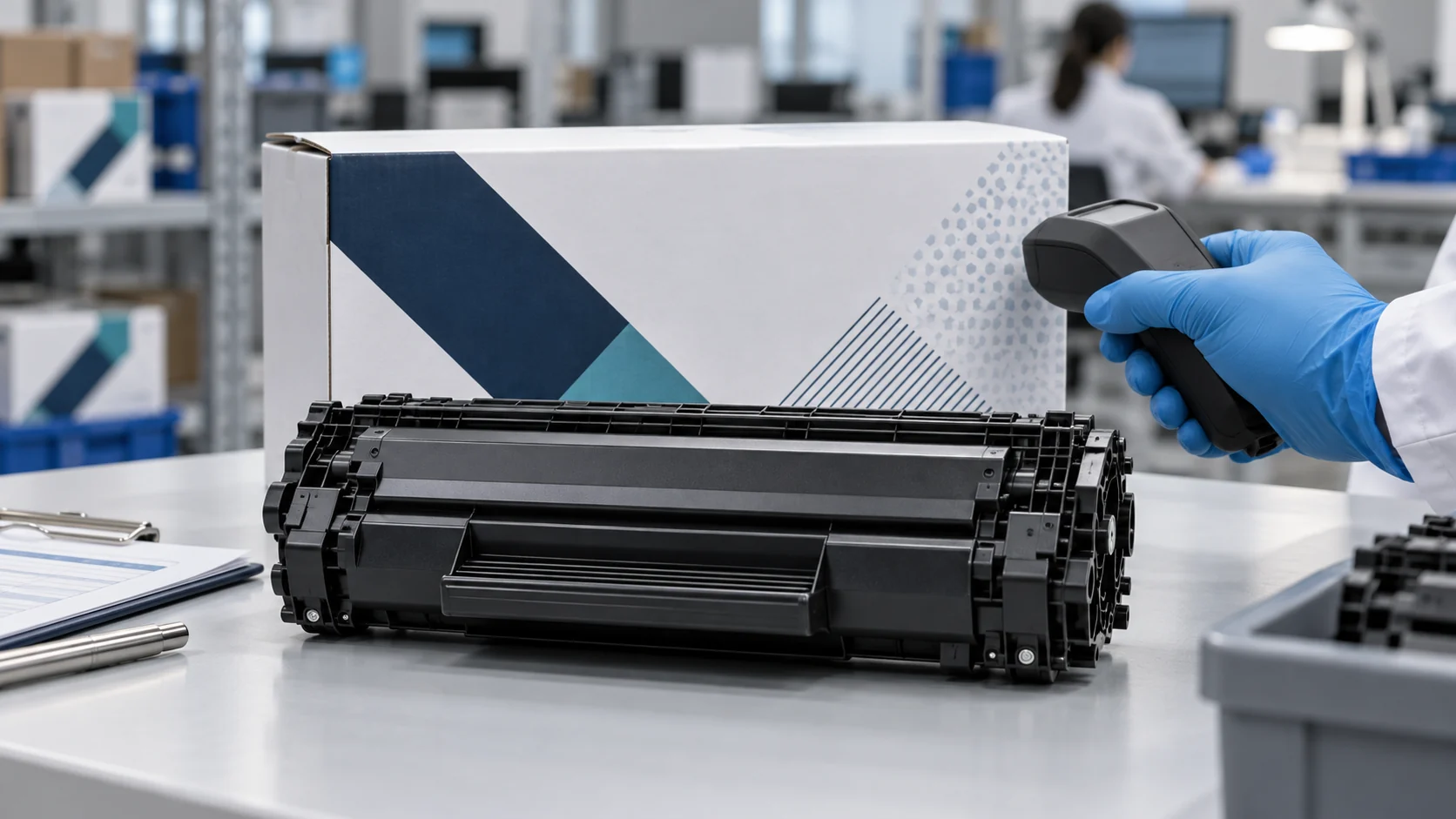
- Post-Crash Field Verification: When a vehicle is involved in a collision where brake failure is alleged, OEM forensic engineers or police accident investigators place the optical probe of the Mina handheld detector directly against the installed brake pad edge, backing plate, or residual friction powder on the caliper. In 0.5 seconds, the detector provides an unambiguous green (authentic OEM) or red (counterfeit clone) verdict.
- Distributor & Dealer Inventory Audits: Brand protection agents visit independent auto parts wholesalers and franchise dealership service bays. Auditors scan unboxed brake pads on warehouse shelves, instantly identifying counterfeit aftermarket stock disguised in counterfeit OEM cartons.
- Court-Admissible Spectroscopic Evidence: In product liability litigation, certified analytical laboratories conduct spectroscopic emission fingerprinting on microscopic friction dust samples. The precise atomic spectra provide unchallengeable legal evidence that the failed brake pad was an unauthorized counterfeit, legally indemnifying the genuine OEM from liability.
Procurement Guidelines: Engineering Due Diligence Checklist
Before standardizing covert inorganic taggants across OE and aftermarket friction formulations, brake engineering and procurement directors should verify the following baseline parameters:
Engineering Checklist for Automotive Brake Pad Taggant Trials
- Friction Formulation Type Match: Verify additive compatibility across specific friction chemistries (Non-Asbestos Organic NAO, Low-Metallic, Semi-Metallic, or Ceramic formulations).
- Dry Mixing Dispersion Quality: Confirm that taggants achieve homogeneous dispersion in high-intensity plow mixers (e.g., Lödige mixers) within standard 3-to-5-minute cycle times.
- Thermal Stability at Hot Baking: Ensure taggants maintain calibrated optical excitation intensity after post-cure baking cycles at 220°C for 8 hours.
- Dual-Custody Supply Governance: Establish secure batch delivery protocols to ensure covert taggant concentrates are supplied exclusively to certified Tier-1 brake manufacturing facilities.
Structuring a 3-Phase Brake Friction Validation Roadmap
Automotive brake manufacturers should execute a disciplined qualification protocol prior to commercial production:
- Phase 1: Laboratory Compound Mixing & Chase Bench Testing: Blend 0.5% taggant into standard NAO and Semi-Metallic friction compounds. Press standard Chase test sample blocks (25 mm × 25 mm). Execute SAE J661 testing to confirm friction coefficient stability and verify baseline optical reader calibration.
- Phase 2: Full-Scale Dynamometer AK Master Testing (100 Brake Pad Sets): Manufacture 100 complete brake pad sets on production tooling. Subject pads to full AK Master dynamometer schedules (SAE J2522) on high-inertia dyno rigs. Measure friction fade, rotor wear, and verify post-dyno optical readability on heavily scorched pad surfaces.
- Phase 3: Vehicle Fleet Road Testing & Service Center Blind Audits: Install pilot marked pads on commercial test fleet vehicles for 50,000 km durability road testing. Distribute marked and non-marked control pads to warranty service centers to benchmark handheld reader reliability and 100% detection accuracy in dirty workshop environments.
Protect Your Brake Brand from Catastrophic Counterfeit Liability
Ensure that every brake pad carrying your brand name delivers genuine stopping power and unchallengeable forensic traceability. Consult with Mina’s automotive materials specialists to evaluate 800°C high-temperature inorganic taggants and request sample friction additives for your dynamometer trials.